


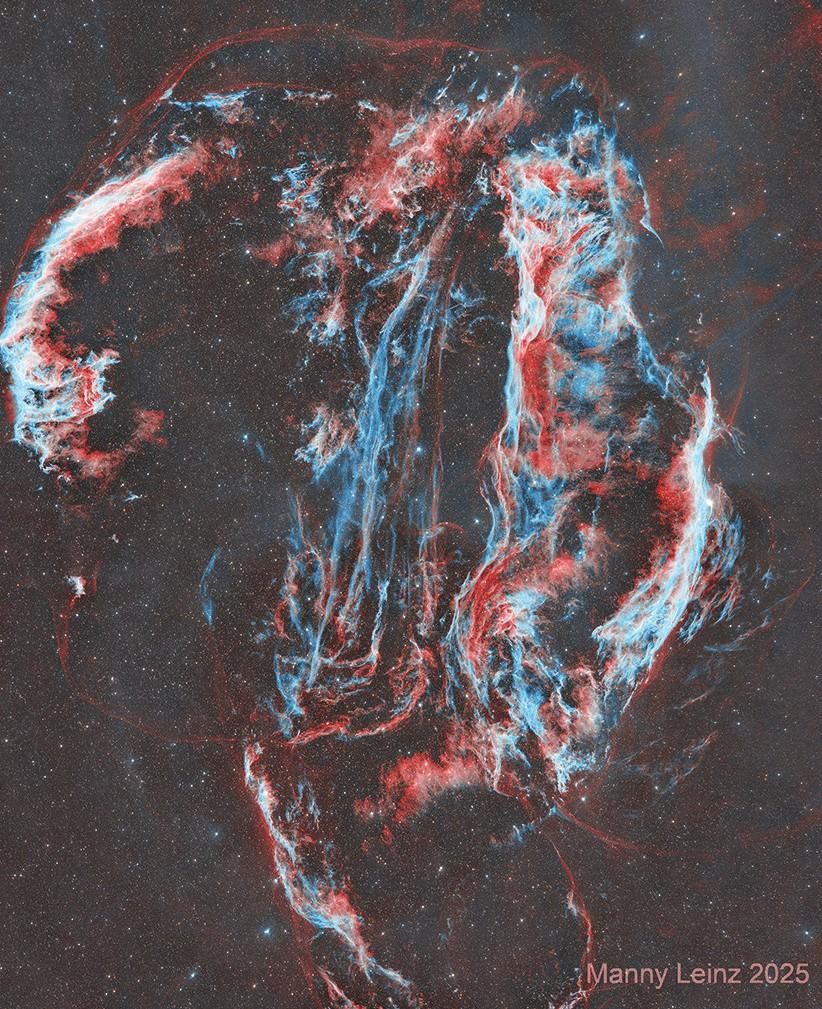

The Veil Nebula – A huge supernova remnant more than six full Moons across on the sky – Image taken by the author. Photo by Manny Leinz
Most of us have had the pleasure of sitting around a cozy campfire on a cool evening. We’ve felt the warmth and perhaps enjoyed toasting a few marshmallows or hot dogs over the flames.
We know that to keep that campfire burning and giving off heat requires fuel — wood. A larger, hotter fire requires more fuel, which will be consumed more quickly, whereas a small one can be kept going by just adding an occasional log.
Much like the campfire, stars need fuel to give off their light and heat, and that fuel is hydrogen gas. Like the campfire, the amount of fuel that the star starts with determines how long and hot it burns.
A star’s life — birth, death and resurrection
Stars begin their lives in a “stellar nursery,” a cloud of mostly cold hydrogen gas and dust called a nebula. Over time, random local areas of slightly denser gas begin to form in the nebula.
This extra gas begins to exert a gravitational pull on its surroundings, attracting yet more gas, which then further increases the gravitational pull. This process continues for hundreds of thousands, or even millions of years; gravity increasing, the gas becoming more and more dense, and hotter, until its temperature reaches roughly 15 million degrees.

Manny Leinz
At this point nuclear fusion begins; the gas ignites and the newly born star begins to shine, “burning” its hydrogen fuel and converting it into helium. This reaction creates an outward pressure, counteracting the force of gravity that tries to further collapse the star.
Equilibrium is reached, and the star — depending on the mass it starts with — can shine for millions or even billions of years. The star spends 90 percent of its life during this phase, called the main-sequence. What happens next depends on the mass of the star — how much fuel it started out with.
Stars remain stable on the main sequence, fusing their hydrogen fuel into helium until that fuel begins to run out. For low to intermediate mass stars — up to eight times our Sun’s mass — when the hydrogen in the star’s core is gone, it begins to burn the hydrogen farther out.

The Ring Nebula, a planetary nebula in the constellation Lyra – Credit NASA Photo courtesy NASA
The star begins to expand and cool, reaching up to 400 times its original size. If you read my article in the Jan. 1 issue of the Gazette, you know that as a star cools, it reddens. Appropriately, this part of a star’s life is known as the Red Giant phase.
As the hydrogen fuel is exhausted, gravity begins to overpower the pressure from fusion, and the star begins to shrink. The pressure increases and fusion starts up again, this time with helium being fused into heavier elements, mostly carbon and oxygen.
The star throws off its outer layers into a planetary nebula — so called because early astronomers thought these sometimes-spherical nebulae looked like planets — and the core of the star shrinks to become a white dwarf. The resulting gas from the planetary nebula can collapse to form new stars over time, while the tiny Earth-size hot white dwarf slowly cools over billions of years.

This is the fate of our own Sun. When its hydrogen fuel runs out, it will inflate dramatically, swallowing up the inner planets Mercury, Venus and possibly our Earth. Regardless of whether Earth survives, it will be an uninhabitable scorched cinder.
Thankfully, our Sun is just middle-aged. We have about five billion good years left before our descendants need to worry.
Live fast, die young – the fate of giant stars
For massive stars — greater than eight and up to 20 solar masses, the end looks quite different. They burn their hydrogen at a furious rate, exhausting it in just a few million years.
The star expands to a Red Supergiant, resisting collapse by fusing helium into carbon. The temperatures are far higher than in intermediate mass stars, however, so the fusion process continues as carbon fuses into heavier elements: oxygen, then neon, magnesium, sodium, silicon, sulfur, nickel and, finally, iron.

The Circle of Life of stars. Courtesy of NASA
Here the process stops, as even the extreme temperatures reached — up to three billion degrees! — aren’t enough to fuse iron. Gravity wins the tug-of-war and the star collapses, literally within a few seconds.
The collapsing material hits the dense core of the star and rebounds, causing a massive explosion; a spectacular supernova. Left behind is a small, rapidly spinning Neutron Star, or Pulsar, so incredibly dense that atoms themselves are broken down into their component parts: protons, neutrons, electrons and other particles.
The mass of just one teaspoon of a neutron star is more than 900 times the mass of the great pyramids!
For the most massive stars, from 20 to 200 times the mass of our Sun, the end is even stranger.
After the supernova explosion, the star’s core continues to collapse into a black hole. Black holes are so incredibly dense that nothing, not even light, can escape their gravitational pull.

The Crab Nebula, the remnant of a supernova that exploded in 1054 A.D. Photo courtesy NASA
Black holes will continue to pull in gas, dust, even other stars, that venture too close to their event horizon — the point of no return. Most galaxies contain a large black hole consisting of millions or even billions of solar masses.
While some of the mass of a supernova goes into forming a neutron star or black hole, the vast majority — 70 to 90 percent — is dispersed widely through space as a nebula, where new stars can form.
The shock wave caused by the supernova explosion causes yet more extreme temperatures and pressures, enabling heavier elements to form. Gold, silver, platinum, uranium, lead, mercury and zinc, for example, are all formed only in supernova explosions. In fact, the iron, calcium and other elements in our bodies was almost certainly made in a supernova. We are truly made of star stuff!
Seeing is believing
There are a few supernova remnants that are visible in small telescopes or binoculars. The Crab Nebula, designated as M1 by professional and amateur astronomers alike, is a remnant of a supernova that exploded in the year 1054 AD.
The event was recorded by astronomers around the world, and was so bright that the star was initially visible in the daytime. The Crab Nebula can be found in the constellation Taurus, the bull.
The Veil Nebula, or Cygnus Loop, has several designations for its various parts, including NGC 6960, 6974, 6979, 6992 and 6995 — now you know. The Veil can be found in the constellation Cygnus, The Swan, and requires a larger telescope and preferably a narrow band filter to see it well. It is the remnant of a supernova explosion that happened 10,000-20,000 years ago.
There are two planetary nebulae that are good targets for binoculars or small telescopes: the Ring Nebula (M57) in the constellation Lyra, the Lyre, and the Dumbbell Nebula (M27) in the constellation Vulpecula, The Fox.
Unfortunately, most of these objects are not well placed for us in the sky at the moment. The Crab Nebula is low in the west at sunset and getting lower, while the Veil, Ring and Dumbbell Nebulae are best seen after midnight.
I’ll provide more details on when and how best to see these objects in a future article. In the meantime, you can enjoy some photos in this edition.
What’s else is up this month?
This month is still a great time to see the King of Planets, Jupiter. You can see it blazing brightly in the west in the constellation Gemini all month, but is slowly getting lower each day and will disappear into the sunset by the end of June. Catch it as soon as it gets dark in the evening, and use binoculars to see Jupiter’s four large Moons.
Venus is still low in the west after sunset, but you can’t miss it. Venus is so bright that it’s easily seen even before the sky gets completely dark. Watch it gradually climb higher throughout the month. Venus will be highest in the sky by mid-June.
Finally, go out early in the morning on May 14 to see the sliver of a rising crescent Moon join Mars and Saturn low on the eastern horizon. Both Mars and Saturn are moving higher in the sky and will be visible as morning objects for the rest of the year.
I hope you have a chance to get out under the stars sometime this month; and if you light a campfire, take a moment to think about the amazing lives of stars, including our Sun.
To get help finding planets, stars, and other celestial sights checkout skyandtelescope.org/interactive-sky-chart/ or theskylive.com/. There are also some great free smartphone apps, including Stellarium, SkySafari and SkyView.
As always, if you have questions, comments or suggestions for future articles, you can get in touch with me by email at: celestialdeep55@gmail.com. You can find my prior Gazette articles on my website at celestialdeep.space/.
Manny Leinz is a long-time amateur astronomer and night sky photographer. He and his wife live part time in Bootjack where they also have an observatory.






Responses (0)