


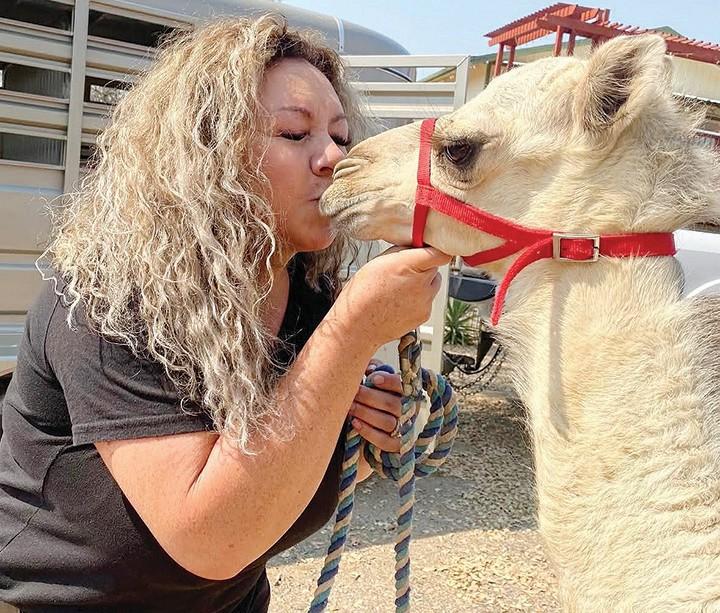

Perscilla Davis is pictured with her first camel, Lucas. Submitted photo
There’s a dangerous shortage of vets in the United States who are trained to treat large animals. If you don’t think that’s a problem just ask some of the camel ranchers and pre-vet students who gathered recently in Raymond for a day of training and bonding.
The history of camels in America dates back to the U.S. Camel Corps, a mid-19th century experiment by the Army in using camels as pack animals in the Southwestern United States
While the camels were well suited for the job, the Army abandoned the plan when the Civil War interfered and the camels were sold at auction. While they never adapted as wild animals, camels began to be bred and cared for in the U.S.
Meanwhile, since the end of World War II, the U.S. has lost 90 percent of its large animal and livestock veterinarians, according to the National Conference of State Legislatures (NCSL).
“The exodus of doctors from large animal practice has left many regions of the country with little or no access to veterinary services.”

The “Camel Lady” Valeri Crenshaw is pictured at Patient Feather Ranch Rescue. Photo by Kellie Flanagan
It’s so bad at least 10 states have enacted legislation to address the veterinarian shortage, including Iowa, Kentucky, Maine, Mississippi, Virginia, Colorado, Utah, Vermont, New York and California.
Now, tucked away amid the rolling hills of Raymond in Central California on a 40-acre ranch, a group of people are sharing their unique knowledge to help camels — and the people they love — maintain the highest standards of care.
The nonprofit Patient Feather Ranch Rescue is home to a variety of creatures from chickens to bison and beyond. But it was camels people came together for on Friday, April 17, as owners Perscilla and Bruce Davis introduced a trio of experts to the inquiring minds of camel ranchers and would-be veterinarians.
And their camels.
In memory of Lucas
The genesis of the camel clinic at Patient Feather harks back to a tragedy. Perscilla Davis’ first camel, Lucas, became inextricably tangled in some wire which became detached from wayward fencing. When she called the one large animal vet in the area, the vet was away on a different emergency call, unable to help.

A resident at Patient Feather Ranch Rescue. Photo by Kellie Flanagan
Without her local vet to help, Davis called the U.C. Davis School of Veterinary Medicine thinking and hoping they could help.
“I said we have a camel and he needs X-rays on his legs. He’s halter trained, not aggressive and I need to know if his leg is broken. They said, ‘please don’t come here, we don’t see camels, call a local vet.’”
But she’d already done that and the vet wasn’t available so she called the renowned vet school again. And again, begging for help that would never come.
“Please don’t come here,” they said. “Don’t make the drive.”
Sitting in a field with Lucas, unable to get him up, minutes stretched to hours with no cavalry on the horizon.
“Lucas was our first camel,” said Davis, her voice filled with emotion. “We bottle fed him. He was really special to us, our family and friends.”

Shown from left, Michael Roberts and Perscilla Davis.
Sadly, Lucas was unable to recover from his injury and was humanely euthanized. Davis went on to have other camels and vowed she would do her part to make sure help was available when needed for camels in the Golden State and beyond.
“Something needed to be done,” she said. “There are so many camels in California and we have no help.”
That was three years ago. And this year marks the second of the camel clinics at Patient Feather.
“The reason I started having this event is so no other camel would suffer as long as Lucas did without getting the care he needed and no other family would go through with what I went through — feeling helpless and not being able to get help.”
Three wise wranglers
Doug Baum, Valeri Crenshaw and Michael Roberts are among the top camel experts in the country. They were present to address five camel families, or people who own camels, along with four pre-veterinary students from Fresno State.

Pictured from left, Valeri Crenshaw and Doug Baum
Also on board for support were volunteers, visitors and friends including Ashanti Coulter, Katie Acosta, Carly Calvillo and Patient Feather’s Erin Lamont.
World traveler Doug Baum is the owner of Texas Camel Corps, an educational organization which highlights the “Great Camel Experiment” in the American West through live camel demonstrations and re-enactments at historical sites.
Kansas-based Valeri Crenshaw, sometimes known as “The Camel Lady,” operates at the forefront of camel welfare. She’s the secretary of the North American Camel Ranch Owners Association (NACROA) and is top of her field in husbandry, handling and conservation.
“Finding vet care can be super challenging,” Crenshaw confirmed.
Michael Roberts, whose social media is under the name Tazah The Camel, has been training for 16 years. Once he began working with camels and “realized how smart they are,” he decided to pursue the passion as a career.

Shown are participants and leaders in the Patient Feather Camel Clinic.
“I’m doing something I love,” Roberts said. “I don’t feel like it’s work.”
Among the camels families present at Patient Feather were Jake Richardson, 19, and his mom Jodi Richardson and Jake’s camel, Jaffar.
Jaffar is a seven or eight year old male who lives with the Richardsons on their acreage in Petaluma along with his companion, Otis the mule.
“I’m excited to work with Jaffar and these trainers,” Richardson said.
The Richardsons acquired Jaffar from a nearby breeder who was looking to re-home four male camels. Male camels are not hard to come by if one looks far enough — unlike their female counterparts, they do not produce milk.
Camel milk is the closest milk to human mothers’ milk and is naturally antibacterial, anti-fungal, easily digestible and non-allergic, according to Oasis Camel Dairy Farm and Foundation.
The farm sells fiber products along with a wide range of items made with camel milk including lip balm, bath bombs, lotions, chocolate, powder and ghee.
On top of its many uses is new research indicating camel milk may contain healing properties for a variety of conditions. The foundation said camel milk in the U.S. today “is being consumed by people with certain forms of autism, gut issues like crones, colitis and IBS and diabetes.”
Leslie Reese is another camel owner. She’s from Calavaras County and her camel named Kevin will turn two years old in July. Reese is no stranger to animals including those considered exotic. Her rescue organization is home to alpaca, parrots and about 30 donkeys.
“I’ve been learning so much with Kevin,” said Reese, who uses some of Kevin’s fluff to make fiber products. “It’s so different compared with other animals I’ve worked with.”
Reese brought Kevin to the Patient Feather clinic to learn more about proper care and so he could socialize with others of his ilk – and she hers.
Camel class
One of the main topics of the clinic was veterinary restraint for camels. In other words, how do you and the vet know your camel is going to behave?
To answer that question the trainers, using different camels, demonstrated a technique known as “hobbling,” where the camel’s front legs are tethered together with something as simple as an extra large nylon dog collar.
The hobbling is designed to slow them down and restrict their range of motion so they can be groomed or cared for at the vet.
Baum said part of the lack-of-vets problem has to do with a dirth of understanding when it comes to camel care.
“We don’t have generational knowledge,” in the United States, he said.
Baum was taught to hobble by an “old nomad in Egypt,” and said even a “six year old in the Sahara” knows how to herd camels.
“They can handle 50 at one time. With 5,000 years of domestication camels are genetically programmed. They yield. We’re training humans.”
Crenshaw values their intelligence and intuitiveness, emphasizing the critical nature of the bond between a camel and its owner.
“The foundation is the relationship,” she said. “Interacting is the most important thing you can do. You can’t be a casual camel owner.”
Welfare for a camel means their nutritional requirements are being met, for one thing. They have a high Vitamin D requirement — one that would kill a horse, Crenshaw said.
“They must move,” she continued. “They must browse and have exercise. They can go 30 miles a day and they need it for physical and mental stimulation.”
They also need to interact with their own species, another reason the Patient Feather ranch clinic was helpful.
Once the group learned more about hobbling, they turned to twitching — a gentle way to convince a camel to move — and later on were able to have one-on-one training with the experts.
This second year of the camel training was well received and plans are already underway for the next one in 2027.
“It turned out great,” Davis said.
“We will be doing it again next year on the third Friday in April. I wish we had more veterinarians, technicians and students interested. They are greatly needed in California.”

Responses (0)