


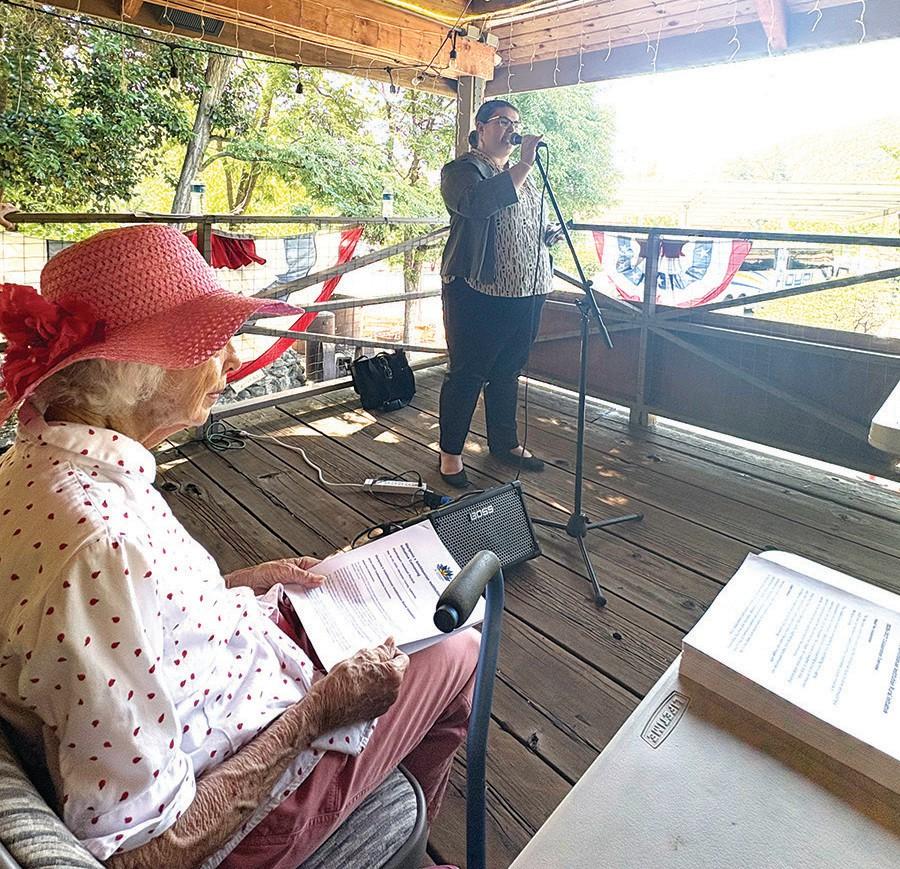

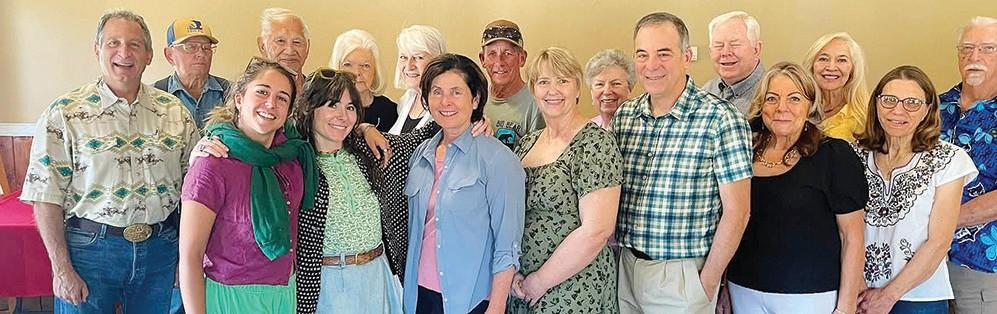
Longtime Mariposa Museum and History Center board member Sylvia Emery listens as museum director Amanda Adams opened the meeting with the Smithsonian last week. Photo by Greg Little
When it comes to name recognition, it’s hard to argue the stature of the Smithsonian Institution.
It is one of the most recognizable and distinct names in the world and its presence in Washington, D.C., is unmistakable and ingrained in the history of America.
But don’t think the Smithsonian is just about D.C.
Quite the opposite, in fact.
Thanks to the vision of Cara Goger, executive director of the Mariposa County Arts Council, the Smithsonian is now becoming a part of Mariposa County — and will be for the next few years and most likely well beyond.
“We are doing a show and tell around the community,” said Goger last week while speaking to a group of people who had assembled on the porch of the Mariposa Museum and History Center.
She was talking about the Smithsonian Institution Rural Initiative, a program launched by the storied institution several years ago and one that Goger zeroed in on in the hope it could lead to what was unfolding last week.

Cara Goger, director of the Mariposa County Arts Council, speaks to the audience last week at the Mariposa Museum and History Center. Photo by Greg Little
The collaboration began when Goger was part of a group that traveled to Washington to begin exploring the possibilities. That led to a meeting earlier this year in Mariposa, the first step in the process.
The meeting in February featured Andy Mink, the director of Rural Initiatives for the Smithsonian.
It was then when the concept of a partnership was presented to the community — a concept that seemed overwhelmingly favorable among those who attended.
Then last week, a full three-day agenda unfolded that included Mink and four other experts from the Smithsonian getting the “show and tell” of which Goger spoke.
The schedule was completely full and included visits to varied places like Yosemite National Park, the Stookey Preserve, the Yosemite Climbing Museum, the Mariposa Museum and History Center, the Mariposa Creek Parkway and it culminated with a dinner and visit to the historic town of Hornitos.
What does it all mean?
That central question was what this trip was all about.
The concept is for the Smithsonian to work in partnership with local groups on “strengthening local storytelling, encouraging collaboration among community organizations and expanding access to Smithsonian expertise and national cultural resources,” according to information provided at the meeting.
The Smithsonian, for its part, can provide a lot of expertise, which was on display last week with various people from the institution on hand to discuss the direction the local group might take.
Those in attendance were Kara Blond, director, Smithsonian Institution Traveling Exhibition Services and Smithsonian Affiliations; Shannon Brogdon-Grantham, photograph and paper conservator, Museum Conservation Institute; Halle Butvin, director of strategic initiatives and external affairs, Smithsonian Center for Folklife and Cultural Heritage; and Katrina Lashaly, program coordinator, Center for Community and Environment.
That direction, with the input of the Smithsonian experts, was the focus of the meeting on the porch of the museum, where ideas flowed from a wide variety of people representing various groups in the county.
“We want to focus on a central project,” said Goger.
To begin the discussion, Mink outlined the “project vision,” which includes:
• Explore and share the diverse stories and experiences that shape life in Mariposa County.
• Strengthen relationships among organizations working in arts, history, education, land stewardship and community service.
• Build long-term capacity for cultural programming and collaboration.
• Expand local access to Smithsonian programs, expertise and institutional partnerships.
• Support inclusive, community-rooted approaches to storytelling and cultural presentation.
“We are exploring diverse stories,” said Mink.
How all that unfolds remains to be seen, but Mink did give a hint as he said a target is to have some kind of showcase of the work at the 2027 Mariposa County Fair.
“What is it that Mariposa County aims to do?” asked Mink. “We’re here to listen. We’re here to contribute.”
He also stressed they wanted to be “realistic” about expectations while also being “creative” and “innovative.”
The “end goal,” he said, was to launch the “community-based storytelling program” during the fair in 2027.
“None of this is final,” said Mink to the audience. “We’re listening.”
How to tell the stories
Then he asked, “What stories need to be told in Mariposa County?”
“How do we start?” asked county resident Richard Westfall who is a member of the museum board and many other historical groups in the county.
The floor was then opened up to those in attendance for input, ideas and anything else that came to mind.
The list was lengthy, interesting and diverse.
For instance, Ken Yager of the Yosemite Climbing Museum, said he thinks there are distinct areas that need to be highlighted. Those include the indigenous story, the Gold Rush, farming and ranching and Yosemite National Park.
Another person pointed out how fire and water have a unique story in Mariposa County.
Scott Gediman, public information office at Yosemite, said there is a lot of history that is not as well known when it comes to the park which, he said, also reflects on Mariposa County.
That includes the impact of Chinese immigrants, the Buffalo Soldiers and much more. Gediman talked about “how the story has evolved.”
Gediman also pointed out it was in 1864 when the Yosemite Grant Act was passed by Congress. It was the first time, anywhere in the world, where land was set aside for the public good. That land was the Mariposa Grove of Giant Sequoias and Yosemite Valley. It was the precursor to the national park system.
That, said Gediman, made Mariposa County “key in how we look at land conservation. We are the model.”
“There are a menu of themes,” said Mink.
Yager added there is a history of geology (including mining and the natural wonders of Yosemite) as well as recreation.
The format
How to tell all of this in a concise format is one of the main points of the entire program, said Mink.
One theme which emerged from the meeting was oral history, or the lack of it in Mariposa County.
Many older people in the county, some said, could be key in getting that history onto audio and video to have it preserved for generations to come. Written history, too, could be part of the project.
Mink said in his experience, the “biggest challenge” in that area is convincing people their stories are important.
“Nobody wants to know my story,” is how he phrased his experiences in doing such projects.
Another angle has to do with the younger people in the county, he said.
Mariposa County High School teacher Stephanie Bobman was part of the discussion and she is working with the Smithsonian in many ways.
“They are a part of the history,” said Bobman of the students who go through the high school program.
In fact, she said they live each day in history by attending such a historic high school built by the Works Progress Administration during the Great Depression.
She also pointed out that pictures of every graduating class at MCHS are displayed on the hallways of the historic building.
Gediman told the group Yosemite officials are currently doing an audio oral history project in which they interview retiring rangers and others at the park to preserve those stories. He also said the park has some six million objects of history that are cataloged.
Bridget Fithian, executive director of the Sierra Foothill Conservancy, pointed out all of the land they have conserved in the county and called it a “living classroom.”
She said there are a “wealth of resources” her organization can offer.
Westfall said there are four museums in the county as well as various historical societies. He feels “we need to get together” to collaborate and help preserve the history.
Members of the local storytelling group were also on hand, saying they would like to be a part of the project and would assist in helping others tell stories.
UC Merced was also represented at the meeting and offered expertise as well as boots on the ground in the form of students helping with whatever project is selected.
Kim Lawson of the Yosemite Mariposa Tourism Bureau offered help in the form of spreading the word through their extensive social media and email networks.
Erica Wolfsen of the Northern Mariposa History Center also spoke, saying they want to be involved, as well.
“We want to collaborate,” she said.
But how?
“We will need a working group at some point,” said Minks.
Goger then took the microphone again, quipping, “Who’s going to organize all of this?”
She answered her own questions, saying since it was the Mariposa County Arts Council that started the entire process, they would “take the lead. We are committed to doing this.”
Mink then talked about some of the resources the Smithsonian can offer, but said there are many more.
Four already in place include:
• Democracy in Dialogue, which Bobman is already part of, he said. MCHS students and students from another school elsewhere in the country will be collaborating to discuss commonalities as well as unique experiences in their locations. Bobman will be traveling to Washington in July as part of the program.
• The Smithsonian STEM Schools if Distinction, a program, led by the Smithsonian Science Education Center, recognizes middle and high schools employing a holistic, sustainable approach to STEM (science, technology, engineering and math) education.
• Smithsonian Rural Library Program, which Mink said provides a year’s worth of various content to rural libraries. He said the Mariposa County Library has been approached and asked to participate.
• Smithsonian Intern Program, which is a fully paid 10-week program for a student who spends the internship at the Smithsonian Institute in Washington.
Mink said those are just examples of programs offered by the Smithsonian, noting there are many more, most of which are funded fully by the institute.
That expertise, he said, is how the Smithsonian can help local places like Mariposa County and is why the Rural Initiatives Program was formed in the first place.
In closing the meeting, Goger said the Arts Council is interested in talking to anyone who might have an interest in participating in the program as it evolves.
You can contact her at goger@mariposaartscouncil.org or Polina Pivak at pivak@mariposaartscouncil.org.

Responses (0)