


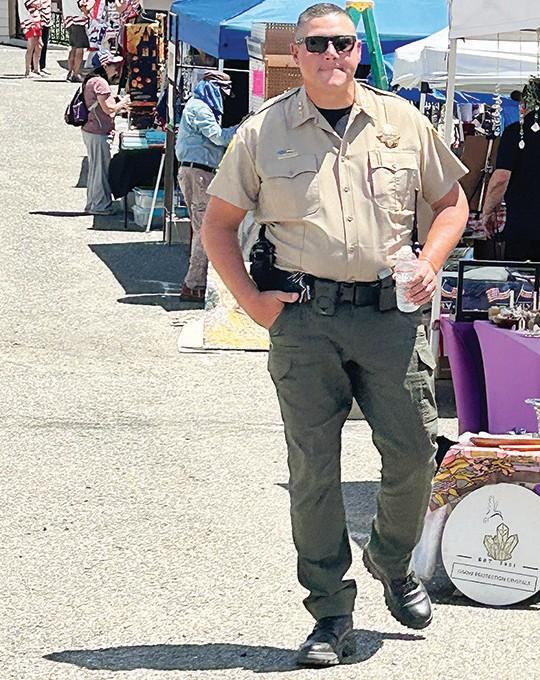

Mariposa County Sheriff Jeremy Briese is shown at last Saturday’s July 4 celebration in Mariposa. Photo by Mark Ruggerio
Mariposa County Sheriff Jeremy Briese knows there is a homeless problem in Mariposa.
However, he also knows there are no easy solutions and he is hoping an initiative by his office can ease some worries.
“I want to focus on the whole picture and how to make corrections,” said Briese. “We need to be more proactive.”
The homeless situation has grown in the town of Mariposa over the past year or so, and with the uncertainty of the future of the Connections Emergency Shelter, it means there appears to be more visible signs of the problem.
To that end, Briese said his officers have been issuing warnings to people, even arresting some for various offenses, from public intoxication to littering.
However, Briese said his focus is trying to get people the necessary resources.
“There are corrective measures,” he said.
But he also said if people are in public areas “smoking meth or drunk,” his officers will take action.
“It is more about accountability,” he said.
Briese said “a lot” of the issues take place in and around the rest area on Highway 140 near the Mariposa Museum and History Center and Pioneer Market.
The sheriff said during his career, he knows of “many success stories” of people who have overcome homelessness and addiction and he is hoping the focus of his department can lead to more success.
“They were in a wrong space,” he said, saying resistance to help is normal.
“They hated it at first, but it got the ball in motion,” he added of past experiences.
A hard look
“What are we missing?” Briese said about how they are approaching the problem.
That’s a hard question and Briese admits that’s the case, but he is still trying to focus on the approach.
“We see people and know they have issues,” said Briese.
He also sees the compassionate side of the issue, saying when they see someone in that condition on the streets, it doesn’t lessen them as human beings.
“That’s still somebody’s daughter,” he said.
But, he added, they have to “hold some rules accountable. They have got to want it.”
One of the major pushes, said Briese, is that personal contact between officers and those who are suffering.
“We are making contact with people,” he said. “We are taking a run at it because it is a small population of folks.”
On the other hand, Briese said “they are part of this community” and deserving of help.
But that doesn’t lessen what Briese calls some of the “dangers” associated with people living on the streets and in the wooded areas around Mariposa.
Mainly, he said, fire is the biggest danger, though violence is also a factor as he pointed out the recent attack of a sword-yielding man who severely injured another person.
He estimates “25 to 30” people are in the current group.
“We cannot let their actions jeopardize the town, the citizens and the visitors,” said Briese.
He’s also blunt when it comes to the use of methamphetamine.
“Let’s call a spade a spade,” said Briese. “Meth is a horrible drug.”
He said he’s seen “good people” become consumed by the drug but also he has seen “people who have beat it.”
In some recent incidents, some people have been taken to jail, but Briese called that a “quick timeout” and not the solution that is needed.
“We hope to transition them to other programs,” said Briese. “It’s almost like tough love.”
His office is working with many other agencies in an effort to get people into treatment programs.
Briese said the amount of homeless people has increased in recent months. He believes the mix of people with Mariposa ties and those coming from other areas is “about 50- 50.”
In some cases, he said officers have been told by the people they can receive their benefits quicker in Mariposa and also have said it is a safer place to be homeless than other areas, including in the Central Valley.
All calls
Another factor for Briese is the fact his officers respond to “all calls for service.”
In some more populated areas, he said these types of calls can take a long time, meaning the danger level rises.
“As a community, we need to stay on top of it now,” he said.
Briese said “constant communication” is a focus for his department, saying deputies make contact almost daily with people who are on the streets.
Deputies encourage and will help them to reach out to agencies who offer services like drug addiction assistance and alcoholic rehabilitation, among others. It can also include mental health services, he said, which is a major concern.
One impact in the town is how it affects the business community.
Briese said “there are a lot of compassionate people” in Mariposa and most of them want to see those suffering get help, including those in the business community.
“We encourage people to call,” he said, noting that if a local business is having an issue, he wants to know so they can be proactive.
That business community relies on visitors, the backbone of the economy in Mariposa County.
Briese stresses that not only is his department responsible for the local citizens, but also the millions of people who visit the town and county each year.
“Being visible, involved and engaged,” is how he described the sheriff’s office approach. “We have a duty to make sure the county is safe. As sheriff, I’m responsible for the safety of every resident and every visitor.”
He also stressed that helping people “is not a matter of if you are rich or homeless,” rather they are in need of service from the sheriff’s office.
“Our community has to trust us,” said Briese.
Part of that trust is “treating people with compassion,” he added.
Unique perspective
Briese said the fact he was born and raised in Mariposa gives him some insight into the community in general.
“I had a unique upbringing,” he said.
That includes being a member of the Southern Sierra Miwuk Nation.
Briese grew up with loving parents and he feels that shaped his outlook on life. But he also said he “knows the feeling” of not getting new clothes all of the time.
Still, Briese said he was taught “to work hard and do right,” something he carries to this day as the sheriff of the county.
For some, he said, getting involved in the issue of homelessness and addiction is difficult.
“Society,” he said, sometimes does not want to get involved “because it’s not pretty.”
However, Briese said when people are struggling it takes society to get involved and find ways to help those in need.
Briese said many times a “stigma” is attached to those who are homeless. In some cases, he said there are people who don’t want help and that’s when it becomes difficult.
But, others do need help and Briese said he cannot just let people suffer without at least trying to help.
If the sheriff’s office — and the public — doesn’t help, he said the ending is generally one of two things: “prison or death.”
Briese doesn’t want either of those fates for as many people as possible.
The sheriff is also realistic, saying there are “always criminals and scammers” who try to take advantage of any situation.
But for the most part, the sheriff said helping those who are downtrodden is the number one priority.
“A lot of people have beaten addiction,” said Briese.
He’s hoping the directive of the sheriff’s office can help in that area of this problem.
“We need more reaching out than enforcement,” he said, but stressed enforcement will be used when necessary.
For Briese, compassion is at the forefront and he is hoping that translates into help for those who need it the most.





Responses (0)