


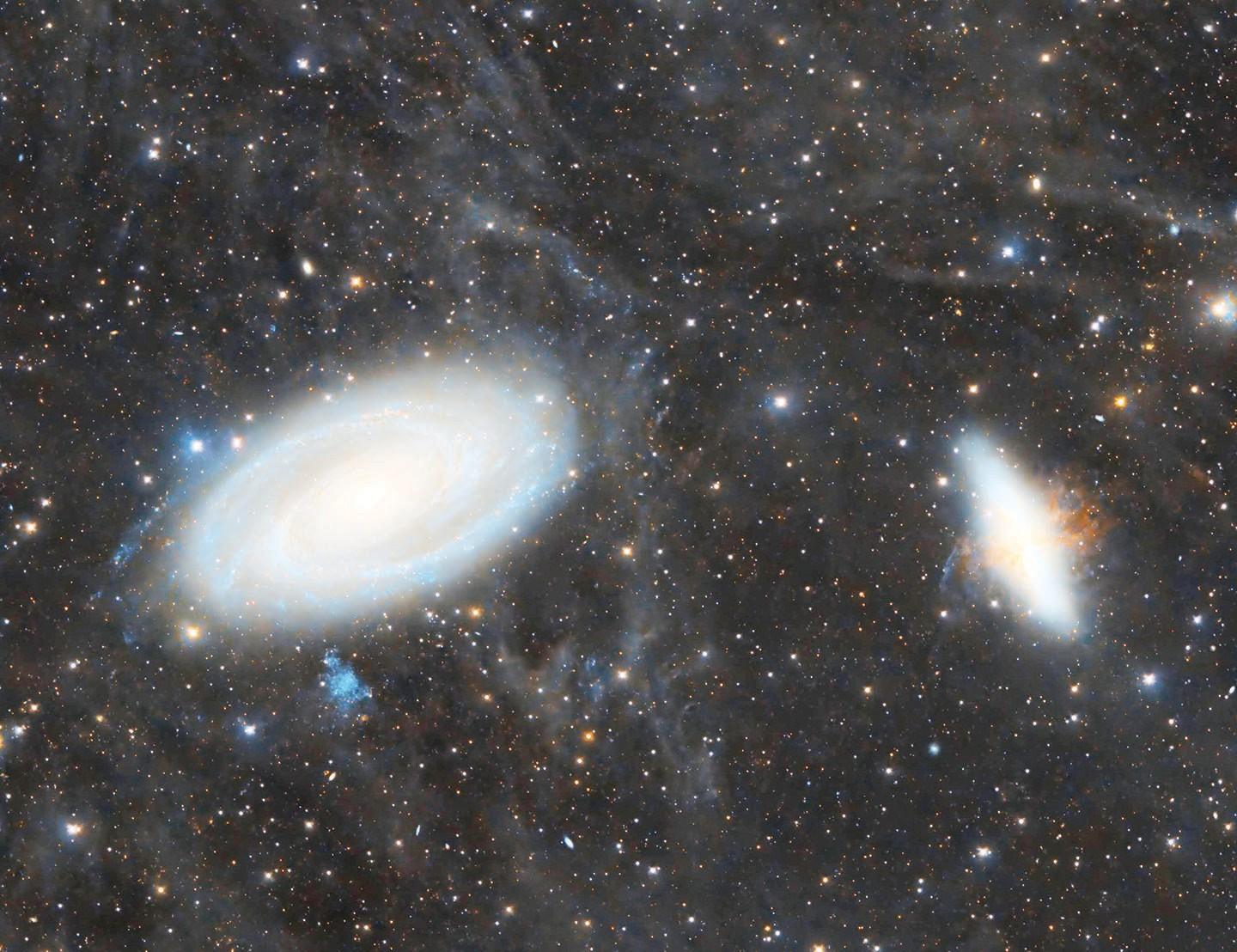

Messier 81 (left) and 82 are two relatively nearby galaxies — about 12 million light-years away. Each contains hundreds of billions of stars. Photo by Manny Leinz
Today we’ll discuss a big question in astronomy — a really big question — just how large is the universe?
We all know that the numbers are huge; in fact the distances are so mind-bendingly immense that it’s hard to wrap our heads around them.
To better understand the scale of the cosmos, join me as we climb aboard a virtual spaceship for a journey to the edge of the known universe. We strap in and feel the rumble in our core of our bodies as the engines ignite. Pressed firmly into our seats, we roar off the launch pad to our first destination: low Earth orbit.
The neighborhood
If you’ve been out under a dark sky after sunset and gazed up for any length of time, you’ve probably seen little dots — satellites — crossing the sky in all directions. There are currently well over 15,000 functional satellites in space.
Although they may seem far away, these satellites are almost all in low Earth orbit, within 250 miles or so of the earth’s surface: shorter than a medium length road trip. Of course it took a whole lot more fuel for our spaceship to get here than you can get from the local Grizzly Gas station, but that’s a topic for another day.

Manny Leinz
With another burn of our engines we leave Earth orbit, bound for our nearest neighbor, the Moon. Just two months ago we saw NASA’s Artemis II mission take four astronauts around the Moon; and at little over a quarter million miles, farther than any humans have ever been from our fair planet.
NASA intends to land astronauts on the Moon again as soon as 2028, nearly 60 years after Neil Armstrong took his “one small step for man” on July 20, 1969. Longer term ambitions, by NASA and private companies such as SpaceX, are to land humans on Mars.
The red planet is more than a thousand times farther away than the Moon — about 300 million miles — and the journey will take seven to nine months, rather than the five days it took Artemis II to reach the Moon. Our spaceship glides past Mars and then beyond the outer planets: Jupiter, Saturn, Uranus and Neptune.

Messier 13 is a star cluster in our own galaxy. It is 24,000 lightyears away and contains hundreds of thousands of stars. Photo by Manny Lienz
As we continue our trek further into space, the distances become so large that we need a new distance scale, based on the speed of light. When we flip on a switch, it may seem that the light arrives instantaneously, but it’s not so.
Those packets of luminous energy we call photons travel at a very specific speed: about 186,000 miles per second. As we know from Einstein’s theory of relativity, this is the cosmic speed limit; nothing can go faster.
Light from the Sun, at a distance of 93 million miles, takes about eight minutes and 20 seconds to reach the Earth. A beam of light, or a radio signal, traveling at light speed from Mars takes almost half an hour.
The Voyager 1 spacecraft, launched way back in 1977, and the farthest man-made object ever launched, will officially reach one light-day from Earth this November. Its total distance at that point: over 16 billion miles.

But we are just getting started.
To reach the edge of our solar system, far beyond the dwarf planet Pluto in the so-called Oort cloud where icy comets are born, our spaceship needs to travel up to three light-years. From this vantage point, as we look back toward home, the Earth is hidden in the glow of our sun, which appears as just one of numerous fairly bright stars.
Stellar suburbs
We have traveled three light years from Earth, and still haven’t encountered a star beyond our Sun. To reach that nearest alien solar system, Proxima Centauri, we’ll need to travel a bit farther — out to 4.2 light-years.
Based on careful observation by ground-based telescopes, we know that Proxima has at least two or three planets. One of them, Proxima Centauri b, is in the so-called habitable zone, where the conditions for life as we know it could exist.
In 2016, a concept was researched to consider sending a flotilla of microchip-sized spacecraft to this planet. Massive lasers would accelerate the craft to 20 percent of the speed of light; yet still the journey would take nearly 30 years. As of now, the project has not gone beyond the concept stage.

This “Deep Field” image, taken by the James Webb Space Telescope in 2022, shows thousands of galaxies, including some of the earliest, in a field the size of a grain of sand held at arms length. Photo courtesy NASA
Reaching stars beyond Proxima Centauri takes us into the realm of science fiction. The recent movie, Project Hail Mary, highly recommended, by the way, revolves around a mission to a planet orbiting the star Tau Ceti, which is about 12 light-years from Earth.
The technology needed to carry a spacecraft to this solar system in a human lifetime does not exist today.
Thankfully our virtual spaceship is not constrained by a lack of technology — or the laws of physics! Our next stop is the edge of our galaxy, the Milky Way.
All of the stars we can see in our sky — and the over 100 billion that are too dim for us to see — are part of the Milky Way galaxy. Astronauts in a real spaceship would not live to experience the sight, nor would their distant descendants, because to reach this point, even traveling at the speed of light, would take over 25,000 years.
Into the void
Leaving the Milky Way behind, we set a course for the nearest large galaxy to our own: Andromeda. At a distance of 2.5 million light-years, it is the largest member of what we call the “local group” of galaxies, and home to about a trillion stars.
From a dark place, if you know where to look, you can just see the Andromeda Galaxy with your naked eye. If you do spot it, consider that the light that you are seeing left Andromeda long before the first humans walked the Earth!
Beyond the local group lie so-called superclusters of galaxies, arrayed like cosmic spider webs, with largely empty space between them. Our Milky Way and local group are on the outskirts of a supercluster in the direction of the constellation Virgo.
The distance to the far edge of this supercluster, which contains up to 100,000 galaxies, is over 100 million light-years.
Far beyond the cosmic web of the superclusters lies the edge of the observable universe. Science tells us that the universe formed 13.8 billion years ago in an explosion we call the big bang.
However, because of inflation — the expansion not of matter into space but of space itself immediately after the big bang — the farthest objects that we have seen are farther away.
Distant galaxies recently found using the James Webb Space Telescope are over 33 billion light-years distant. There are certainly galaxies yet farther away than this, but we have no way to see them because their light has not yet had time to reach us.
Our virtual spaceship has reached the edge of the observable universe.
Are there universes beyond our own — so-called multiverses? Are there ways to travel to distant realms via cosmic tunnels — wormholes — without violating the laws of physics? There are theories, but as of now, science has no definitive answers to these questions.
What’s up in the night sky this month?
June is the best time all year to see the little planet Mercury in the evening sky. Look for it low in the west as soon as it starts to get dark. Binoculars may help you find it.
This is also your last chance this year to see Jupiter in the evening sky. You can see it blazing brightly in the west in the constellation Gemini all month, but is slowly getting lower each day, and will disappear into the sunset by the end of June.
Catch it as soon as it gets dark in the evening, and use binoculars or a small telescope to see Jupiter’s four large Moons.
Venus is still low in the west after sunset, but you can’t miss it. It is so bright that it’s easily seen even before the sky gets completely dark.
Watch Venus gradually climb higher throughout the month. It will be highest in the sky by mid-June. And don’t miss a rare opportunity on June 17 to see Venus in the daytime! Use the waxing crescent Moon as your guide, and use binoculars to find the planet.
(See the Celestial Highlights sidebar for more information.)
I hope you have a chance to get out under the stars sometime this month; and if you do, take some time to drink in the night sky, and perhaps ponder your place in the immensity of the universe.
To get help finding planets, stars, and other celestial sights checkout skyandtelescope.org/interactive-sky-chart/ or theskylive.com/.
There are also some great free smartphone apps, including Stellarium, SkySafari and SkyView. As always, if you have questions, comments or suggestions for future articles, you can get in touch with me by email at: celestialdeep55@gmail.com. You can find my prior Gazette articles, night sky photos and more on my website at celestialdeep.space/ .
Manny Leinz is a long-time amateur astronomer and night sky photographer. He and his wife live part time in Bootjack where they also have an observatory.







Responses (0)