


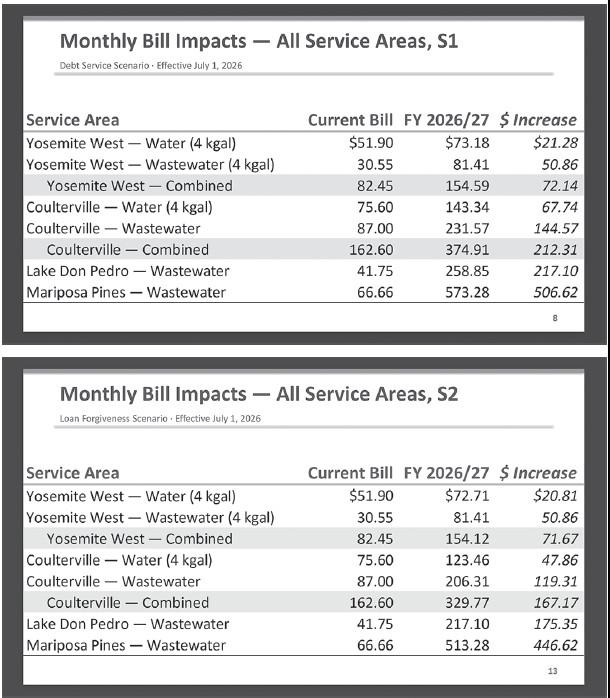

Mariposa County is considering two scenarios for a possible rate hike. S1 would include debt service on $1.2 million already loaned to the district’s to cover losses. S2 would involve Mariposa County forgiving the loan. Bartel Wells Associates graphics
Four small water and wastewater districts in Mariposa County, many that haven’t had a rate increase in 20 years, are looking at a potential whopping hike.
The systems — in Yosemite West, Coulterville, Lake Don Pedro and Mariposa Pines — could see their rates double, or even triple, by next year.
And that could be just the beginning.
The latest rate study was presented April 22 to the Mariposa County Board of Supervisors. A series of town halls in those communities are planned.
Several residents said the suggested rate increases would turn their communities into ghost towns.
“Most people had no idea what we were getting into,” said Randy Hilt, who lives in the Lake Don Pedro subdivision, where the wastewater system serves only 114 customers.
The subdivision was originally intended to have at least 200 more homes before financing dried up.
The current monthly wastewater bill in Lake Don Pedro is $41.75 a month. Under one scenario, it could climb next year to $258 a month. By 2030, the monthly bill could be $358.
The 24 wastewater customers in Mariposa Pines could see their monthly bill go from $66 to $573 next year. By 2030, the cost could climb to a staggering $1,033 a month.
In Coulterville, the water and wastewater system serves 81 customers. The combined utility bill of $162 a month could go up 130 percent next year to $374. By 2030, it could be $804 a month.
Virginia Smith is on the Coulterville system and said most of her neighbors are seniors on a fixed income. She wondered why she and her neighbors aren’t allowed to have wells or septic systems.
“A rate increase will force me to sell my home that I love,” wrote Michael Riley, 80, of Coulterville.
Tiffany Lindsay said she moved to the area because it was affordable.
“Everything is going up,” she said. “I can’t afford groceries. Now I can’t afford water.”
In Yosemite West a combined water and wastewater bill of $82 a month could go up 86 percent next year to $154. By 2030, it could be $804 a month.
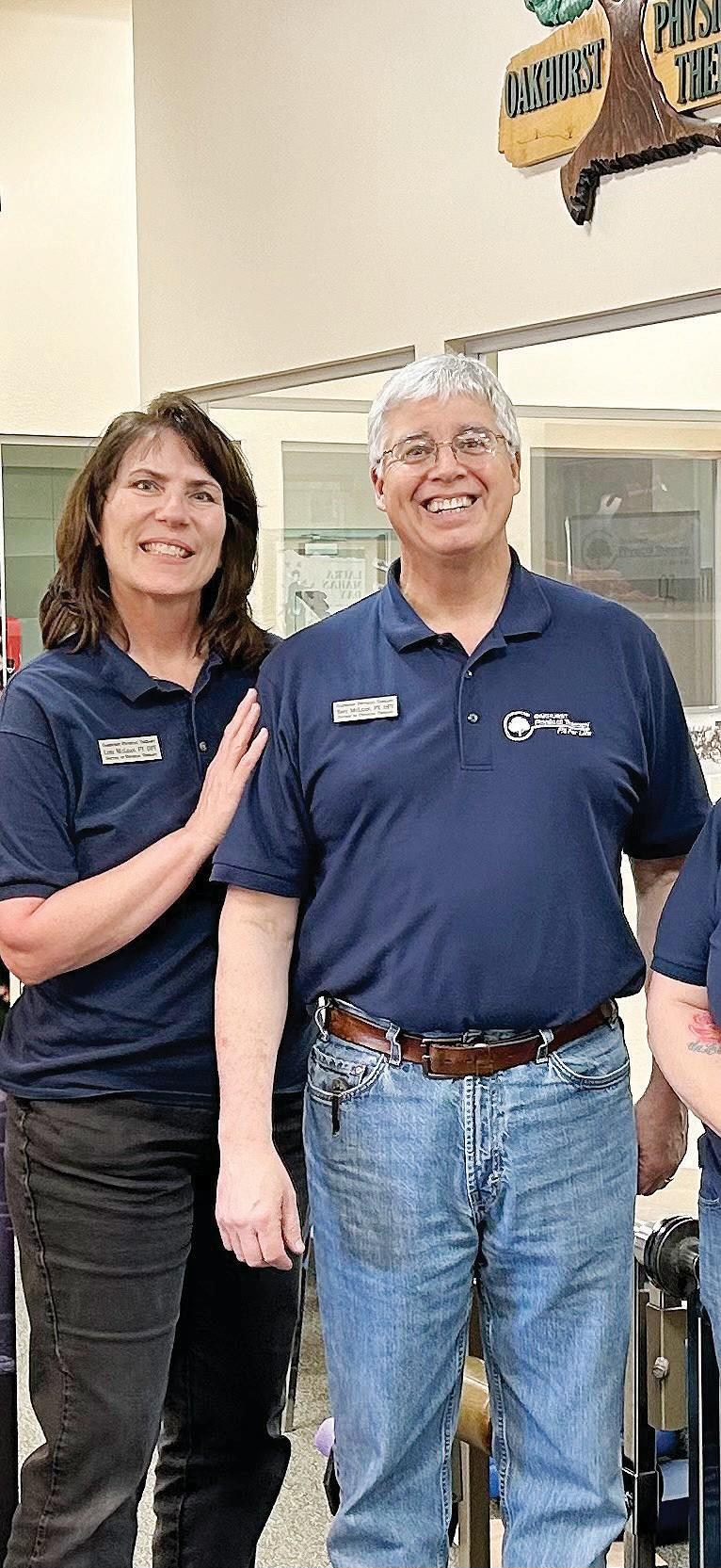
John Locke has lived in Yosemite West for 24 years. He believes the increase will force many long-time residents to leave.
“The result will be the loss of single family homes, they will all be rentals,” Locke predicted.
Some residents questioned the calculations.
Ted Williams of Yosemite West said the analysis is under-counting revenue and adding theoretical expenses.
“Despite a long process to get here, why are we now rushing here at the end,” Williams asked the board.
The problem for all four utility districts is one of scale and high fixed costs.
The utilities serve a small number of residents, meaning operational costs and capital improvements are spread out over very few ratepayers.
Operating costs have gone up 77 percent in the last decade.
Mariposa County has loaned the utilities — with the exception of Yosemite West — a total of $1.2 million.
The two scenarios in the rate study compare whether that $1.2 million loan would be forgiven by the county.
Most of the communities have rejected rate changes when they were proposed in the past, including in 2015, when the last rate study was completed.
Using a provision of Proposition 218, those communities have gathered enough signatures, 50 percent of ratepayers, to block proposed increases in the past.
“In layman’s terms, is it okay to say they did it to themselves?” asked Supervisor Miles Menetrey.
“In some sense, yes,” said Michael DeGroot of Bartel Wells Associates, the Berkeley firm that conducted the rate study.
“But these are serious increases,” DeGroot said, who noted there is also $5 million in deferred maintenance.
Public Works Director Shannon Hanson said the county subsidizing the districts is not sustainable.
Years of inadequate funding and deferred maintenance have put the systems at regulatory risk, she said.
Hanson said the utilities are unable to seek out grants or loans because they must show two years of financial stability.
If residents were to reject a rate hike again then receivership is a possibility.
“We’ve kicked the can down the road and there’s no road left,” said County Administrative Officer Joe Lynch.
Lynch said other county residents are essentially subsidizing those systems when the county loaned them $1.2 million.
“There’s no support I’ve seen for loan forgiveness,” said Supervisor Shannon Poe.
“That said, we owe it to people to talk to them. These are legacy families,” Poe said.
Poe said the town halls that staff will be scheduling need to give people more than three minutes to speak.
“It may take a couple of rounds, let’s be realistic,” Poe said.




Responses (0)