


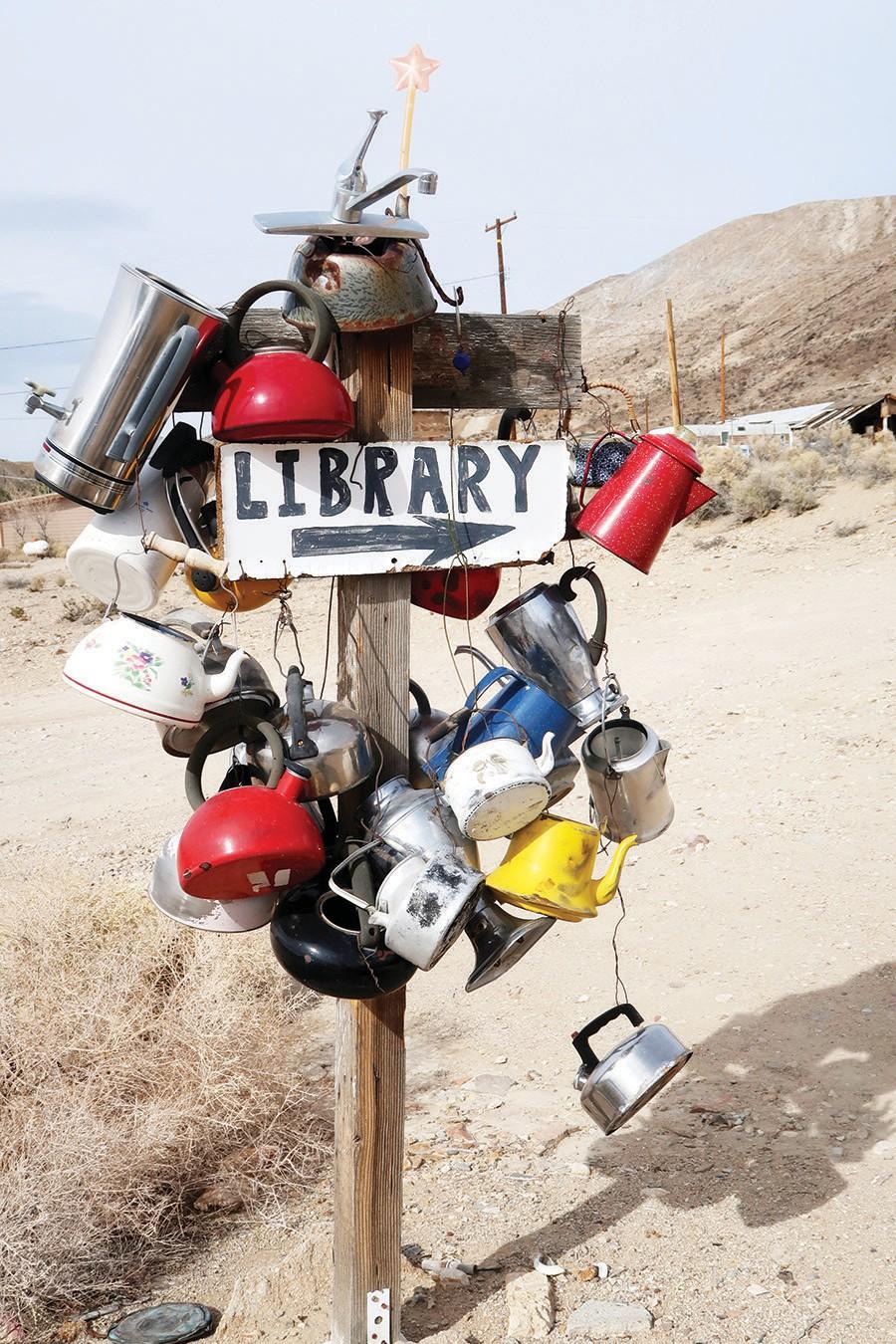

The library is a table with a few books on it. Photo by Linda Shepler
This tough old man-of-a-town is cradled in a stark and isolated depression between the Argus and Coso mountain ranges in eastern California.
On first glance, it seems to be barely breathing. Some say it’s just another desert ghost town waiting to happen, but don’t even think about saying that to one of the 40 or so residents.
Darwin, named for prospector E. Darwin French, is a former mining town, 4,750 foot elevation, sequestered in the high desert between Death Valley National Park and China Lake naval weapons testing center. A six-mile-long, paved two-lane road with a faded yellow stripe down its center leads to it.
Though it is situated at the end of the road physically, by no means is it a terminal community where people have lost all hope and have come to mark time ‘til the end of life. Not by a long shot. Though on the surface it may not be obvious, Darwin is very much alive.
People didn’t come here because they had to. They came and stayed because they wanted to. It takes a different breed of cat to do that, and most of us can’t begin to understand it. Reasons for people living here in this remote land of little rain in the back of beyond are as diverse as their pre-Darwin lives.

Sharon Giacomazzi
Some folks are lured to desert environs for the tranquility and wide open spaces, finding great comfort and soul nourishment. They like living on the edge of civilization and realize deep contentment in the peace and quiet of an empty landscape.
Those attracted to the desert feel its pulse and see its unique beauty, qualities that make utterly no sense to most others. They enjoy the challenge of living by their wits and the freedom from the rules and constraints of urban settings.
As an old-timer said, “Life is either what you make it or what you don’t make it. Your choice.”
And so it is in Darwin.
Rickety wood buildings, kiln-dried in the relentless and intense desert sun, mining detritus, countless rusty tin can lids, abandoned vehicles that outnumber residents three to one, numerous dilapidated RVs and trailers, piles of junk, dirt roads that seem to head to the end of the known world, unusual and creative dwellings, a few geriatric business buildings, burros, left over progeny from mining days, wander through town at night, massive structural remains of the abandoned Anaconda Copper Mine Company town and workers’ houses, a shiny red stop sign in the middle of town for non-existent traffic, a picturesque cemetery of departed souls and the restless desert wind whispering stories to anyone who will listen.

Population 40, plus or minus, then thousands of gold seekers. Photo by Linda Shepler
And there are lots of stories here.
It’s a haunting and quirky place with deep history that almost on one knows about. Like the residents, if you decide to go to Darwin, you must want to. You just don’t happen to drive by it.
It’s off the radar and has nothing in the way of services or “things to do” that usually lure visitors. No postcards, no T-shirts, no cold beer, no shady picnic spot, except for the Dome. Nothing here.

Art is everywhere. Photo by Sharon Giacomazzi
Your first clue to entering an unusual space should be the parody of the well known image of a fish, especially displayed by Christians on license plates, stickers, labels, etc.
However, this fish has legs in deference to Darwin the evolutionist. It’s very big and outlined in rock on a knoll near town and a fun tongue-in-cheek nod to the town’s name.
In case you were wondering, the faded yellow center line on the road into town was evidently a reminder to stay on your side on the well-traveled route frequented by vehicular traffic to/ from the Anaconda business.
Beneath the jumble and conglomeration of junk and “stuff,” there is an artistic vibe. An incongruous and eclectic assortment of art is found in most every yard.
It is among them that I felt the beating heart of this community and its people. There are beautiful, elaborate sculptures along with glass bottles, scrap metal and tin can creations. A tall, graceful, flowing sculpture of a woman carved into a tree stump is lovely.

The Dome was fashioned by Hal Newell in memory of his father Gordon Newell. Photo by Sharon Giacomazzi
A yard full of abstract white marble sculptures by James Hunolt grabs the eye. Particularly riveting is a figure of a man and woman locked in a sensuous embrace.
Sometimes referred to as “the dome” or “Hallhenge” is a fantastic work of art. Tall, thick slabs of cut dolomite arranged in a circle are the foundation of a handsome steel pipe canopy. It was fashioned by Hal Newell in memory of his father Gordon, a renowned sculptor in California.
There is a tradeoff for living in Darwin, and the citizens accept it. Nearest fuel, supplies and medical help are 40 miles away. Supermarkets and malls are 90 miles distant. People live here without a government, Starbucks, high speed internet, businesses, schools, churches, gas stations, police, cafes, grocery stores or McDonald’s. Or children.
They manage with excruciatingly slow dial-up, comparable to a steam engine vs. a bullet train and very spotty cell coverage. There is no one under 25 years of age. The only person in town who has a job is the postmaster.

Long-time Darwin resident, David Reese, with Oakhurst residents, Brenda Negley and Melva Hale, next to the peace tree made by David’s father decades ago Photo by Linda Shepler
To say that consumerism does not drive this town is an understatement.
I don’t know how they sustain their lifestyle. It’s none of my business to ask, question or judge their choices. What I do know is that Darwinites aren’t “dim-witted desert rats,” as someone suggested to me. According to the 2010 census, all have at least high school diplomas and once had jobs and paychecks.
There are retirees, artists, writers, musicians, loners, eccentrics and independent personalities who have no problem living in this quiet and desolate desert outback. Said one resident, “Darwin is more frontier than rural.” Well said, sir.
So, you might wonder, what is the backstory here? Why Darwin?
Darwin of old was rich and wild and violent. Think mini-Bodie. Discovered in 1874, by 1877 it had reached its height with a population that exceeded 3,000. The barren hills were pocked with tunnels and waste rock spewed from all of them. The mines gave up enormous quantities of gold, silver, copper and lead.

Employee housing at the mine was basically shacks. Photo by Linda Shepler
Typical of mining towns, there followed a series of boom and bust cycles. Darwin died three times from fires and a depression. But, like the Phoenix rising from the ashes, it survived. It’s hard to believe now, but for a few years Darwin was a bustling tourist town. Of sorts.
In 1928, the Eichbaum Toll Road was built through Darwin to Stovepipe Wells on the western edge of Death Valley. Small tourist cabins were constructed, gas was available and a hotel and cafe served travelers. A menu boasted a shrimp dinner, rare and unexpected boondock fare. German toast, meaning with jelly, cost 15 cents.
The economic boost provided by tourists was short. When Death Valley was designated a National Monument in 1933, it was decided a better road was needed, bypassing Darwin. In 1937 a cut-off was completed, and the town lost its life support, effectively isolating the community.

No gas, old post office. Photo by Linda Shepler
Today, with a sturdy vehicle, it is still possible to drive on the lumpy old road. Dirt and rocks of course. In my opinion, it’s an excellent way to recreate what early motorists experienced, as well as traveling on a piece of history.
Darwin, down but not out, had grit. After World War II, Anaconda
Copper Mining Company bought all mining operations and saved it for more than three decades before pulling up stakes in the 1970s. The company soon became the number one lead mine in California, producing two-thirds of the lead in the state.
The total value of lead, silver and zinc totaled $15 million. When it shut down most everyone wandered away, leaving Darwin to dwindle to the sleepy settlement seen today.
On the hillside of Mt. Ophir can still be seen the extensive remains of the company camp, a bona fide ghost town for 50 years. Massive tailing dumps, decaying rows of wood houses and various mill buildings offer mute evidence of a very large operation. Not much more than shacks, the first row of “houses” was for single men; above was more substantial housing for married men.
Just imagine how torrid in summer and how frigid in winter it was for the residents. Highest on the hill, a large home for the superintendent is presently occupied by a watchful caretaker. And his big dog. All of the area is strictly off limits.
When you get into town, park and walk around, easily done because it’s the polite thing to do rather than a slow drive by. The town is small and conducive to strolling.
Above all, be respectful and quiet, especially when taking pictures. Stay out of yards and don’t go knocking on doors and bothering folks. This is their home.
My motto in a nutshell: Where the blacktop ends, the fun begins. Explore. Do it now. Get out there, go see it. Get your socks dirty and your boots muddy, who cares?
Take someone new with you and take someone young. Engage in new things in nature and grow a family of kids who will love and care for the Sierra and all other environments today and tomorrow.
Directions: Without stops — virtually no traffic on this route — it takes about 50 minutes, 38 miles, to reach Darwin from Lone Pine. Just south of Lone Pine, veer off Highway 395 onto State Highway 136 which becomes Highway 190. Continue on 190 to turn off on your right to Darwin, marked by a small white stone monument with historical information. Continue 5.7 miles to town.
Sierra native Sharon Giacomazzi is the author of Sierra historical hiking guidebooks and articles for outdoors publications. She can be reached at sharong@sti.net. “Feet are like dogs, they are happiest when going somewhere.”



Responses (0)