


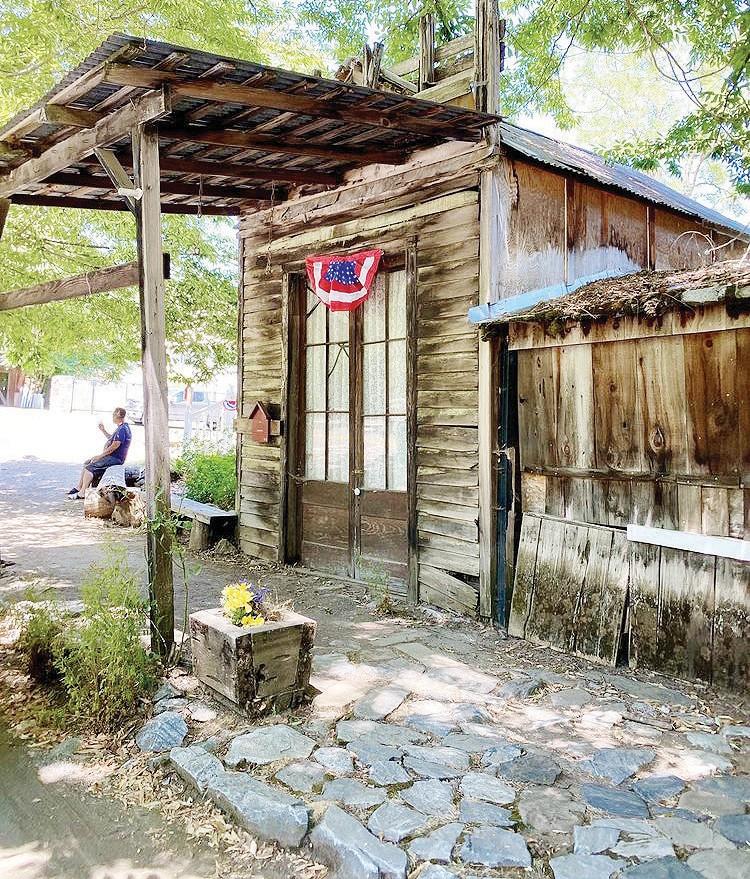

Original assay office still stands. Photo by May
Often referred to as the most picturesque setting in the Mother Lode, I had to see it for myself.
That’s a really big statement and claim to fame. It is also a historical experience like none other.
I can honestly say that because 40-plus years of exploring and hiking in the central Sierra Nevada environs have blessed me with extraordinary environments and history. The name alone lured me and I had to experience it.
I couldn’t imagine volcanism in this setting.
At the dawn of the Gold Rush, the world poured into the central California hills, among them a detachment of soldiers passing through on their way home from the war with Mexico. Cold temperatures and deteriorating weather prompted Colonel Stevenson to make camp until the weather improved.
Designated by the men in 1849, it was called Soldiers Gulch. The men found gold flakes — and the rest is history. Before long, its setting in a bowl-shaped valley was widely believed to be the result of a volcanic eruption. Nope, no volcano, but the colorful name stuck.

Sharon Giacomazzi
News of gold in them thar hills spread like wildfire. It was humanly impossible to keep it a secret.
News spread almost as fast as hitting “send” on your computer. Eventually, when easy placer mining — pick, shovel, gold pan, creek — proved less and less productive, hydraulic mining blasted away hillsides and mountains.
By 1893, this method powered most of Volcano’s mining operations. This method was extremely detrimental to the natural environment. So much so that the “California Debris Commission” deemed it illegal and put a statewide stop to it.
During the Civil War, Volcano’s gold supported the Union (North) efforts. Because there were Southern sympathizers in the population, an 800-pound canon was smuggled into town to intimidate the “Rebs.”
Though there was never a battle, it was fired once to scare Confederate sympathizers. The blast shattered many windows ending even thoughts of war in Volcano.

Metal sculpture of Miwuk man with visitor center in the background. Photo by A. Soudhu
Eventually, the Gold Rush petered out. The initial frenzy waned as the precious metal became harder to find as it did most everywhere.
With little reason to stay, miners began to drift away. At its peak, 5,000 gold seekers jammed the town and its environs. Around $90 million were ultimately extracted from the area …that’s $3.5 billion in purchasing power today!
Now a community not fueled by the impermanence and frenzy of gold could develop. And it did, culminating in what you see today.
Main Street is only a block and a half long, but within that short walk is more revealed history than seems humanly possible. I treasure that there are few cars, no music or gaudy signs or vendors hawking their wares.
Especially pleasing is the absence of commercialization and a theme park setting. Instead there are tasteful metal plaques that reveal the town’s amazing history and list of “firsts.”
• 1854 — first theater group in California
• 1854 — first debating society in California
• 1854 — first circulating library in the state
• 1855— first private school in the state
• 1855 — first private law school in California
• 1856 — first legal hanging in Amador
County

Cobblestones, or rock slabs, line the block and a half-long Main Street. Photo by Linda Shepler
• 1868 — first amateur astronomical observatory in California
Volcano was more educationally and culturally sophisticated than many towns in that era.
Visit the Sizemore Country Store and Café opened in 1852, the oldest operating general store in California. Interesting collection of goods that were for sale back in the day. Café offers good food. There is also a bakery, featuring sour dough items.
Check out the reborn 1880 Union Pub and Inn, formerly a miner’s boarding house. Wonderful, shady outdoor seating and fine dining. There are four upstairs a/c guest rooms available.
I highly recommend Huel Howser’s video: Episode 127. It’s almost like being there.

Elaborate 1860s placer mining operation in Soldiers Gulch, Volcano, Calif. Photo courtesy of Western Mining History
It’s not tricky to get there. From Coulterville follow Highway 49 to Jackson, then take Highway 88 east to Pine Grove Volcano Road and you’ll arrive at Volcano in Amador County, about 100 miles from Mariposa, population 105, elevation 2,070 feet.
Main Street is only a block and a half long, but within that space is more history than you can ever imagine. You will treasure the lack of tourist mobs and commercialization of so many other historic destinations that have become like theme park settings.
Not far from town is the highly acclaimed Indian Grinding Rocks State Park featuring a reconstructed Miwuk village and 1,185 grinding holes and excellent visitor center.
In a future article, I will feature the park and nearby Black Chasm cavern.
Sierra native Sharon Giacomazzi is the author of Sierra historical hiking guidebooks and articles for outdoors publications. She can be reached at sharong@sti.net. “Feet are like dogs, they are happiest when going somewhere.”

“Old Abe” Civil War cannon, fired just once to scare Southern sympathizers, broke many closed windows. Photo by May

Shown are the 1,185 grinding holes used for food prep. Photo by A. Soudhu

In 1864, picks and shovels were tools of the trade for placer mining. Photo courtesy of Western Mining History

Expert stone work fronting the amphitheater still in use today. Photo by Linda Shepler


Responses (0)