


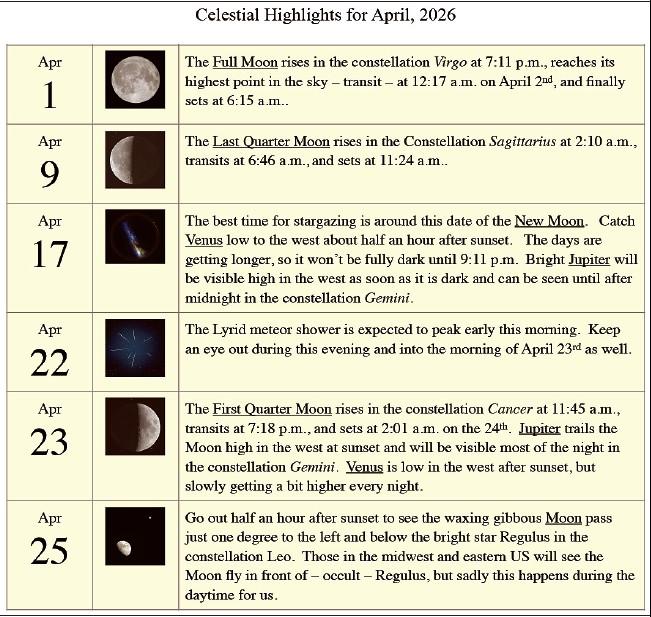
 4.jpg 300w, https://www.mariposagazette.com/wp-content/uploads/images/2026-04-02/39p1-400x379.jpg 400w, https://www.mariposagazette.com/wp-content/uploads/images/2026-04-02/39p1-106x100.jpg 106w" sizes="(max-width: 651px) 100vw, 651px" loading="lazy" />
Since you are reading this article, you are probably already aware of a special gift that we have here in Mariposa: the blessing of dark, starry skies.
Every month, around the new Moon, we have the opportunity to get out and soak in some ancient light from stars, nebulae and distant galaxies.
This month, from April 13-20, however, is something a bit special, as we celebrate International Dark Sky Week. Sponsored by DarkSky. org, IDSW features worldwide events to draw attention to the importance of dark skies, raise awareness to the current threats and provide an opportunity to reconnect with the immensity of the cosmos.
Besides getting out under the stars, there are a number of free virtual live stream sessions available on topics as such as the Giant Magellan Telescope now under construction in Chile (summit.giantmagellan.org/), astrophotography adventures and, for beer lovers, “dark brews for dark skies.”
Unfortunately there are no local in-person events here in Central California, but for those who may find themselves in other locations, there are a number of activities in Southern California, for example checkout idsw.darksky.org/activities for more information.

Manny Leinz
Why dark skies matter
Most of us probably don’t stop to think about the importance of dark skies to we humans, and other creatures of our planet, but there are very good reasons why we should care.
Our bodies operate on an internal 24 hour clock — the so-called circadian rhythm — that governs our natural sleep/wake cycle. Artificial light at night disrupts this cycle and has been shown in studies to be associated with insomnia, anxiety, depression and other adverse heath effects.
Of course, we can control the environment we sleep in, so it’s worthwhile taking steps to be sure that the space is as dark as possible.
Unlike we humans, animals have no control over their nighttime environment and artificial light can be detrimental to them in many ways. Creatures as diverse as migratory birds and sea turtles rely on the Moon and stars to navigate, and artificial light can cause them to become fatally disoriented and exhausted.
 5.jpg 300w, https://www.mariposagazette.com/wp-content/uploads/images/2026-04-02/39p3-768x576.jpg 768w, https://www.mariposagazette.com/wp-content/uploads/images/2026-04-02/39p3-400x300.jpg 400w, https://www.mariposagazette.com/wp-content/uploads/images/2026-04-02/39p3-133x100.jpg 133w" sizes="(max-width: 900px) 100vw, 900px" loading="lazy" />
An example of a fully shielded light fixture.
Many natural nighttime pollinators, such as moths and bats, can also be distracted by artificial lights, leading to reduced pollination and lower agricultural yields.
Excessive artificial light, known as light pollution, also is a tremendous waster of energy. It is estimated that in the United States, 30-35 percent of all outdoor lighting energy is wasted.
This is because of poorly designed light fixtures that cause light to shoot into the sky or into areas where it isn’t wanted or needed. In the U.S. alone, this amounts to an annual cost of $3-$3.3 billion and dumps 15-20 million tons of carbon dioxide into the air each year!
Of course, to those of us that love the night sky, this wasteful light causes skyglow that robs us of our view of the cosmos. Most of us can see the Milky Way from our homes in and around Mariposa, but 80 percent of people in the U.S. don’t have that privilege.

This map shows how much our local area is affected by light pollution.
Even here in the mountains, if you look to the south on any clear night, you can see easily the light dome from Fresno, 50 miles away. Beyond the affect on the general public, skyglow impacts scientific research, impairing the ability of ground-based telescopes to discover the nature of the universe.
Are we losing the night?
Unfortunately, the threat to our nighttime environment is increasing. Scientific studies indicate that night skies in North America are brightening by roughly 10 percent each year.
There are multiple reasons for the increase, including the spread of populations into previously dark areas — so called urban sprawl — and the increased use of cheap LED lighting.
These LED lights, which are often brighter and “bluer” than older incandescents, have another negative effect: the blue light scatters more effectively, causing more light to be thrown into the sky.

You can help protect the night by making responsible lighting choices.
Not all sources of light pollution are earthbound, however. The reflected light from satellite mega-constellations over the last few years is adding to the overall sky brightness with each launch.
There are, as of this writing, more than 10,000 Space X Starlink satellites in orbit with more being added almost weekly. Space X is attempting to reduce the reflected light from their satellites, but there is only so much that can be done.
Potentially far worse than Starlink is the proposed constellation by the start-up company Reflect Orbital. They propose a constellation of up to 50,000 satellites, with huge mirrors of up to 34,000 square feet each, to provide sunlight to the Earth at night.
Needless to say, such a system would devastate astronomical science and obliterate the night sky for a large number of people.
What can we do?
It may seem hopeless to protect our night skies from the threats just described, but it’s important to remember that unlike other types of pollution, light pollution is reversible. And all of us have at least some control of our immediate environment.
The five principles outlined by the international organization DarkSky can help. We can improve our ability to see the night sky from home by making sure that our lighting is:
1. Useful — Only use light where it is needed. Consider how light will impact the area, including wildlife.
2. Targeted — Make sure light falls only where it is needed. Use shielding and careful aiming so that the light beam points only downward and doesn’t spill over to your neighbor.
3. Low level — Use lights no brighter than necessary. Consider that some surfaces, such as concrete, reflect more light into the night sky.
4. Controlled — Light only when it is needed. Use timers or motion detectors so that light is available when needed, dimmed when possible and turned off when not needed.
5. Warm-colored — Use warmer-color lights where possible. Minimize the use of blue light, which scatters more into the sky and adversely affects your night vision.
You can also contribute to a light pollution monitoring project during International Dark Sky Week, and the only equipment you need is your eyes!
Globe at Night, sponsored by the National Science Foundation, is accepting “citizen-scientist” reports from all over the world on the number of stars they can see.
These reports are being used to make maps, which enable us to improve our understanding of how light pollution affects our lives and our environment, and you can help! Checkout globeatnight.org/ for more information.
What’s else is up this month?
This month is still a great time to see the King of Planets, Jupiter.
It still rides high in Gemini all month, but is slowly getting lower each day, and will disappear into the sunset by the end of June. Catch it as soon as it gets dark in the evening and use binoculars to see Jupiter’s four large Moons.
Venus is still low in the west after sunset, but you can’t miss it. Venus is so bright that it’s easily seen even before the sky gets completely dark. Watch it gradually climb higher throughout the month. Venus will be highest in the sky by mid-June.
If you are a fan of meteor showers — and who isn’t? — there is another opportunity this month with the Lyrid shower in the early morning of April 22, continuing into the evening and early morning of April 23.
You won’t see as many meteors during this shower as during the upcoming Perseid shower in August — 15 to 20 maximum per hour from a dark site — but it’s still worthwhile to get out a lawn chair, blanket and maybe a hot beverage to enjoy the show.
I hope you have a chance to get out and explore the wonders of the night sky during International Dark Sky Week. If you are as passionate about preserving the night sky as I am, consider joining darksky.org/; it truly makes a difference.
To get help finding planets, stars, and other celestial sights checkout skyandtelescope.org/interactive-sky-chart/ or theskylive.com/.
There are also some great free smartphone apps, including Stellarium, SkySafari and SkyView.
As always, if you have questions, comments or suggestions for future articles, you can get in touch with me by email at: celestialdeep55@gmail.com. You can find my prior Gazette articles on my website at celestialdeep.space/.
Manny Leinz is a long-time amateur astronomer and night sky photographer. He and his wife live part time in Bootjack where they also have an observatory.







Responses (0)