


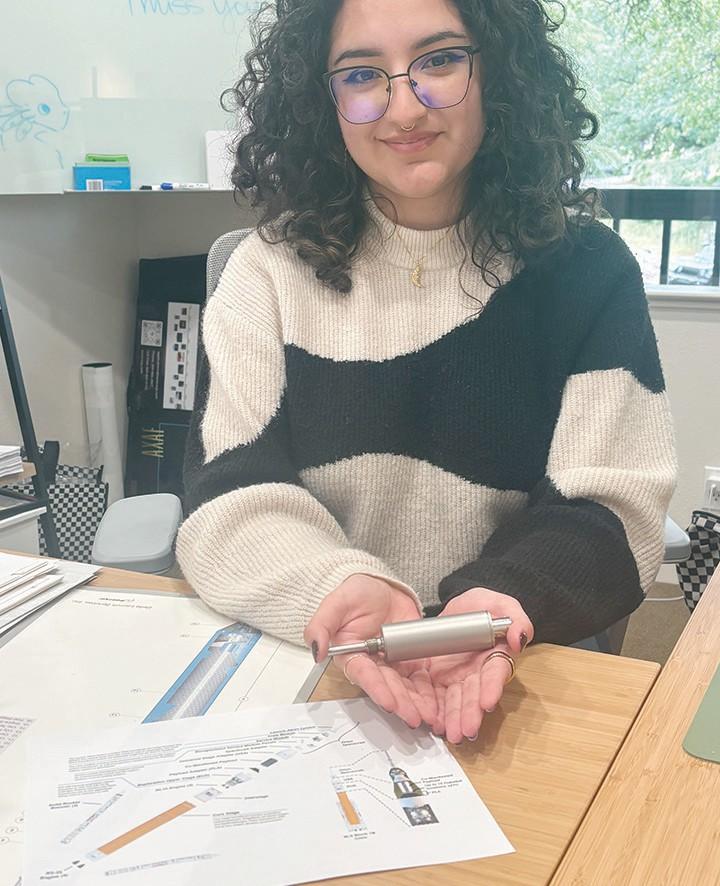

Maxine Chance, brand director at Tavis, holds a transducer at her office on Monday of this week. The diagram on the desk depicts where transducers from the company were on the Artemis II mission. Photo by Greg Little
It captured the world’s attention for 10 days.
And Mariposa played a key role.
“Very emotional,” said Maxine “Max” Chance, brand manager for Tavis Corporation.
Tavis make transducers, maybe not the flashiest components, but crucial for spaceflight — and human safety.
And there were more than 70 of those transducers aboard Artemis, the recent spaceflight that gained the attention of the world when four astronauts traveled past the Moon and farther into space than any people before.
“Excitement,” said Lori Scherf, an electrical assembly supervisor who has been at Tavis for 37 years. “It is so neat to build something here.”
“It is extremely rewarding,” said Nichol Green, an electronic assembler who has been at Tavis for four years.
“It’s been a long time coming,” said Rob Vossler, who works in drafting for the com- pany and has been following the space program since humans first went to the Moon more than 55 years ago.
The Artemis mission began with an unmanned flight to the Moon in 2022, basically to test the systems and lay the groundwork for what would be Artemis II just last week.
That mission featured astronauts Commander Reid Wiseman, Victor Glover and Christina Koch along with CSA (Canadian Space Agency) astronaut Jeremy Hansen who circled around the dark side of the Moon on their historic mission.
With nervous moments from liftoff to the return, the crew splashed downed right on target in the Pacific Ocean west of San Diego just after 5 p.m. last Friday.
It’s safe to say there was a huge sigh of relief from the people at Tavis.
“I was nervous,” said Scherf. “But excited. The mission was a full success.”
Like everyone else, Scherf said it is the “teamwork” at Tavis that makes everything work.
Green praised the company for allowing the employees to use time at work to watch the mission live.
She was quick to point out there were more than 70 transducers aboard the rocket ship.
“Were my hands on some of that?” she said during an interview on Monday of this week.
Though it’s never really quite known, in this case, it’s probably safe to say many Tavis hands were on the transducers of Artemis.
Varied applications
As Chance explained, in many cases, the transducers are on submarines or missiles, and they just don’t know how many there are or where they are located.
With Artemis, it is much different.
In fact, Chance had a detailed graphic of just where the transducers were located on the ship.
A transducer is a device that converts energy from one form to another, typically transforming a physical quantity (like pressure, temperature or motion) into a proportional electrical signal. In other words, it takes key measurements to make sure systems are operating properly and can detect when they are not.
Just some of the areas on the ship where the Tavis transducers are located include the Launch Abort System, Core Stage, Payload Adapter, Service Module, Crew Module, the Solid Rock Boosters and many more.
For Sherf, knowing their products help the humans is critical.
“Safety,” she said. “That’s the main thing. It gives us extra confidence. They always preach safety to us.”
She’s not complaining, for sure.
“We do quality here,” said Scherf.
One of the key moments of the flight came when it was heading toward the splashdown. The heat shield on the crew module had shown some flaws in the test flight and just how it would operate on this flight was in question.
“I was so nervous,” said Chance, not just about the heat shield but the entire mission. “My company has parts on this.”
For Green, she could hardly find the words when pondering the entire Artemis II mission. In fact, she couldn’t.
“Indescribable,” she said. “There is no particular word.”
And then she did. “I am very proud to work here. There is a lot of excitement. Everyone is pretty upbeat.”
Back to the future
Vossler, who will be retiring in a just a few years, said he feels like the entire mission harkens back to those Apollo missions so many decades ago.
Back then, there was the Vietnam War, the “hippie movement” and so much more.
“It was all the bad stuff in the newspapers,” he said.
And then Neil Armstrong set foot on the Moon — and the world was watching.
“It was all pushed aside,” he said, noting the world rallied around the American astronauts and just what they had accomplished.
More than 50 years later, it’s a similar situation.
He said Artemis accomplished some of the same things with the world watching even though there are major wars happening and the political turmoil is undeniable.
Vossler also said the role of Tavis has been fascinating when it comes to Artemis.
“Artemis is a big part of what we do,” he said.
Though it began before he started four years ago, it doesn’t lessen what has transpired and what will transpire.
“We have parts on every portion of that rocket,” he said.
He also pointed out Tavis has had parts on Mars, they have many on the International Space Station, in satellites and much more.
Vossler also said his nerves were enhanced, as well, but in a different way than the others.
In fact, during liftoff, he was more fascinated with the “mechanical aspects” of how everything works in harmony to do the heavy lifting to get the astronauts into space.
“It’s like a symphony,” he said.
Concerning reentry, Vossler said it wasn’t just the heat shield, but the parachutes also had to deploy and slow down the ship from a blazing 12,000 miles per hour to under 20 at splashdown.
“It was pretty amazing,” he said.
In fact, Vossler came into the office on his day off to listen to a guest speaker who came here to talk about how NASA operated back in the days of Apollo.
He pointed out that back then, they were literally flying by the seat of their pants. Now, he said, the processes have been more fine tuned and it appears with the success of Artemis, things are moving along smoothly.
“We have a space race going on right now,” he said, noting China is part of what will hopefully be a trip to Mars at some point in the future.
The goal of Artemis is to get humans on the Moon and then build a base there that will eventually lead astronauts to Mars.
Interestingly, Vossler said during the normal “day to day” operations at Tavis, he doesn’t think a lot about spaceflight.
But that changes, he said, when he is home in the evenings and looks up into the sky and sees the International Space Station or satellites where Tavis parts are functioning.
“We do this,” he said.
And he stressed even with all of the technology, it still takes humans to make it all work.
“It still takes people,” he said.
The community
Chance couldn’t agree more.
By far the youngest of those interviewed, Chance is quite knowledgeable about spaceflight and aerospace in general.
In fact, she said when she was just 13 years old and in school, during breaks she would pull out here tablet and was “identifying galaxies.”
That makes the success of Artemis II even more special for Chance.
“I’m excited,” she said. “I had a play in this.”
But it’s the human aspect, she said, that is crucial to the success of the mission — and humankind itself.
She watched as Koch spoke about being a female astronaut — and now the female who has traveled farther than any other from planet Earth.
That, she said, inspires her and many other women about what the future could hold.
“It was very emotional seeing a woman in space,” she said. “It is so relatable; so inspiring.”
She also felt the mission was a “bright aspect with darkness going on.”
Since becoming the brand manager for Tavis, Chance has been working hard at simply trying to inform the community about the company and the dynamic work it does around the world.
“It is extremely rewarding to bring Tavis out into the world,” she said.
One of the main points, she said, is to show the teamwork she sees everyday at the company.
“And we’re a lot of fun,” she quipped.
It’s also not lost on her just how important of a role Tavis played in the success of Artemis II.
Both Tavis and Artemis, she said, rely on technology and many things, but the most important is “humans. There were humans around the Moon.”
And to see the dog of Koch react to seeing its master after two weeks or the emotions of Wiseman, the mission commander, when his crew mates asked NASA for permission to name a crater of the Moon after his late wife, meant everything to Chance.
“They were humans being humans,” she said about those moments.
That kind of sums up the entire atmosphere for Artemis — and at Tavis.


Responses (0)