


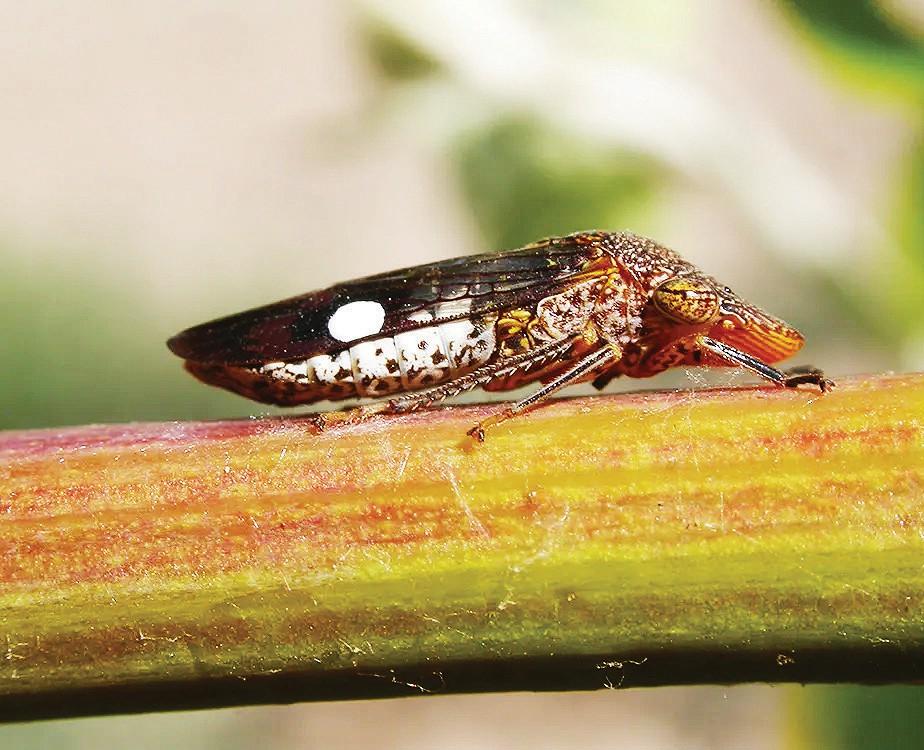

The glassy-winged sharpshooter can carry a bacteria that will kill grapevines. A set of egg casings and a nymph molt were recently discovered in two locations in Mariposa County.
It was here. In some form. Someplace.
And now, it looks like it’s gone.
Hopefully, for good.
The glassy-winged sharpshooter, or at least an early life-cycle stage of the pest, was found at two locations in Mariposa County, said Monica Nielsen, Mariposa County’s Agricultural Commissioner.
The pest was found on grapevines purchased at Costco between April 21 and May 21.
Nielsen believes the county is currently free and clear of the glassy-winged sharpshooter after the infected grapevines were confiscated and destroyed.
The glassy-winged sharpshooter spreads a bacteria that causes Pierce’s Disease, which attacks a grapevine by clogging its internal waterways, choking off its supply of nutrients.
The bacteria grows in the mouth of the sharpshooter and is transferred to other plants.
Infected grapevines develop chlorosis and scorched leaves and usually die within five years.
The glassy-winged sharpshooter, known scientifically as Homalodisca vitripennis, is considered a major threat to California’s $84 billion wine industry because it spreads faster and flies farther than native sharpshooters.
Last week, California Lawmakers asked the U.S. Department of Agriculture (USDA) to release $32 million in funding to help the state detect, control and combat the pest.
Evidence of its presence in Mariposa County was found at two locations that are not being publicly disclosed.
In one case an inspector found a set of egg casings on leaves.
The other case was a nymph molt, an early stage of the glassy-winged sharpshooter. Nielsen said they are still waiting for confirmation from a lab.
Nielsen said one of those locations is within two miles of a grape vineyard.
One person who purchased grapevines from Costco refused to allow a county inspector on to their property. The homeowner said they destroyed the plants, but wouldn’t explain how.
If there is an outbreak, that property would likely be considered ground zero, Nielsen explained, and there might be some kind of legal action through the California Department of Food & Agriculture.
Three other locations, with a total of seven grapevines, are free and clear of the pest and will be monitored with traps.
There are eight locations, with 18 grapevines, with an inspection still pending, but none of those are commercial growers.
Kris Casto, owner of Casto Oaks, one of nearly a dozen vineyards in Mariposa County, said the risk of Pierce’s Disease is well known in California.
“It is something we definitely don’t want around,” said Casto.
Vineyards like hers are assessed a fee, $1.25 per $1,000 value on all grapes produced, to fund the Pierce’s Disease and Glassy-winged Sharpshooter Control Program.
Casto said inspectors routinely collect traps placed in her vineyard and others looking for the pest.
The trapping season is from May 1 through Oct. 15 and about 80 traps are placed around Mariposa County that are serviced about 752 times a season, according to the 2024 Mariposa County Agricultural Report.
California produces 81 percent of the wine consumed in the United States and is the fourth largest wine producer in the world.
The Costco grapevines were sold from the warehouse store nurseries directly to consumers and did not involve commercial producers, which may lessen the impact.
The infested vines were shipped to Costco by Burchell Nursery in Fresno, and investigators have been working since May 19 to track the shipments and the individual vines that were sold.
Customers who purchased a grapevine from Costco have been told to seal the plant inside two trash bags and contact their local agricultural commissioner.
The glassy-winged sharpshooter was already permanently established in 14 California counties, but the Costco nursery stock infestation has spread the pest to homes in at least 24 counties.
The Pierce’s Disease bacterium, Xylella fastidiosa, has been in California for at least 140 years, since it was discovered in Anaheim in the 1880s.
Caleb Moseley, the executive director of Napa Valley Grapegrowers, told Wine Spectator there is a low incidence of the disease currently, and therefore less of it to be spread by the glassy-winged sharpshooter.








Responses (0)