


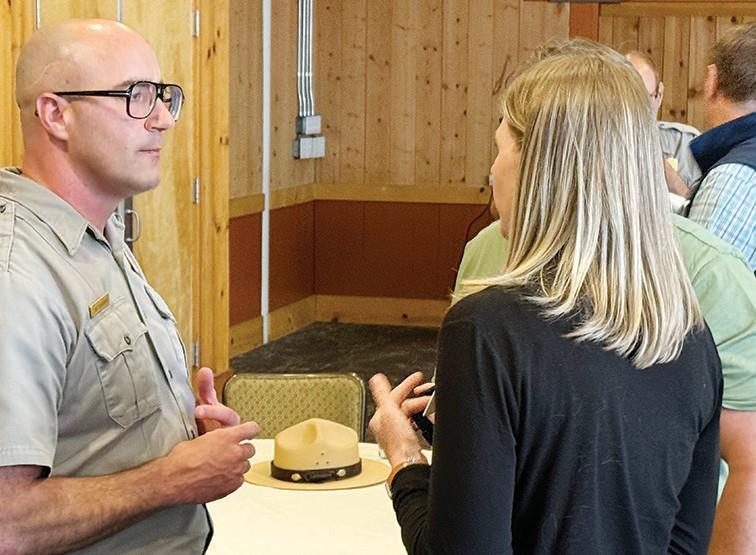

Yosemite National Park Superintendent Ray McPadden talks with tourism leaders Noel Morrison of the Yosemite Mariposa County Tourism Bureau, and Brian Deninger, president of Incredible Adventures, at the quarterly Yosemite Gateway Partners meeting on April 9. Photo by Tom Lyden
Yosemite National Park Superintendent Ray McPadden opened his talk with tourism leaders last week with an endearing anecdote about climbing the Mist Trail with his seven-year-old son, who was wet, cold and having a meltdown.
He gave his son a succession of escalating incentives, beginning with candy, then a bow and arrow and finally a Ferrari when his kid turns 16.
It was a cute story.
But with the National Park Service facing a proposed 25 percent budget cut from the Trump Administration, it was hard not to wonder if he was offering up a subconscious metaphor.
Like the Ferrari, was McPadden making promises he might not be able to keep?
“We have a dual mission, visitor enjoyment and resource protection,” McPadden said a few moments later.
“I don’t think these two elements of our mission are inherently in conflict. What I tell our staff is don’t fall into the trap of thinking you have to pick a side. We can do both really well,” he explained.
McPadden’s remarks came at the April 9 quarterly meeting of the Yosemite Gateway Partners.
Real time traffic info
Yosemite had 4.3 million visitors in 2025, a post-pandemic high, and McPadden believes the park will exceed that number this year.
McPadden said one-way traffic flow in the valley has been effective at alleviating gridlock and anticipates on busy days this summer directing traffic to other less populated locations like Glacier Point or Tioga Pass.
“Mother Nature’s on our side this year. We’re going to be able to open those corridors earlier than we normally do,” said McPadden, who predicted access two to three weeks ahead of schedule.
As visitors transition to admission passes purchased online, the transaction time at the gate will go from two to three minutes to 10 to 15 seconds, McPadden said.
But he also acknowledged that “infinite volume doesn’t necessarily equal a great experience.”
“We’re going to be paying close attention to conditions on the ground,” he said.
McPadden obliquely referenced new technology, including cameras and license plate readers, that give a “real time” picture of traffic in Yosemite Valley.
“We can see how long it takes somebody to go from point A to point B. So we’ve got a lot of good data that we can use to deploy people and smooth out problems,” he said.
But McPadden said visitors who have a low tolerance for crowds should consider a weekday visit.
No reservations
McPadden appears to have no reservations about abandoning the vehicle reservation system for this year, which he said was ineffective and costing the park revenue.
Last year, the reservation system was only in place for 60 days and the vast majority of time the park didn’t sell out of tickets except on Saturdays during the peak summer season, he said.
“We were creating obstacles for visitors. And for what?” he asked.
The vehicle reservation system was also costing the park millions of dollars in lost revenue, McPadden said, because early risers would dodge the reservation system by slipping through the entrance gate before staff went on duty at 6 a.m.
“On an average Saturday, we would have 800, maybe even a thousand cars coming into the park before our gates were staffed. And these are folks who are avoiding the reservation system,” he said.
The vehicle reservation system had been in place since 2020, with the exception of 2023.
“We were trying different things, and we are a learning organization. We saw there were very real downsides. I think that we have to be eyes wide open about it,” McPadden said.
Heavily reliant on fees
McPadden said Yosemite National Park is “heavily reliant of fees” for infrastructure improvement, campground and bathroom maintenance.
Yosemite National Park keeps 80 percent of the admission fees collected at its gates. Former park officials have said that amount is usually more than $25 million a year.
Given the importance of those admission fees, McPadden was asked about reports that the entrance gates, particularly the Arch Rock Entrance, have been frequently closed in recent weeks without a park ranger on duty.
McPadden said that is “not our goal” and blamed a seasonal transition.
He said the park has never had enough permanent staff in the off season to have “super robust operations” collecting fees. Seasonal staff are currently onboarding.
The Mariposa Gazette asked McPadden about any anticipated loss of revenue when people buy online admission passes through Recreation.gov
McPadden acknowledged that online passes are “not tethered to Yosemite.”
According to the latest Trump Administration budget plan for 2027, the money collected from the America the Beautiful pass will be disbursed by the Secretaries of the Interior and Agriculture.
But McPadden said the plan is for the fees to be proportionally channeled back to the parks based on historic sales.
“There’s no net loss there,” McPadden said.
The Department of Interior wants to make sure the park doesn’t see “revenue siphoned off ” in the transition to online passes, he said.
“If anything, I think we’ll probably see an increase focus on our fees. I think the culture right now is seeing parks be a little more self-reliant with their fee money,” McPadden said.
As for the 25 percent proposed budget cut to the National Park Service, McPadden said it is the first step in a long budget process.
“I’m certainly not stressed about that,” he said.
Odds and ends
The Yosemite Gateway Partners is generally a friendly platform for McPadden, and most support his decision to cancel the vehicle reservation system this summer.
Hospitality leaders also seem to appreciate his open, and somewhat candid, communication style.
McPadden confirmed plans are under consideration to turn the Upper and Lower River Campgrounds on the north side of the Merced into overflow parking. The campgrounds were inundated by the 1997 f lood.
McPadden said those sites are potential “safety valve parking this summer” when construction projects could put parking at a premium.
He said the sites would be covered with gravel or wood chips and not asphalt.
McPadden said there has also been discussion about moving the Arch Rock Entrance further into the park, to help mitigate long lines, but he said that is a far off consideration.
One tourism leader asked about a seven day window for using an admission pass purchased online. Foreign visitors usually want to purchase an admission pass much farther in advance.
McPadden said the team landed at seven days to try to minimize refunds, which the park “has to eat.”
“The thinking was the narrower we get in the advance window, the fewer folks will be trying to return the passes,” he said.
Several people in the audience interrupted at once and suggested the passes should simply be non-refundable.
McPadden seemed to like their thinking. Jokingly he added, “And let’s throw in a fee for my son’s Ferrari.”



Responses (0)