


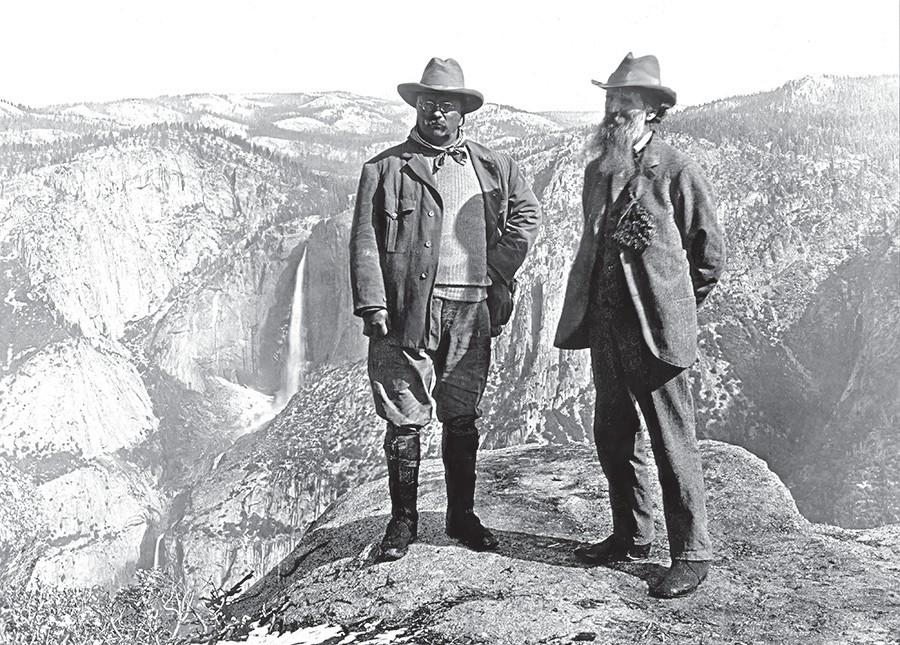

President Theodore Roosevelt and conservationist John Muir are show in Yosemite in 1903. Photo courtesy Library of Congress
As the United States approaches its 250th anniversary in 2026, communities across the country are reflecting on the people and places that helped shape the nation’s story.
Beyond our county lines the ideas that were shaped here define how Americans understand the West, public lands and travel itself.
While Mariposa County’s written history begins in the early 1800s, our region quickly became part of events that reshaped the young nation. During the California Gold Rush of the 1850s, gold from the Sierra foothills helped expand the country’s monetary supply at a critical moment in American history, supporting westward growth and strengthening the national economy.
Mariposa, the “Mother of Counties,” comprised up to one-fifth of the new state of California. Communities like Mariposa, Coulterville and Hornitos grew rapidly as people arrived from around the world seeking opportunity and a new beginning.
From these early settlements emerged a tradition of hospitality that would help welcome generations of travelers to Yosemite and the Sierra.

Noel Morrison
Just over a decade later, another milestone here would influence the nation in a different way. In 1864, President Abraham Lincoln signed the Yosemite Grant, setting aside Yosemite Valley and the Mariposa Grove of Giant Sequoias, for preservation and public enjoyment.
The Yosemite Grant marked the first time in the United States that land was set aside by the federal government and helped inspire what would become the national park system. These iconic places in Mariposa County shaped how Americans think about protecting extraordinary landscapes for future generations.
While Lincoln never stepped foot in Mariposa County, several other presidents have. Including Theodore Roosevelt, who along his famous journey to Yosemite stayed at the Hotel Jeffrey and at the Wawona Hotel before his fateful meeting with conservationist John Muir, who then swept him away to sleep beneath the giant sequoias.

Stoneman House, Yosemite Valley, 1888. Photo courtesy of Tom Phillips
The experience left a lasting impression on Roosevelt and helped shape the conservation policies that followed, including the 1906 transfer of Yosemite Valley and the Mariposa Grove from state control into what we recognize today as Yosemite National Park.
In addition to Roosevelt, the historic hotels on main street Mariposa have hosted Presidents Grant and Garfield as guests.
Long before tourism became common across the American West, people were dreaming of visiting Yosemite, inspired by the art of Thomas Hill, Carleton Watkins and many others. Early entrepreneurs such as James Hutchings and the Washburn family, whose relatives still reside in our community today, helped transform those aspirations into reality, building hotels, stage routes and visitor services that welcomed travelers to the region.
Lodging such as the Wawona Hotel and the Hotel Jeffrey became part of a growing hospitality network that welcomed visitors to the region, each serving guests for more than a century.

Lower Ben Hur Ranch. Photo by Charles Phillips
Communities from Coulterville and Mariposa to Wawona/Fish Camp and Yosemite Valley helped shape one of the earliest tourism economies in the American West. In many ways, these efforts established the gateway community model that still supports national parks across the country today.
Over time, improvements in access continued to shape how people experienced our county.
The Yosemite Valley Railroad connected visitors from Merced to El Portal in the early 1900s, and this July we recognize the 100 year milestone of the completion of Highway 140, a road that helped make Yosemite more accessible to families traveling by automobile.
Together, these connections helped transform travel to scenic public lands from something only a few could experience into something many Americans could share. National parks remain a powerful symbol of democracy even today, and the idea has its roots here.
Outside of Yosemite, the idea that land should be valued beyond its commercial worth remains evident through the Williamson Act, which conserves significant areas of Mariposa County as open space and agricultural land. More than half of Mariposa County is managed for public benefit, conservation and recreation.
Local organizations such as the Sierra Foothill Conservancy also work with landowners to protect working ranches, wildlife habitat, cultural resources and open space through voluntary conservation easements. Alongside these protected landscapes, generations of ranching families have helped shape the county’s character, maintaining working lands that contribute to the scenic vistas, rural traditions and sense of place that define Mariposa County today.
This longstanding commitment to stewardship and heritage is woven into the fabric of our community and continues to shape the county’s identity. Join a Sierra Foothill Conservancy program if you’d like to explore these places.
Mariposa County also played an important role in shaping modern outdoor recreation. The granite walls of the Sierras inspired intrepid trailblazers to push the limits of what was possible in big-wall climbing, with techniques and tools developed here influencing climbers around the world.
Today, that legacy continues through the Yosemite Climbing Association Museum. The most extensive public collection of climbing artifacts anywhere in the United States is in Mariposa, preserving and sharing this important chapter of American recreation history.
History in our county did not begin with settlers; Indigenous communities inhabited this landscape for millennia and are vital cultural leaders in our community today. The 250th can also be a moment to pause and reflect on what has been lost and elevate these stories so that they can be preserved and celebrated.
The Mariposa Museum & History Center offers a compelling exhibit dedicated to the Southern Sierra Miwuk, alongside the history of the Gold Rush-era to modern day.
As we approach the nation’s 250th anniversary, we celebrate how our community has helped shape not only the history of California, but also the broader story of tourism in America.
For more than 150 years, visitors have traveled here to experience Yosemite, Gold Country and the Sierra, helping foster an appreciation for western landscapes, outdoor recreation and the idea that extraordinary places should be protected and shared for generations to come. An idea worth considering as we move into the next century of our nation’s history.
Special thanks to Sierra Foothill Conservancy, historian Tom Phillips and Mariposa History Museum and History Center for their assistance with this month’s column.
Noel Morrison is the Tourism Development Director for the Yosemite Mariposa County Tourism Bureau (YMCTB), building partnerships with tour operators, travel companies, and meeting professionals to position Yosemite Mariposa County as a premier year-round destination for leisure and group travel. Yosemite Mariposa County Tourism Bureau is the official destination marketing organization (DMO) for the County of Mariposa. Learn more about YMCTB at Yosemite.com.



Responses (0)