


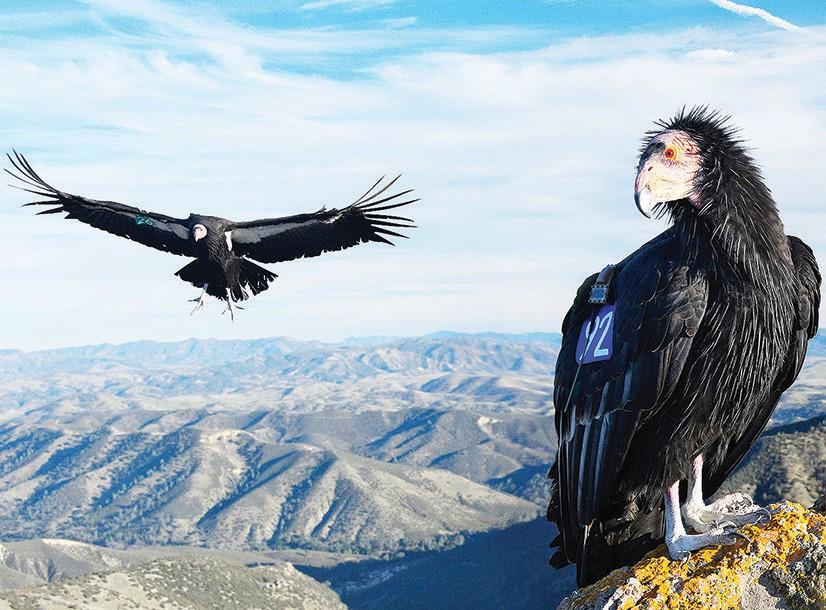

The condors are large birds, with wingspans of nearly 10 feet.
It’s a story John McCamman never thought he’d know anything about, yet he has turned into an expert.
The story began nearly 70 years ago and continues to this day. McCamman, of Mariposa, entered the picture in 2013 and made a big difference.
The story is about condors.
They are huge birds and were nearly extinct.
In the beginning
McCamman said the story of the condors came to light in the 1950s when there were reports they “had been disappearing everywhere. It had actually been disappearing 100 years before that.”
In fact, a near miracle happened in the 1963 when a bird was hatched. That bird, named Topa Topa, was immediately taken to the Los Angeles Zoo. (Unbelievable, Topa Topa is alive to this day at the zoo.)
McCamman said officials at that time “realized, based on him, they could keep him alive. There is a way of saving these creatures if you protect them.”
And so began a major undertaking.

John McCamman speaks at the Mariposa County Library recently, giving a program about the condor recovery program. Photo by Mike Healy
In the late 1970s, famed environmentalist David Brower was head of the Sierra Club “and the birds were still disappearing,” said McCamman.
Brower led an effort to take the birds from the wild and raise them in zoos because it had been determined they would live in that setting.
Incredibly, McCamman said many in the environmental community scoffed at that concept. There were lawsuits and many other maneuvers. Their point was “let them die with dignity,” he said.
But in 1982, the California Fish and Game Commission decided they were going to “take them in,” he said.
There were 22 birds left in the wild — and Topa Topa in Los Angeles.
McCamman said the birds were taken from the wild and placed in zoos in San Diego and Los Angeles. By April 7, 1987, all of the birds had been captured.
Extirpated is the term used when a species is taken from the wild.
One interesting issue that arose, McCamman said, was the fact once the birds were in zoos, bird watchers could not claim them in their findings. The same is true if you capture and breed them, he said, “which is what we started to do in various places.”

This drawing by Lewis and Clark shows how the western explorers even documented the birds.
Back to nature
By 1995, he said officials began putting the birds back out into the wild.
“Sure enough,” he said, “they got on electric poles and touched wires. It killed about five of them in the first two years.”
Other birds, he said, would wrongly roost on the ground instead of in trees and became prey for mountain lions, bobcats and more.
At one point, he said condors from the Andes were put out with their U.S. cousins to teach them the ways of the wild.
“Who ever knew one species could train another,” he said. “They realized this worked and we could actually put more birds out in the wild and they would survive.”
Once that began happening, McCamman said “the more senior” condors began training the younger birds and they, too, learned how to survive.
The condors are majestic birds, with wingspans of 9-1/2 feet, they stand two feet tall and can weigh up to 25 pounds.
“They can live out there for a long time,” said McCamman, who added they mate for life.
Can is one word, but did they?
McCamman said officials discovered even with all of the training and other steps that were being taken, “about half would die” anyway.
One angle they explored was how the birds were being bred in captivity. McCamman said there were “lots of places breeding them and lots of eggs.”
By 2010, San Diego Zoo officials began studying the genetics of the birds. They found there were actually only 14 families.
“You don’t want cousins marrying cousins,” said McCamman.
In fact, there was a “stud book” keeping track of the eggs and birds, McCamman said. According to that book, there was not a lot of inbreeding happening.
But, he said, it was discovered “they were cross breeding. The stud book was wrong. If you want a genetically balanced population, you have to connect to the right birds.”
A first
By 2013, McCamman said that two birds that had been born in the wild produced a chick “for the first time ever.”
It was that same year that McCamman became the condor coordinator for the U.S. Fish and Wildlife Service.
He noted that under the Endangered Species Act, it is the U.S. government that takes control of all of the endangered birds.
McCamman admits he is a “political guy,” and said that is what the scientists and others wanted in the hope of getting some things done via legislation.
“I was a political guy. Biologists were running the program and nobody knew about it,” he said. “So they wanted a political guy to come in and see how to move things forward.”
At the time, McCamman said they shipped some eggs to a zoo in Mexico “and to this day” they continue to grow the eggs and the birds live in the wild.
The same is true in far northern California, where there is a release site.
But even with all of that, he said a major problem persisted.
They continued dying at a high rate.
Their death rate continued at about 50 percent and officials were struggling to figure out why it was so high.
Some of the causes were power lines, being shot, wildfires, starvation and more, he said.
However, they also discovered something confounding: Fifty percent of those dying were from lead poisoning.
“Where was it coming from?” McCamman said was the big question.
Studies were done and it turned out the lead was from bullets fired by hunters. He said it was determined that even when hunters shoot game, a lot of the time the animal gets away only to die later.
Condors are scavengers and were eating those carcasses.
“Birds were eating the game and being poisoned by lead,” he said.
In 2014, McCamman was one of the leaders in swaying the California Legislature to ban the use of lead ammunition for shooting of wildlife.
They received a lot of resistance, he said, but the law was passed.
Lead bullets are only supposed to be used for target practice, he said, and some narrow other uses. However, McCamman said there remains “some lead in the system” and he figures it has been reduced by about half, though there are no exact studies.
But even with that, the success of the condor recovery program has been remarkable.
There are now 607 total birds in the world, with just under 400 of those in the wild. Condors can live up to 60 years or more, as evidenced by Topa Topa in Los Angeles.
The birds are in California, Arizona, Oregon and Mexico, though they are spotted in other places.
That happened a few years ago locally, in fact, when four of them were spotted in the Merced River canyon in 2023.
Two others were seen in the Oakhurst area in 2018.
A storied history
McCamman said the birds used to be in many other places, including some 50,000 years ago on the East coast.
Also, he said the birds were recorded by Lewis & Clark in the Columbia River basin. They documented the birds, calling them the “Wild buzzard of the Columbia.”
McCamman was once the director the California
Fish and Game Department but then became the director of the condor program after he left the state position.
He said the condor program remains in place to this day and is funded with around $5 million per year. Every six months, he said, the birds are tested. All of the birds are tagged and can be tracked.
The birds remain on the Endangered Species List, he said, though the goal is to reduce the classification to threatened.
Whether that will happen or not remains unknown. McCamman said one of the biggest issues is the fact condors are scavengers and only eat dead animals.
“There is not enough to sustain the population,” he said.
Way back when, they would feast on woolly mammoths and other large animals. But those days are over and the amount of wild animals has been reduced over the years.
McCamman said he continues to follow the program — for good reason.
“I did a lot of different kinds of jobs and interesting stuff,” he said. “This is the most satisfying.”
It was 2012 when he encountered his first condor and said they are magnificent birds with bright colors and quite the historical significance in the country.
Now, he said, there are birds in Big Sur, Ventura County and Baja, California, among other places.
And even though McCamman is no longer involved with the program, he continues to keep a close eye on the birds — including trying to see them when he travels to certain areas.





Responses (0)