


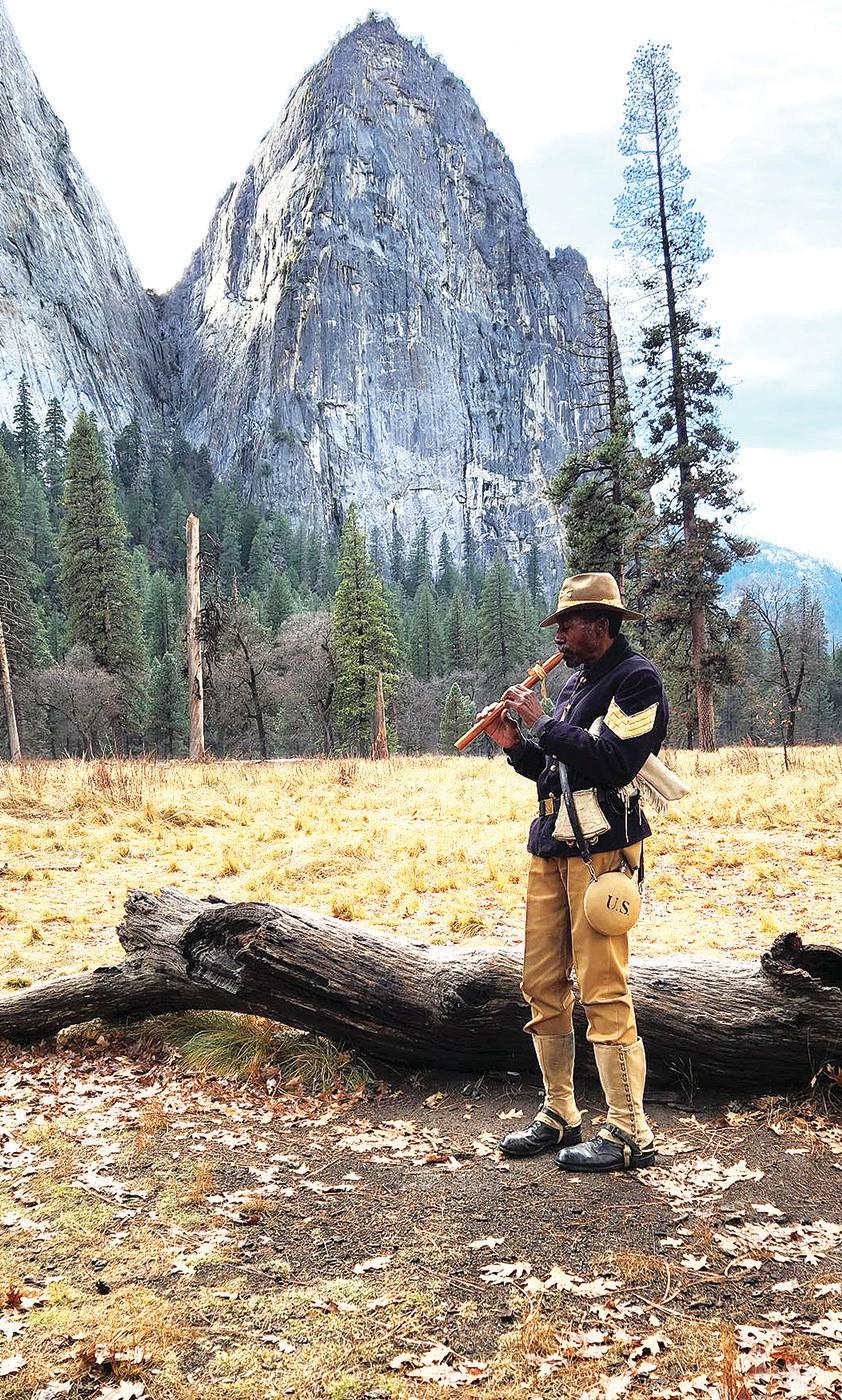

Shelton Johnson, in full Buffalo Soldier regalia, is shown playing a wooden flute in front of Sentinel Rock in Yosemite National Park. Photo by Scott Gediman/National Park Service
Editor’s note: This is the first in a two-part series chronicling the long and storied career of National Park Service Ranger Shelton Johnson, who recently retired from his duties at Yosemite National Park. The second part will appear in next week’s newspaper.

Rangers Scott Gediman and Shelton Johnson are shown at Yosemite National Park. The two of them have worked together for decades and have many tales to tell about their adventures over the years. Submitted photo
Shelton Johnson will tell you he doesn’t belong in the same category with some of the prominent and successful people with whom he’s rubbed elbows.
But most people who know him will tell you just the opposite. That he’s a living legend and belongs right there with the likes of Ken Burns, Oprah Winfrey, Barack Obama and many more.
“I’m going to take time to just be me,” said Johnson, 68, during a lengthy interview last week at his rural Mariposa County home where a light breeze was blowing as he sat in a favorite chair in the backyard.
Johnson is, or now was, without a doubt one of the most well-known rangers in the National Park Service. His expertise has taken him to the White House and all around the world.
“Notable,” said Johnson humbly, “not famous.”
In the beginning
Johnson’s story is incredible in nearly every sense of the word. Raised in a rough and tumble neighborhood in Detroit, he used his knowledge and some good advice to make a career out of being a park ranger.
“I was a military brat,” said Johnson.
At the age of five, his family moved to Germany — an event that would shape the rest of his life.
“I had not even been exposed to the outdoors,” said Johnson.
Attending kindergarten in Germany, Johnson was quickly exposed to the outdoors in the form of the Black Forest and into the Berchtesgaden area in the Bavarian Alps, where his family took a vacation.
It was during that trip at a tender age that Johnson, though he may have not realized it at the time, fell in love with the outdoors and the mountains.
“It is a connection young people have with nature,” said Johnson. “It is nonverbal.”
Another major impact on his life at the time was what he — like many people born in the mid 1950s — calls his first real childhood memory.
And it is grim.
That memory is of the assassination of President John F. Kennedy.
“Mom and dad were sad,” he recalls.
But beyond that, he vividly recalls “the German people were sad. I felt the sadness of the German people.”
That showed Johnson the impact JFK had around the world.
By the next year, his father, who was in the Army, moved the family to England.
He remembers a rugby field in the neighborhood where they lived. Incredibly, decades later at Yosemite National Park he met some people who lived in that area. He described the place, including the rugby field.
They told him they walk that area all of the time and “the rugby field is still there.”
Full circle.
Educational choices
The family continued to move to many places, including South Carolina, California and Kansas City before they made their way back to Detroit.
“It was right after the big riots in 1967-68,” he said.
Johnson enrolled in Cass Technical High School in Detroit, the only magnet school at the time in the city. Some of the famous graduates include Lilly Tomlin and Alice Coltrane, to name a few.
There’s little question Detroit is known for its musical influence and Johnson was going to find out about that, as well. His first job was as a janitor at the M Studio Music Shop, known for its high-profile clients.
It was owned at the time by Earl Klugh, a Grammy Award-winning guitarist and composer.
It seems Johnson was keeping the right company.
He then attended Wayne State University in Detroit, mainly because he wanted to join the fencing team. He fenced with Olympic athletes but decided to move on and transferred to the University of Michigan in Ann Arbor.
He put down his sword and graduated with an English degree with a focus on poetry on 1981.
“I majored in unemployment,” he jokes.
He then joined the Peace Corps for a couple of years.
A chance taken
Then there came a point where he was living with two roommates.
They were majoring in subjects like math and engineering and gave Johnson the business for focusing on poetry. He took it all in stride.
But then one of his roommates had a blank employment application for a company called TW Services. It was the concessions company for Yellowstone National Park.
Taking a good ribbing from his roommates for his choice of major and bleak outlook for the future, Johnson filled it out and sent it off in the mail.
A few weeks later, a letter came back saying he could have a job in Yellowstone.
As a dishwasher. But at least it was to wash dishes at the Old Faithful Inn, one of the most famous national park hotels in the country.
At the time, he was considering getting his masters degree in poetry, but he couldn’t stop thinking about how he fell in love with the outdoors as a child in Germany.
It was 1984 and he jumped on a bus to Yellowstone National Park. He didn’t even have a drivers license as the time.
“If I had only grown up in Detroit, I might not have gravitated to that job,” he said.
But he did gravitate to it thanks to those mountains in Germany.
He got off the bus in Gardiner, Mont., a young, African-American man in the wilds of the West.
“It was visual grandeur,” he recalls.
But he had a larger notion.
“I have always been a proponent of getting young kids, especially kids of color, into national parks,” he said.
As he began his time in Yellowstone, Johnson said he was “like a sponge sucking up everything.”
He began his dishwasher job at Old Faithful and lasted “much longer than I thought I would,” he joked.
He spent the tourist seasons of 1984 and 1985 doing the concession work in Yellowstone.
Then, another opportunity arose and he traveled, to all places, Hawaii, to work at hotels in the Aloha State.
“It doesn’t take long to fall in love with Hawaii,” he said.
He had three female roommates in Hawaii who also worked at hotels. Johnson still vividly recalls the open-air feel of the front desk of one of the hotels where doors were not even needed. Just something above to keep out the rain.
It was during this time that Johnson realized he didn’t want to go back and get his masters in poetry. He felt his natural abilities would guide him on the right path.
It was back to Yellowstone.
A permanent hire
Back in Montana, he decided to apply for a position as a park ranger.
He felt he had a few things going for him, including having a bachelor’s degree, time in the Peace Corps and one year of his master’s program. Oh, and don’t forget the experience of working in the park as a dishwasher.
He talked to a man named George Robinson in Kemmerer, Wyo., about the job.
“I had a phone interview,” he said. “He didn’t know I was Black.”
Whether that would have mattered or not may never be known, but what did matter was he landed the job as a full-time park ranger.
When he came to work, his manager felt Johnson “did not have the best background” to be a park ranger.
Too late.
Johnson worked an entrance station at the park — another event in his life that would change it forever.
It just so happened that in 1989, he was working that entrance station when the park superintendent rolled up to the gate. The superintendent and one of his top aides were intrigued by Johnson and his background.
“If I had been sick that day …,” says Johnson now.
At the end of the conversation, the superintendent said they “had to get that young man out of that box.”
Not too much later, he was hired on to work in the public affairs office at Yellowstone, dealing mainly with the media but working alongside that superintendent who saw a future for that young man in the box.
He spent five years working in that position and then became part of a National Park Service intake program where they sought promising employees to move up the ranks.
Johnson ended up getting a new job but it was in the rat race of Washington, D.C.
He felt he belonged out in the field.
“Most African-Americans are in rural or urban locations, but not in wilderness locations,” he said. “To this day.”
In the Washington area, Johnson worked at Oxon Hill Farm where he gave tractor rides to students and taught them “all about farming in the 19th century.”
But it just didn’t seem right.
“I didn’t want to stay there,” he said. “They had plans for me.”
Johnson, though, had other ideas. It was mainly because he didn’t want to be in an urban setting.
“It was like taking me back to Detroit,” he said.
Not that Detroit was bad, but Johnson had found his calling among the mountains and the wild.
“I had already proved myself,” he said.
He recalls one of the managers “yelling at me for wanting to leave.”
Then he politely asked the manager if he could tell his side.
“Yellowstone changed me,” he said.
Johnson left the program.
Then a woman named Becky Mills heard about it and knew the National Park Service would be losing a key person.
“She saved me,” he said.
Mills pulled some strings and targeted Great Basin National Park, the newest national park at the time. It’s located in far eastern Nevada near the Utah border.
At the time, there were no permanent rangers at the park.
He became the first.
“My career was saved,” said Johnson.
At first, he thought those working there might be resentful because they were not permanent employees, but Johnson took the approach of becoming part of the team.
“I was just being me,” he said, and he was accepted with open arms.
Yosemite calling
About a year and a half later, Johnson, against his better judgment, had to travel back to Washington for a conference.
“I met a guy,” he recalls, saying it was sitting in a lounge area.
That “guy,” said Johnson, was the “first and only deputy superintendent” of Yosemite.
“He wanted more diversity at Yosemite,” said Johnson.
That was all it took and Johnson was dispatched on a detail to Yosemite. He was placed in NPS housing just off the main drag in Mariposa.
“The detail ended, but they wanted me to stay,” he said.
He spent another month in Great Basin working to celebrate Pioneer Day in Utah and in 1993, he was permanently assigned to Yosemite. It wouldn’t be until 40 years later that he would retire.
And what he has done in that time is incredible.
Next week: The incredible journey of Johnson’s career in Yosemite — and beyond.

Responses (0)