


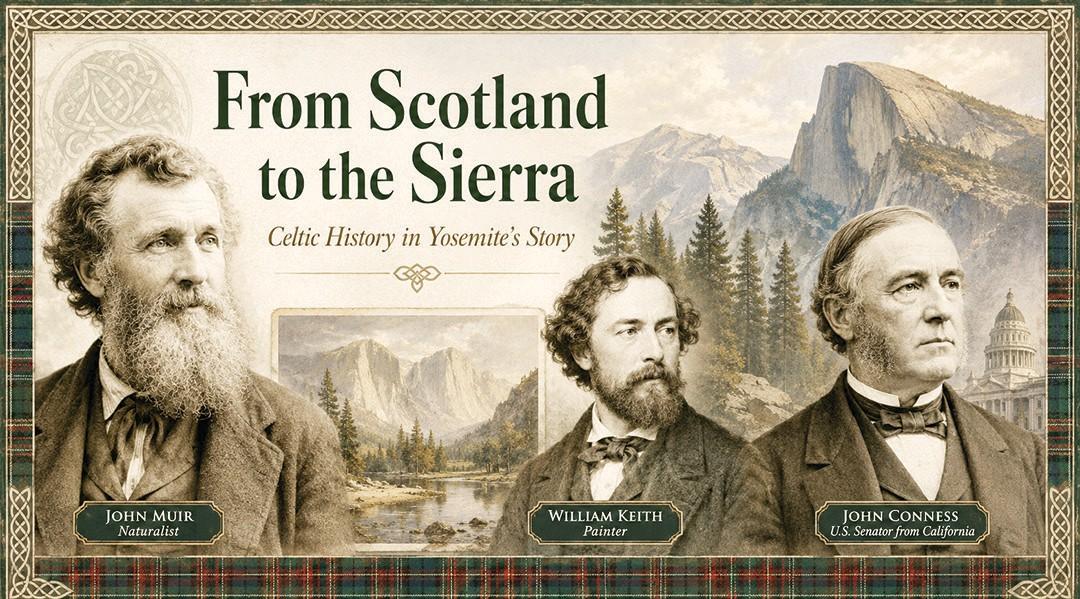

From Scotland to the Sierra, Yosemite Celtic Festival & Highland Games returns to the Oakhurst Community Center on Saturday and Sunday, Oct.17 and 18.
Long before the first bagpipe sounded across the grounds in Oakhurst, Celtic history was woven into the story of Yosemite and the Sierra foothills.
It is easy to think of the Yosemite Celtic Festival & Highland Games as bringing something new to the region. In truth the culture, people and influence of the Celtic nations have been part of this landscape’s story for generations — through conservation, art, public service and the immigrant communities who helped shape life in the Sierra during and after the Gold Rush.
The clearest and most beloved example is John Muir.
Known today as the “Father of the National Parks,” Muir was born in 1838 in Dunbar, Scotland. His family immigrated to the United States when he was still a boy but it was California — and especially Yosemite — that would define his life’s work.
When Muir first arrived in Yosemite Valley in 1868 he encountered a place that would become central not only to his personal story but to the nation’s understanding of wilderness itself.

John Muir
He spent years exploring the Sierra Nevada on foot, studying its cliffs, meadows, forests and glaciers. His observations helped advance the idea that Yosemite Valley was shaped by glacial forces, while his essays and books introduced readers across America to the grandeur and spiritual power of the High Sierra.
Muir did not write about Yosemite as if it were simply scenery. He wrote with reverence, urgency and devotion. He believed wild places were not luxuries, but necessities — places that shaped the human spirit and deserved protection.
His influence helped build momentum for the creation of Yosemite National Park in 1890.
In 1892, he founded the Sierra Club and served as its first president until his death in 1914. In 1903, he famously camped in Yosemite with President Theodore Roosevelt, a trip that helped strengthen the national conservation movement and influenced the future of public lands.

Painting of Yosemite by William Keith.
He wasn’t the only one
And Muir was not the only Scottish-born figure to leave a mark on Yosemite. Another was William Keith, born the same year as Muir in Aberdeenshire, Scotland.
Keith became one of California’s best-known landscape painters and developed a close friendship with Muir. While Muir introduced people to the Sierra through language, Keith helped them see it through art. If Muir gave Yosemite its voice, Keith helped give it an image.
His paintings of Yosemite and the California mountains captured more than topography. They conveyed mood, light and atmosphere — the sense that these places were not only beautiful but deeply meaningful. In an era before color photography and digital media, paintings like Keith’s helped shape the public imagination of Yosemite as a place of majesty and wonder.
Yosemite’s Celtic story also includes an important political figure: John Conness, an Irish-born United States senator from California.
Born in County Galway, Ireland, Conness immigrated to the United States and eventually became one of California’s most influential early political leaders.
He played a key role in the 1864 Yosemite Grant, the landmark legislation that transferred Yosemite Valley and the Mariposa Grove to the state of California for protection and public use.
That action came decades before the modern national park system took shape and marked one of the earliest major preservation efforts in American history.
Today, Mount Conness and Conness Creek in the Sierra still bear his name, a quiet reminder that Yosemite’s preservation story also carries an Irish connection.
Together Muir, Keith and Conness represent three very different but deeply meaningful Celtic ties to Yosemite. One helped Americans understand it. One helped them see it. One helped ensure it would be protected.
A broader history
Their stories also exist within a broader regional history.
During the Gold Rush and the decades that followed immigrants from Ireland, Scotland, Wales, Cornwall and other parts of Europe came to California in large numbers. They worked in mines, opened businesses, built roads, raised families and helped establish communities throughout the Sierra foothills.
Madera County, Mariposa County and the surrounding region all carry traces of that history in family names, archival records, cemeteries and local lore. Some families locally can trace their roots directly to those Celtic communities.
Others may feel connected through music, food, storytelling, dance, athletics or a lifelong love of Scottish or Irish tradition. And many simply enjoy the atmosphere, pageantry and fun of a cultural celebration that brings people together.
For Yosemite Celtic Festival producer Kimberly Vaughan, that broad sense of connection is part of what makes the event so meaningful.
“It is easy to think we are bringing Celtic culture to the Sierra foothills for the first time,” Vaughan said. “The truth is that Celtic history is already part of this region’s story. The festival gives us an opportunity to celebrate that connection while welcoming everyone to experience the music, traditions and joy of the culture.”
That spirit of welcome is central to the Yosemite Celtic Festival & Highland Games.
Some guests arrive eager to discover a clan connection or trace a surname. Others come for the live music, the Highland Games, the pipes and drums, the food, the costumes, the history or simply the joy of spending a weekend in a lively and welcoming community celebration.
All of them belong.
This year’s Yosemite Celtic Festival & Highland Games returns to the Oakhurst Community Center on Saturday and Sunday, Oct. 17 and 18, inviting the public to celebrate a heritage that has deeper roots in the Sierra than many people realize.
In a place shaped by granite, mountain light, immigration, imagination and the determination to preserve what matters, the connection between Celtic history and Yosemite feels less like a novelty and more like a homecoming.
Tickets and event information are available at www.YosemiteCelticFestival.com


Responses (0)