


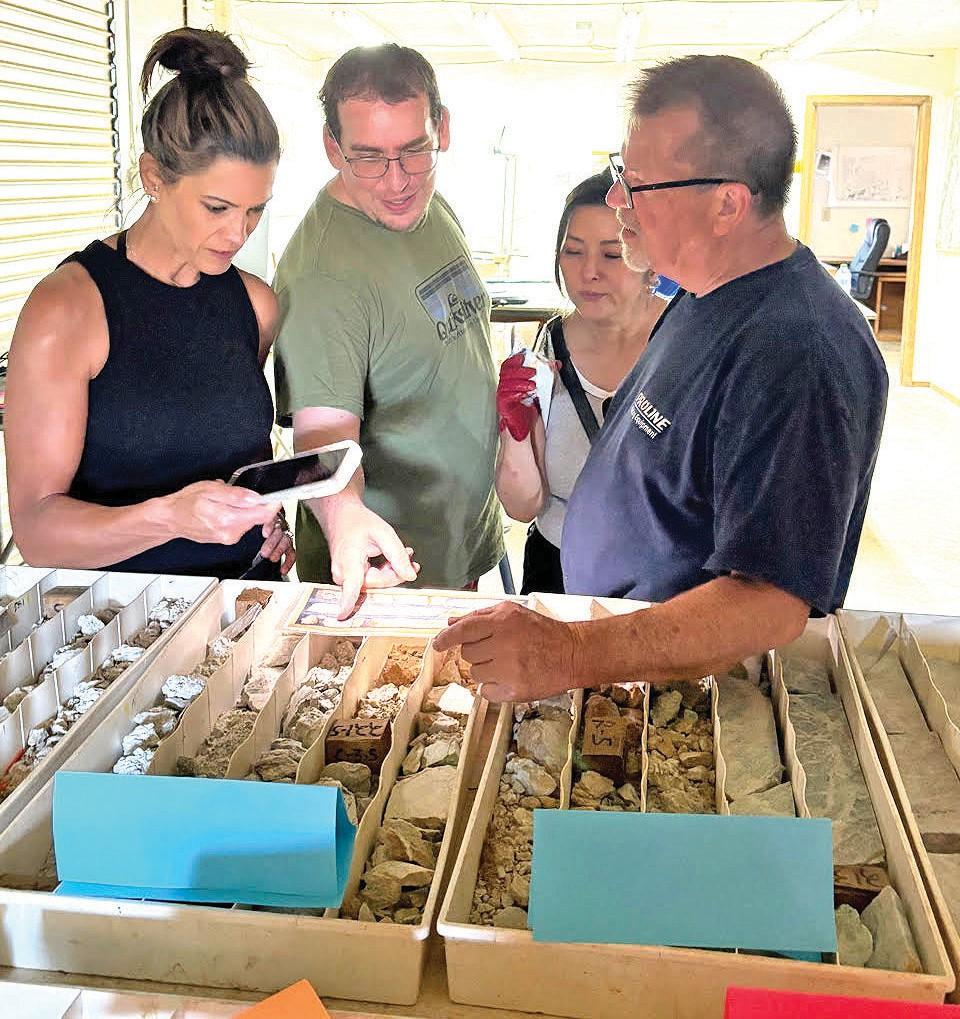

Shown inside the Lode Gold building are, from left, Jenni Kiser, Carlos Saban, Wendy Chan and Shannon Poe. Photos by Nicole W. Little
Is there gold in them thar hills — still?
If you ask officials with the Lode Gold, there’s not only gold in those Mariposa County hills, there’s a true Mother Lode.
“They picked the cherry and threw away the pie,” said Carlos Saban, a geological engineer and the technical adviser for Lode Gold, the company that owns more than 3,000 acres of property that once was the southern end of the California Gold Rush.
The Gold Rush is what transformed California — and Mariposa County.
But not in some ways people may think.
Mariposa County was on the fringe of the area where the Gold Rush began. The California Gold Rush began on Jan. 24, 1848, when James W. Marshall found gold flakes in the tailrace of a sawmill he was building for John Sutter along the South Fork of the American River in Columbia.
From there, California was forever changed.
The Gold Rush brought scores and scores of prospectors to the entire Mother Lode region, which stretches 120 miles from Mariposa on the southern end to Nevada City in the north.

Shannon Poe examines a rock and points out gold inside the find.
Gold is a central part of the heritage of Mariposa County, without a doubt. The Gold Rush expanded the state population and the local population. It also led to what would eventually be the attraction that became Yosemite National Park, which also changed the dynamics of Mariposa County.
But a central question remains and that is how much gold was left behind?
That question has burned in the heads of local residents and people around the world for more than 150 years.
Saban and Wendy Chan, the CEO of Lode Gold, believe they have an inkling of an answer — and it’s a big number.
They were both part of a tour of the project site last week, which included this newspaper as well as Jenni Kiser and Shannon Poe, both Mariposa County supervisors.
For nearly four hours, the group traipsed through old, abandoned dirt roads, thickets and more while exploring what Chan and Saban say is the Mother Lode II.

This is the view from the well-known overlook north of Bear Valley with Lake McClure in the distance. Lode Gold owns a huge portion of this area. Photos by Nicole W. Little
“It’s the Big Kahuna,” said Chan.
The speculation — and science
The tour began along the well-known vista point on Highway 49 North just north of Bear Valley overlooking Lake McClure. There, they showed just how much property they own, much of which was the site of the Fremont Mine, one of the most famous in the county.
Saban explained that gold was formed because of a “continental scar,” which was the result of “two continents smashing together.”
That, he said, is the gold they are exploring now, the result of that incredible natural collision. It’s the same gold that lured those prospectors so many years ago. e company owns
Th 3,351 acres of land along Highway 49 North and their vision is to utilize what they say is much safer underground mining techniques to begin extracting the precious metal.
Saban estimates there could be three million ounces of gold still to be unearthed. The current price for an ounce of gold is hovering around $4,500 an ounce.

Shown are the ruins of the old Fremont Mine located on Highway 49 North.
You can do the math.
Chan said the key to this operation is the fact many of the tunnels used in mining from back in the Gold Rush days still exist. That means many things, including what would likely be a smoother permitting process as well as much less work digging new tunnels because many already exist.
And with new technology, Saban said they can make good estimates of what might be in those hills.
“We can rebuild history,” he said.
Back in the days of the 1800s, the mining techniques were anything but sophisticated. Miners made estimates and then began digging, sometimes striking gold and sometimes not.
At the mine site north of Mariposa, Saban said the miners began making tunnels and then adding more as they dug deeper into the hillsides, hoping to find lodes of ore.
Once they began with the tunnels, those then branched out as they explored deeper into the hills of Mariposa County.

Shown inspecting the ruins are, from left, Carlos Saban, Shannon Poe, Jenni Kiser and Wendy Chan.
“Mining is a very tough business,” said Saban.
But it’s getting more sophisticated, he added, saying AI technology along with remote machinery can mean fewer people underground and more people doing everything from operating joy sticks to arranging trucking schedules.
Back to the future
One of the keys to this new operation, he said, is the fact they can go back underground, unlike previous proposals that would be surface mining — a technique that would likely be frowned upon not only by the government, but by local residents.
By being able to take the operation back underground, Saban and Chan said they can utilize those existing tunnels as well as new technology to increase their chances of finding that Big Kahuna.
Saban said initial studies have been done about what might be underground and the numbers are impressive.
“Most of the ounces we have are in a very small area,” she said.
Saban agreed, saying they believe there are narrow veins packed with gold, which would make the operation much more efficient than many gold mines.
“You don’t have to drill as much,” said Chan.
The early estimates are there is enough gold they already know exists to operate the mine for 10 to 12 years, however, Chan said “it could be up to 30 years because we will keep going. We are just now figuring things out.”
“We know there are assets left behind,” said Saban. “We have continuity here.”
Though a lot of this is in the early stages, Chan said the hope is the process will move quickly. Initial paperwork has already been sent to the county, said Chan, and they are hoping to begin work on a massive engineering study in the near future.
That study, said Saban and Chan, is key to how the operation will work in the future.
She said the engineering will hopefully begin in the next three months and it would be completed next year.
Chan also said the costs are steep — but the rewards could be immense.
Initially, the engineering study and initial work will cost some $20 million, she said, with another $200 million expected to be needed through 2029. Chan is actively seeking investors and is moving forward with the project as quickly as possible.
The literature she provided also lists many experts in the mining industry as being a part of this massive project.
The concepts and locations
The concept for the developers is to have the actual rock crushing operation located underground, in what Poe called a “ballroom,” or a large area that can handle big quantities of rocks.
The mill would be located above ground and housed in a building.
“All people would see is the building,” said Chan.
The mining of gold involves extraction of large amounts of earth and rocks. Those are then crushed and more processes come into play in sifting out the gold.
During part of the tour, the group stopped along the pullout on the north side of the Bagby Recreation Area.
Saban explained that just south of the parking lot at Bagby is where the mining operation took place when the Gold Rush started. He said there was an old tunnel in that area and the company began mining “up” the hill in search of gold. He noted there was work done in 2018 and in 2022 where trenches were used “to do research.”
Lode Gold has taken it from there.
For Lode Gold, the “Pine Tree Mine” will be the “main area” they are focusing, said Chan. That old site still has concrete foundations as well as the entrance to the original mine. That entrance is now cloaked with cattails and other vegetation.
In fact, there is standing water around the area that is actually running out of the mine. It is speculated there was a spring or other water source encountered by those original miners and it still runs to this day.
Another huge advantage Lode Gold will have, said Saban, is the fact the water they will use in the mining operation will only have to be filtered. That’s because it does not contain chemicals which need treated with more advanced techniques.
“We will only need a filter and can put it back into the river,” he said.
Saban said the concept is to “go on the original drill path,” again saving time and money.
“The idea is to use what was already used,” said Saban.
All of that is part of the recent submission to the county, where officials are hoping to obtain an administrative use permit, or AUP, which would avoid the necessity of a Conditional Use Permit.
“We will start with the permitting and then do the work,” said Chan.
Saban said the engineering work is critical because not only does it determine exactly where and how to mine for the gold, but also reveals the reclamation plan, a critical part of any mining operation.
Poe, a lifetime miner, told Chan and Saban he would “like to be informed” of the progress because he said people in the community will want information about such a major project.
The project, too, could produce a lot of good-paying jobs in the county, said Chan. Some 100-150 to begin with, she noted.
During the tour, tailings from the old Fremont Mine were visible. Chan said there are 23 kilometers of tunnels already in existence on the site. They are hoping to more than double that amount if the engineering results are what they expect.
But in California?
Chan addressed head-on the issue of doing mining in California.
Though many think of California as Hollywood, San Francisco and Disneyland, Chan said it is also a major mining state. She said there are more than 700 mines permitted in California. She added there are 14 gold mines currently operating.
Another factor, Chan said, is the mining friendly policies of the Trump Administration. The relaxing of the regulations and speeding up of permitting is crucial, she said, and they are hoping to take advantage of that current status.
“The environment right now is very conducive to mining,” said Chan.
Poe said he has “had interactions” with officials in the Trump administration and feels they understand the processes need streamlined.
In fact, he believes officials inside the Bureau of Land Management and the United States Forest Service have “no accountability. They feel they are entitled and untouchable.”
They hope all of this can lead to a smoother process when it comes to getting the mine up and running.
Saban said they are looking at crushing 350-500, maybe even 600, tons of rocks a day.
A conveyor belt would then transport the material to the milling operation above ground.
Saban calls it “underground bulk mining,” adding it is “cost efficient.”
Chan thinks only 8 percent of the gold has been extracted from their property. That could mean there are three million ounces still there, or even as much as five million ounces, she added.
It was then she referenced the “Big Kahuna.”
Whether all of this comes to fruition remains to be seen and there are many hurdles to jump in getting there.
But for the optimistic Chan, she’s a true believer in this project and sees gold as once again being a major part of Mariposa County and its future.
If she’s right, the gold in them thar hills could mean Mariposa County’s turn in the Gold Rush could be bigger than ever — 170 years later.
Visit www.lode-gold.com for more information.


Responses (0)