


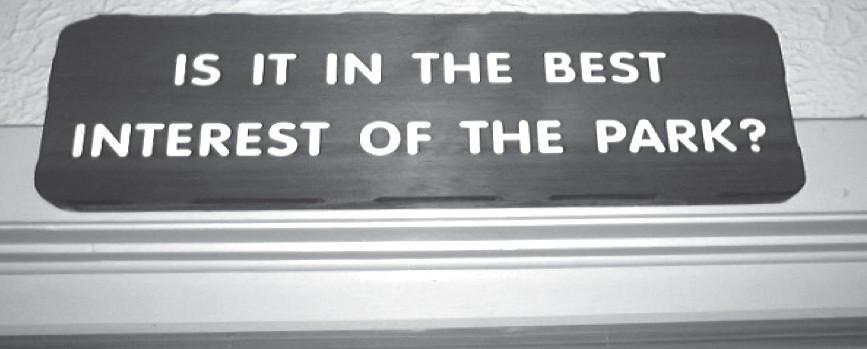

The supposedly controversial sign hanging in its original location in the Administration Building lobby in Yosemite Valley. You won’t find it there anymore.
Yosemite National Park Superintendent Ray McPadden’s unfortunate remarks in the Feb. 26 issue of the Gazette, as well as the National Park Service’s short-sighted decision to shelve the NPS Visitor Access Management Draft Plan and EA (the VAMP for short) demands a response.
When forming an opinion about any issue related to the park, it’s essential to start by answering two basic questions: 1) Why was Yosemite NP created (what is the park there for?), and 2) How is the NPS legally mandated to manage it?
The first question is answered by the park’s enabling legislation (1864 and 1890), the second by the NPS Organic Act (1916); in both cases, the answers were clarified by a long chain of subsequent administrative and judicial decisions and the passage of additional laws that the NPS must follow, chief among them the National Environmental Policy Act (NEPA) (1970).
So if you have not done so before, I urge you to take the time to read the enabling legislation and the Organic Act. The enabling legislation, together with much other information relevant to why the park was set aside, can be found in the park’s Foundation Document: www.nps.gov/yose/getinvolved/upload/YOSE_FoundationDocument_2016_508.pdf

Paul Gallex
The Organic Act can be found at: www.govinfo.gov/content/pkg/COMPS-1725/pdf/COMPS-1725.pdf
The reason it’s important to read and understand what these laws say is that, to put it bluntly, what you or I think the purpose of the park and the park service is (or should be) is irrelevant — what matters is what these laws say.
And what they say is that the park was created for two somewhat contradictory reasons, and that the NPS is legally required to balance the two. And of course, in modern language, they say that the NPS is required to balance resource protection and visitor access.
Which is exactly what the NPS has done at Yosemite from 1916 to the present. If you have actively followed Yosemite planning efforts (say, starting with the 1980 General Management Plan and extending through the Yosemite Valley Plan, the Merced River Plan, the Tuolumne River Plan and the VAMP), it is hard to draw any other conclusion than that the NPS is doing exactly what it is legally required to do by the Organic Act, and by NEPA, which requires the NPS to consider socioeconomic factors in its policymaking.
You may not agree with the balance between resource protection and visitor access that the NPS has struck in these plans (and I personally have not in many cases), but that’s not the point. The NPS has been doing its job in a difficult political environment and we ought to recognize them for it.
Now, at the heart of the issues surrounding day use reservations is the concept of carrying capacity. The idea of carrying capacity originated in a non-biological context in the mid-19th century and literally represented how much cargo of a particular type a ship could carry. It entered biological thought in the 1870s, became a core idea in range and game management in the early 20th century and by the mid-20th century had become a central tenet of ecology, which it remains to this day.
Carrying capacity sounds simple, but it is fraught with complications. There is not one carrying capacity, there are many, depending on the context, and in practice it is impossible even in a given context to specify a single number and work it into policy without a degree of arbitrariness.
The NPS has in recent years tended to shy away from discussing carrying capacity as such, although since the 1980 GMP all of the discussion surrounding the availability of parking in Yosemite Valley has really been about carrying capacity.
There are many examples of how the idea of carrying capacity has affected NPS management decisions. I will briefly describe two, because they both have bearing on the thinking behind day use reservations.
If you have backpacked in Yosemite, you know you are not allowed to build campfires above the 9,600 foot elevation. Why does this regulation exist?
The short answer is that the demand by backpackers for firewood exceeds the replacement rate of wood above that elevation, and if the regulation didn’t exist, there would be significant resource damage in the sub-alpine and alpine environments that backpackers love.
What I want to note here is that the choice of 9,600 feet is arbitrary — the actual level where demand exceeds growth varies by location in a complex way, depending on species composition, soils, site aspect, etc.
But the NPS had to choose a single number for the policy to be workable, and the science indicated a reasonable single number was 9,600 feet.
A second example of how the idea of carrying capacity informs NPS policy is Yosemite’s wilderness permit system. The Yosemite wilderness was divided into roughly 50 zones, largely defined by watershed boundaries.
A carrying capacity was assigned to each of the zones specifying how many people could spend the night in each zone without causing unacceptable resource damage (again, a single number despite the complexities involved).
A study was conducted to determine how many people ended up in each zone each night based on the trailhead they accessed the zone from. A daily quota was then assigned to each trailhead to ensure that the zone carrying capacities were not exceeded.
If you read the VAMP, you will see comments suggesting the same kind of system be used for day use reservations. A common opinion is that Yosemite Valley is the only area of the park where a problem really exists (it’s not, but…), so why not divide the park into a half-dozen major zones (Yosemite Valley, Glacier Point, Tuolumne Meadows, Mariposa Grove, etc.), assign a carrying capacity to each zone and then control traffic entering and leaving the zones?
A version of this idea made it into the VAMP as Alternative D, where there are only two zones, Yosemite Valley and the rest of the park. There would be a carrying capacity assigned to the YV zone and traffic would be controlled at a new traffic checkpoint near Bridalveil Fall. The rest of the park would not have a day use carrying capacity.
So while the NPS would prefer to not use the term “carrying capacity,” it in fact uses the idea all the time and in many different contexts. It does this primarily because no matter how difficult it is to define in any particular context, and coming up with a single number is inevitably arbitrary and therefore easy to attack politically, carrying capacity does exist — limits beyond which both the resource and the visitor experience are significantly damaged do exist.
And the NPS cannot fulfill its mandate to balance resource protection and visitor access without dealing with the issue.
I won’t attempt to prove that such a limit exists here. Anyone who has spent much time anywhere in the park knows there is a problem that has to be addressed (and not just in Yosemite Valley!)
If you haven’t personally seen the carnage, the VAMP is full of photographs that will show you, and if you read the plan, you will understand what the NPS’s reasoning is and why they chose to recommend the particular alternative they did. Here’s a link: parkplanning.nps.gov/showFile.cfm?sfid=753282&projectID=113113
The NPS was ready to release the VAMP in late 2024. But then the country got a new president and all things federal got put on hold. Uncertainty regarding whether day use reservations would be required for the 2025 summer season caused problems for local businesses, and then they were belatedly implemented in early May.
Now we hear from Superintendent McPadden that they won’t be implemented this year because concerns about carrying capacity are just a lot of “hot air” and that there’s “zero evidence” of any “consequential” damage. These remarks are not only shortsighted and an insult to every dedicated NPS employee who has tried to do the right thing regarding carrying capacity, they are a betrayal of the park’s enabling legislation and the fundamental mission of the NPS.
The NPS has a responsibility to show leadership in this area and to help the public understand what’s at stake, which is what it was doing until the plan was killed.
Why would McPadden take this position? Because he works for an administration that is all about profit, and he either really believes what he’s saying or has decided that he needs to follow orders to protect his job.
President Trump has nominated Scott Socha, an executive for former Yosemite concessioner Delaware North, to be the new director of the NPS. The economic interests in the communities surrounding the park have successfully lobbied Representative Tom McClintock to support quashing the VAMP.
In typical fashion, McClintock has invoked the culture wars and attempted to pit the supposedly “deep state environmental extremists” (read: dedicated NPS professionals who have a job to do) as enemies of the park visitor. Despite what some folks apparently believe, Yosemite does not exist for the economic benefit of the surrounding communities. Read the enabling legislation.
As a final note, let’s talk about McClintock’s apparent obsession with a sign that appeared in the Administration Building Lobby in Yosemite Valley sometime in the mid-1990s (see photo).
Superintendent McPadden’s office is in that building and the lobby is where the management team meets regularly to make decisions regarding park policy. McClintock has repeatedly referred to the sign in his culture-war screeds in the Gazette.
As I’ve tried to point out, when NPS employees see the word “Park” in this sign, it means both the resource and the visitor. Sadly, my understanding is that the sign has now been removed in response to McClintock’s misguided complaints.
The NPS should show some political courage and put it back up, as a reminder that it is truly their continuing job to act “in the best interest of the park.”
They need as much public support as they can get if that is to happen.
Paul Gallez is a resident of Midpines. He worked for the National Park Service at Yosemite for 30 years in a variety of roles. He can be reached at gallezpaul@gmail.com.

Responses (0)