




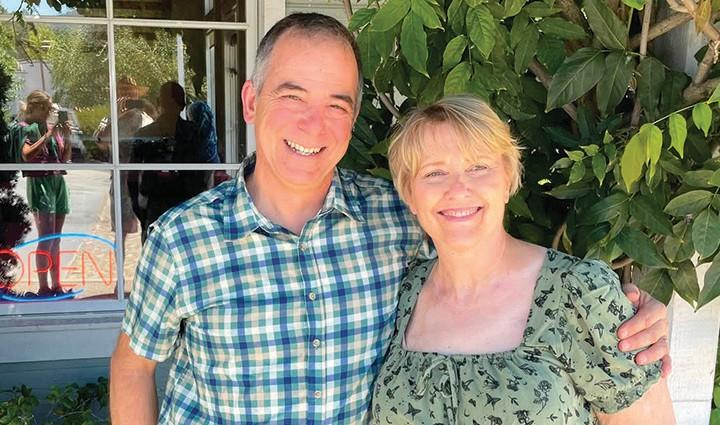
John C. Fremont Healthcare District CEO Stacey Kuzak, right, is shown as board member Rose Fluharty makes a point to the audience at a recent meeting. Photo by Tom Lyden
Stacey Kuzak, the CEO of the John C. Fremont Healthcare District, was up front about her mission: She is trying to win people back.
“My goal today is to earn trust through transparency and accountability because I know there have been a lot of hard times,” Kuzak told a March 14 meeting of the Mariposa Democratic Club.
“We have to change,” she added.
The question that hovered over the meeting was can the district change fast enough.
The district continues to bleed money with a $3.9 million operating loss in the last seven months of FY25-26.
Kuzak was joined by Rose Fluharty, a member of the JCF Healthcare District Board of Directors, who noted the district has had an operating loss every year that she has been on the board.
Former JCF Board member Suzette Prue, who was in attendance, said that by her calculations the hospital is on track to lose more than $7.1 million for the fiscal year, more than the year prior.
Prue suggested that one-time payments from the IRS for the employee retention tax credit, totaling $4.5 million, are masking even more red ink.

John C. Fremont Healthcare District CEO Stacey Kuzak told the Mariposa Democratic Club her goal is to earn trust through transparency and accountability. “We have to change,” she said. Photo by Tom Lyden
Kuzak conceded a number of financial challenges and headwinds.
Insurance companies and government payers, like Medi Cal and Medicare, are not reimbursing at the same rate they once did.
Labor costs also continue to rise, along with pharmaceuticals and supplies.
Those challenges are endemic across healthcare, but are particularly acute because of the district’s relative small size and scale.
Kuzak’s overarching solution is more patients.
“Growing volume is going to offset those challenges,” Kuzak promised.
But to do that, the district needs to lure back patients who may have had troubling experiences.
The audience, mostly seniors, seemed to have plenty of those experiences to share.
One man said he called three times to schedule an echocardiogram, and no one called him back. He eventually drove three hours to San Francisco for the procedure.
Another man said he wanted to assist his girlfriend with filling out forms as she experienced a debilitating migraine, but he was denied access to the emergency room.
Kuzak called that “unacceptable.”
A woman said she had difficulty transferring out of state medical records to the medical clinic.
Kuzak noted that the district does not have a modern electronic medical record system, like EPIC or Oracle Cerner, that can share records with the click of a button.
She admitted “other places in town are better” with more up to date record systems and asked for “some grace as we get through this.”
Kuzak told the woman, “I will do it myself. Reach out to me.”
“Lots of complaints, lots of challenges,” Kuzak acknowledged. “But we don’t hear as many.”
One of the challengers for the district is to keep people who go out of town for services, like physical therapy, which is the number one referral. Kuzak once again floated the idea of a potential partnership with a larger healthcare group, like Dignity Health.
At the same time it manages healthcare in precarious times, the district is in the process of preparing for construction of a new hospital, to be in compliance with state mandated earthquake standards.
Groundbreaking is currently scheduled to begin in 2027, with construction finished by January 2030. The hospital has already sought a six month extension on the 2030 deadline.
Much of the funding for construction will come through Measure O, a 1 percent county sales tax passed by voters in 2022, which has generated $12 million. The district has already spent $2.8 million on the project in engineering, project management and architectural fees.
The hospital is also applying for a loan through the USDA (U.S. Department of Agriculture) at the end of June and is conducting a feasibility study as part of that process.
Kuzak noted in passing that she got “new information Thursday” about that process.
“The world is changing. USDA is changing,” she said.
Asked by the Mariposa Gazette the specific nature of those changes, she would not elaborate.
Kuzak shared with the audience comments from some recent state surveys, specifically with skilled nursing, where she said the district scored well.
But she glossed over the depth and seriousness of the critique from an unannounced Dec. 12 inspection from the California Department of Public Health (CDPH) on behalf of the Centers for Medicare and Medicaid Services (CMS), the most important and feared regulator in American healthcare.
That survey identified “serious deficiencies” that indicated a “systemic breakdown in governance oversight, medical staff competency, controls and contracted services management.”
CMS said it created a “material risk to patient safety, regulatory compliance and reimbursement.”
Speaking of that inspection, what CMS calls a survey, Kuzak said, “Lots of work to do, lots of areas that need attention. Everything is a priority right now.”
“Even though we are a critical access hospital, we don’t get any breaks. We are held to the same standards as other hospitals,” she said.
Since the CMS survey, the district has replied with a letter of correction that has been accepted by the regulator. Kuzak confirmed that CMS has not returned for a follow-up visit.
Many of the findings from CMS centered around credentialing of medical staff.
The Mariposa Gazette obtained a copy of the survey from a California Public Records Act request.
Kuzak, who had been CEO for only one month, told investigators she recognized the district was out of compliance when she became director of quality in December 2024.
Kuzak, who is the ninth CEO in the last three years, blamed staff turnover.
“The CEO stated she was not surprised there were issues identified with medical staff credentialing, privileging, or with contracts because there had not been an organized system in place to process appointments and reappointments,” the report said.
Kuzak, who lives in Merced, told the audience she is in it for the long term. She mentioned her son recently accepted a scholarship to UC Merced.
“It’s a challenge, but I’m optimistic for our future,” she said.
“It’s going to take every one of us.”







Responses (0)