


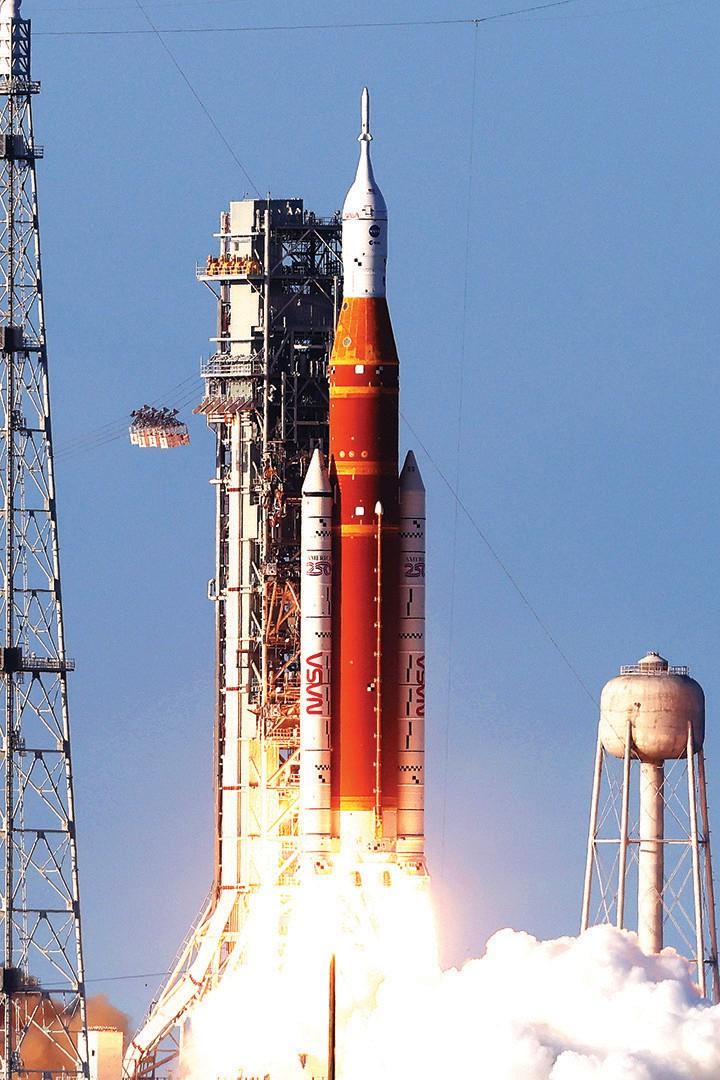

The Orion spacecraft carrying four astronauts blasted off atop the SLS rocket on the Artemis II mission on April 1, 2026. Photo courtesy NASA
In last month’s article we climbed aboard a virtual spaceship, passing by the Moon, planets, stars and galaxies on a fanciful trip to the edge of the known universe. This month, we’ll talk about real missions to the Moon that are happening in the next few years, and eventually Mars in the decades to come.
From Apollo to Artemis
Some of us of a certain age will remember July 20, 1969, as the day when Neil Armstrong and Buzz Aldrin became the first humans to land on the Moon. That mission, and the five that succeeded it, delivered a total of 12 American astronauts to the lunar surface by the last days of 1972.
The NASA program that made this remarkable accomplishment was called Apollo, after the ancient Greek god of sun and light, who rode his chariot across the heavens. In 2017, a new lunar initiative was named after the Greek goddess of the Moon and twin sister of Apollo: Artemis.
The name honors the original Moon missions, while signaling a modern era of spaceflight and recognizing the diversity of today’s astronaut corps.

Manny Leinz
The Artemis program as it was initially defined consisted of four main elements:
• The giant Space Launch System (SLS) rocket, built by Boeing, Northrup-Grumman and Aerojet, which would take astronauts from the Earth to the Moon
• The Orion spacecraft, developed by Lockheed-Martin, which sits atop the SLS and would carry a crew of four into lunar orbit
• The Lunar Gateway, developed by Northrup-Grumman and Maxar Technologies: a small space station that would act as a staging area in lunar orbit
• Two designs of the Human Landing System (HLS): Starship HLS, developed by Elon Musk’s SpaceX, and Blue Moon, developed by Jeff Bezos’ Blue Origin, which would take astronauts from the Gateway to the lunar surface and back again
The objective of the program was to land a man, and a woman, on the Moon by 2028, on a mission dubbed Artemis III. That timeline was later accelerated by four years, with the first landing ambitiously scheduled for 2024.

Artist’s concept of the Human Landing System vehicles in development by SpaceX (left) and Blue Origin. Photo courtesy NASA
The SLS rocket and Orion spacecraft flew for the first time on the Artemis I mission in November 2022. The unmanned flight carried Orion around the Moon and after 25 days in space, to a successful splashdown off the coast of Baja, California.
However, issues with Orion’s heat shield discovered on that flight, and problems with the life support system, delayed the next mission, Artemis II, until April 1 of this year, and scuttled the planned 2024 lunar landing.
The nine-day Artemis II flight was ultimately a huge success, carrying four astronauts beyond Earth orbit and around the Moon for the first time since 1972.
The new plan
On March 24, exactly one week before the Artemis II launch, NASA administrator Jared Isaacman held an event called “Ignition,” where he announced a major revision to the Artemis lunar roadmap.

Lunar Terrain Vehicle prototypes (L-R) built by Astrolab, Intuitive Machines and Lunar Outpost. Intuitive Machines did not receive a follow-on contract. Photo courtesy NASA
Gone was the Lunar Gateway element; astronauts would now transfer directly from Orion to the HLS — much as during Apollo, where the transfer was from the Command Module to the Lunar Module — for the trip to the surface.
In addition, the Artemis III mission was repurposed; it would now become a 2027 test in Earth orbit, verifying the ability of Orion to rendezvous and dock with one or both of the HLS vehicles.
The first Moon landing would therefore be conducted by the crew of Artemis IV, planned for early 2028, a second landing by Artemis V would occur prior to the end of 2028, with subsequent landings scheduled at least once per year afterward.
The other major announcement made at the Ignition event was regarding the development of “Moon Base,” a three-phase program consisting of multiple elements operating near the lunar south pole.
The south pole provides a unique combination of resources that make it the ideal Moon Base location. Its permanently shadowed craters are known to contain water ice, which can be harvested for drinking water, or dissociated into hydrogen and oxygen for use as rocket fuel.

Artist’s concept of four NASA/JPL Moonfall drones being deployed from their delivery vehicle, built by Firefly Aerospace. Photo courtesy NASA
While the depths of south pole craters never see sunlight, the crater rims receive constant sunlight throughout 80-90 percent of the lunar year. This makes the crater rims ideal locations for solar panels to generate electrical power for Moon Base.
The planned Moon Base phases are:
• Phase 1, from now through 2029, will consist of over 20 unmanned landings, deliver over four tons of equipment to the surface, survey potential landing zones and pave the way for human missions. Among the infrastructure elements to be delivered are Blue Origin’s Mark 1 HLS Cargo Lander, pressurized and unpressurized Lunar Terrain Vehicles (LTVs), hopping “Moonfall” drones for terrain scouting, and orbiting data relay satellites for communication with Earth.
• Phase 2, from 2029-2032, will deliver a large mobile habitat, built by the Japanese Space Agency, which will allow astronauts to travel long distances on the surface in a shirtsleeve environment. Other infrastructure will include improved solar power stations, cellular communication, heavy machinery and even nuclear power generators.

• Phase 3, from 2032 and beyond, finally transitions Moon Base into a semi-permanent settlement, with advanced habitats, power systems and communications networks, enabling long term astronaut stays. The experience gained on these missions will be a stepping-stone to allow eventual human missions to Mars.
The new Artemis/Moonbase plan is ambitious, to be sure. There has been a long history of NASA being redirected by each successive presidential administration to change course and pursue entirely different goals, so there is no guarantee that Artemis/Moon Base will be completed as just described.
Nevertheless, there are surely exciting times ahead; and with the Chinese government committed to a 2030 Moon landing of its own, I would bet that the likelihood of a US landing in the next several years is fairly high.
What’s up in the sky this month?
It’s generally accepted that there are five planets — besides Earth — visible to the naked eye: Mercury, Venus, Mars, Jupiter and Saturn.
This month you’ll have the opportunity to try for a sixth, as Uranus will snuggle up tightly to Mars in the early morning of Independence Day. The two planets will be amazingly close: a little more than a tenth of a degree apart, or about the width of a grain of rice held at arm’s length.
You’ll need to go out early — about 4 a.m. — and look low to the east, below the Pleiades star cluster. Binoculars will help you spot blue-green Uranus next to much brighter, reddish, Mars.
Once you’ve seen it with binoculars, try to spot it with just your eyes. You’ll need a very dark sky and very good eyesight. Good luck!
Venus is sinking lower again in the evening, after reaching its best in mid-June. Still, it is so bright that it’s easily seen even before the sky gets completely dark. Spot Venus low in the west half an hour after sunset throughout the month.
Both Mars and Saturn are moving higher in the sky and will be visible as morning objects for the rest of the year. Look for them both in the eastern sky before dawn; Mars will be easier by the end of July.
I hope you have a chance to get out and experience the beauty of night sky this month. If you do, take some time to gaze at the Moon and consider that humans may soon set foot there again, after a nearly 60-year absence.
To get help finding planets, stars, and other celestial sights checkout skyandtelescope.org/interactive-skychart/ or theskylive.com/.
There are also some great free smartphone apps, including Stellarium, SkySafari and SkyView. As always, if you have questions, comments or suggestions for future articles, you can get in touch with me by email at: celestialdeep55@gmail.com. You can find my prior Gazette articles, night sky photos and more on my website at celestialdeep.space/ .
Manny Leinz is a long-time amateur astronomer and night sky photographer. He and his wife live part time in Bootjack where they also have an observatory.








Responses (0)