


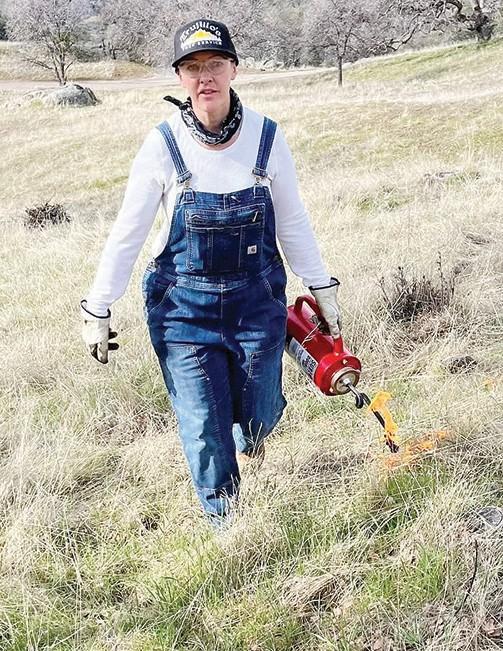

Ashley Nebeker is shown in the field during a prescribed burn in 2023.
A handful of wildfire mitigation agencies is currently active in Eastern Madera County.
Each nonprofit organization is valuable and all work together to create a safer community when it comes to the risk of wildfire.
The Eastern Madera County Fire Safe Council (EMCFSC) is one of these agencies. Through education, fuel reduction and other programs to help homeowners, the goal is to create a safer environment locally for all at risk from the dangers of wildfire.
Led by executive director Ashley Nebeker, senior program manager Kevin Kirk and a board of directors, the Fire Safe Council recently shared its 2025 impact report for review.
Nebeker is trained in wildland firefighting and is a wildfire mitigation specialist with a background in outreach, education and nonprofit leadership. She’s a Coarsegold resident whose father worked at the sawmill in North Fork when she was a kid.
Kirk is also local to the EMC foothills; he is a certified arborist with a background in natural resource and environmental management, ecosystem restoration and sustainable solutions.

From left, Ashley Nebeker and Kevin Kirk.
Highlighting the mission
The new report highlights the progress EMCFSC is making to advance wildfire preparedness and resilience across Eastern Madera County.
The mission of the Fire Safe Council is to preserve California’s natural and man-made resources by mobilizing all residents of the Golden State to make their homes, neighborhoods and communities fire safe — and to be the state’s leader in community wildfire risk reduction and resiliency.
“In 2025, EMCFSC successfully transitioned from 2024 planning into active, on-the-ground implementation — delivering fuel reduction projects, expanding defensible space support and strengthening cross-boundary coordination with local, state and federal partners,” Nebeker said.
“This work reflects a shared commitment to reducing wildfire risk and improving watershed health through a coordinated, landscape-level approach. Our focus remains on scaling implementation, advancing cross-boundary projects and building durable systems that connect planning, funding and on-the-ground delivery.”

Kevin Kirk is pictured with a hard-grazing staff member.
Nebeker said continued partnership enables groups to ensure wildfire mitigation efforts are strategic, efficient and impactful across all ownerships.
“We look forward to building on this momentum together.”
Building resilience through strategic action
Efforts in 2025 included implementing shaded fuel breaks and roadside treatments, advancing innovative approaches including prescribed grazing and wood use programs. They expanded support for residents working toward defensible space compliance.
EMCFSC also deepened regional coordination through the Fire Adapted Madera County (FAM Co) framework, aligning local, state and federal partners around shared, actionable wildfire mitigation priorities.

A crew is pictured clearing and chipping brush for a homeowner in Coarsegold.
“Through this integrated landscape-level approach, EMCFSC delivered measurable progress in reducing wildfire risk and enhancing the safety, resilience and preparedness of communities throughout Eastern Madera County,” Nebeker said.
“By pairing strategic planning with scalable implementation, EMCFSC is establishing a durable, regionally coordinated model for long-term wildfire resilience.”
Strategic landscape-level planning
EMCFSC last year advanced the Mountain Area Strategic Treatments (MAST) suite to guide prioritized landscape-scale fuels reduction and investment planning.
The organization aligned its strategy with state and federal resilience priorities through active participation in statewide and regional planning efforts and developed a centralized GIS-based project database and mapping system to improve project tracking and decision making.
The report said EMCFSC prepared six landscape-scale projects for competitive funding, expanding the pipeline of implementation ready treatments and developed targeted partnerships to address regional gaps in planning, funding and implementation capacity.
The council also established a public facing wildfire resilience office at the Madera County Government Center through the FAM Co initiative. The office is located at 40232 Junction Drive in Oakhurst.
Nebeker additionally noted they created the WUI Community Protection Plan, a suite of 13 projects that will protect forest-adjacent medium to high density neighborhoods through targeted vegetation treatments.
Defensible space and resident support
Last year EMCFSC supported 30 homeowners in achieving PRC 4291 compliance (100 feet of defensible space) through direct vegetation treatment assistance.
The organization launched a region-wide roadside chipping program to reduce hazardous fuels and delivered property-level wildfire risk assessments using the leading software “Fireaside” as a CAL FIRE qualified DSA entity.
Fuel breaks and evacuation routes
The council further advanced planning, design and maintenance strategies for priority fuel breaks and evacuation corridors.
They developed implementation-ready action plans for four regional fuel breaks and strengthened coordination through collaborative growth, co-establishing the planning strategy for the Sierra Sisters Fuel Break Network with neighboring county FSCs and USFS partnerships.
EMCFSC implemented a 17-acre shaded fuel break protecting a high-risk WUI community in Bass Lake, treated roadside vegetation for critical evacuation routes and was awarded funding for two major community protection buffers through competitive grant applications.
A combined total of 400 acres is planned to be treated in 2026-27.
Innovative approaches
The nonprofit in 2025 secured funding and initiated the first Eastern Madera County Grazing Initiative. They advanced development of an evidence-based grazing protocol and partnered with prescribed fire practitioners for maintenance burning strategies.
The council incorporated grazing and prescribed fire into project design and partnered with PG&E to develop an innovative wood-removal pilot program.
Education and outreach
EMCFSC engaged community members through 20-plus outreach events, according to the report.
The council expanded staff capacity through grazing management and science-based solutions training. They enhanced GIS and wildfire risk mapping tools and capabilities using software including ERSI, Fireaside and Pyrologix.
Nebeker said EMCFSC formalized key partnerships through new agreements and memos of understanding (MOU) and they launched and expanded regional collaborative planning efforts.
Importantly, the council secured and pursued competitive funding opportunities while investing nearly $322,500 into local contractors.
A holistic vision for wildfire resilience
“EMCFSC’s 2025 efforts reflect a fully integrated and implementation-driven strategy: advancing wildfire resilience through coordinated, cross-boundary action,” Nebeker said.
“Our work spans home-level risk reduction, defensible space compliance, roadside and evacuation route treatments, shaded fuel break construction and landscape-scale planning across ownerships.”
The executive director said EMCFSC has transitioned from planning into active project delivery at scale by building on a solid foundation while leveraging grant funding, contractor networks and strategic partnerships.
Looking ahead
EMCFSC plans to continue on-the-ground implementation across priority treatment areas in the future, with plans to strengthen cross-boundary coordination and advance innovative approaches such as grazing and biomass utilization.
The organization intends to increase resident engagement and compliance and continue building a scalable model for wildfire resilience.
Nebeker in the report acknowledged senior program manager Kevin Kirk for his exceptional work ethic and the nonprofit’s board members for their direction, including Brian McNamara, Kirsten Englund, Jon Cottington, Alison Deak, Tony Misner and Laura Wisdom.
Local contractors were noted for their excellence and performance and funding partners were offered appreciation for their contributions including CAL FIRE, CFCF, SNC, PG&E, CFF and USDA.
The report also gave a shout out to Madera County and the Fire Adapted Madera County collaborative partners for their dedication to regional resiliency.
For more information visit www.EasternMaderaCountyFireSafeCouncil.com or email info@EasternMaderaCountyFireSafeCouncil.com.



Responses (0)