


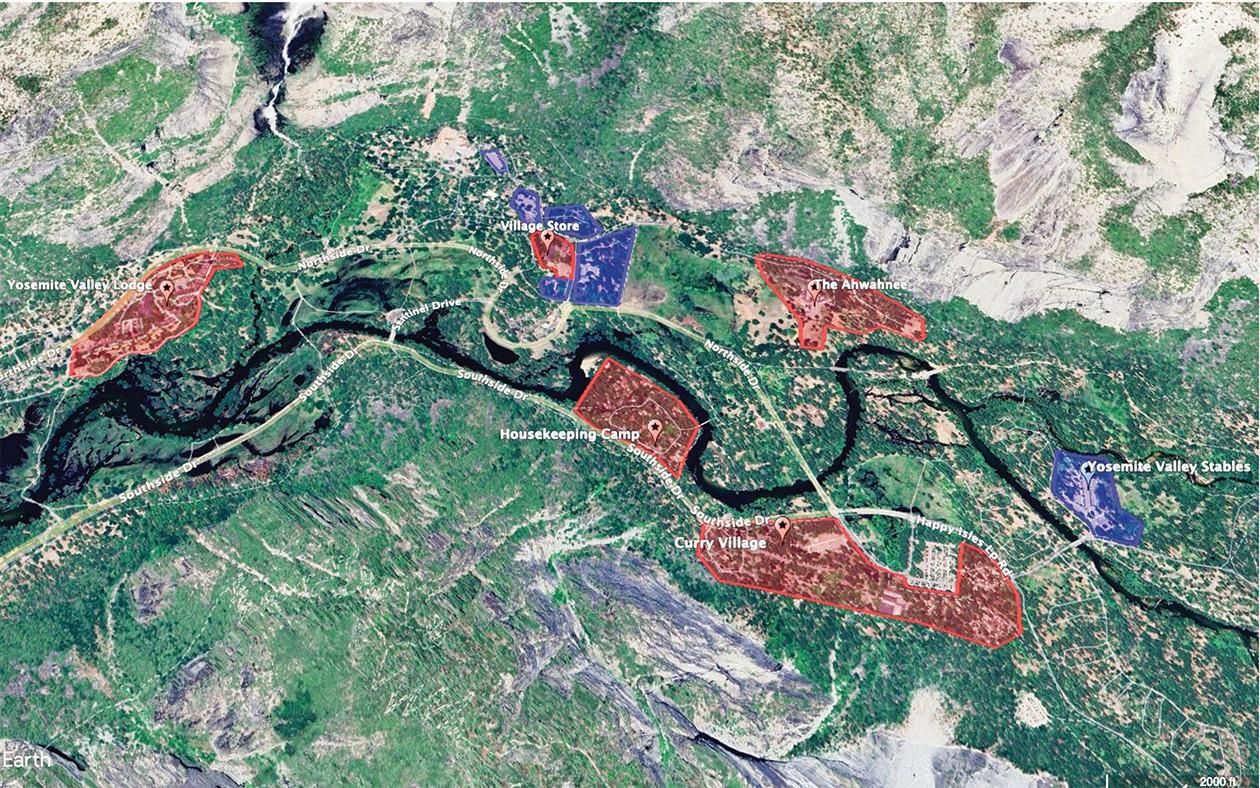

A map of Yosemite Valley shows the concession facilities operated by Aramark subsidiary Yosemite Hospitality. The company has had the concession contract for the park since 2016. This map is from Yosemite Hospitality.
Yosemite Hospitality, the concessionaire for Yosemite National Park, is suing Mariposa County, claiming the county made mistakes calculating the assessed value of the properties it operates in the park and the property taxes it must pay to the county.
Yosemite Hospitality is a subsidiary of Pennsylvania based Aramark. The company operates the Ahwahnee Hotel, Yosemite Valley Lodge, Curry Village, several restaurants, ski lifts, bus tours, shuttle buses and river rafting.
The lawsuit, which has not been previously reported, challenges an October 2025 ruling from the Mariposa County Board of Equalization which rejected a tax appeal from Yosemite Hospitality.
For Mariposa County, the stakes are high.
Yosemite Hospitality paid $1,232,620 in property tax last year, according to figures provided by the Mariposa County Tax Collector.
The properties under the concessionaire contract — the hotels, restaurants and other amenities — have a total assessed value for tax purposes of around $120 million.
But in appeals filed with the Mariposa County Assessor, Yosemite Hospitality has argued the actual value of those properties is much lower, somewhere between $36 and $60 million.
If Aramark lawyers’ are ultimately successful in their cutting edge interpretation of California tax rules, the county could lose anywhere between $630,000 and $868,000 in annual revenue from its largest property taxpayer.
The case could have national implications for how taxes are calculated for concessionaires at state and national parks. Any decision is likely to be appealed to the State Appeals Court in Fresno or eventually to the California Supreme Court.
Board of Equalization
Tax disputes first go to the Mariposa County Board of Equalization, which is made up of the five Mariposa County Board of Supervisors.
Yosemite Hospitality, aka Aramark, made its case to the equalization board during a five hour hearing on May 7, 2025.
The company asked that Supervisors Jenni Kiser and Miles Menetrey be excluded from the decision-making because Kiser is related by marriage to the current assessor and Menetrey couldn’t be present for the hearing.
The tax case file, obtained by the Mariposa Gazette through a California Public Records Act request, runs more than 2,000 pages.
Yosemite Hospitality argued that the taxable value of the land and buildings were inaccurately assessed by the county when the company took over the concessions contract from Delaware North in March 2016.
As part of that 15-year agreement, Yosemite Hospitality must pay its landlord, the National Park Service, 11.75 percent of its gross revenue as a franchise fee. Under federal law, 80 percent of that fee should go toward maintaining the park.
How much money are we talking about?
Nick Sponaugle, the former vice-president of operations for Yosemite Hospitality, testified that the gross receipts for the company was about $170 million in 2024, which means Yosemite National Park would receive about $20 million from the concessionaire.
‘Taxable possessory interest’
Still with us? Good. It is about to get a little complicated.
Because properties like the Ahwahnee Hotel are owned by the federal government, and are therefore tax exempt, the value of the property is determined through a calculation known as “taxable possessory interest.”
In other words, it is the assessed value if it was private property available for sale on the open market, which obviously it is not.
That sounds pretty straightforward. But it’s not.
Th e accounting process for taxable possessory interest can use various technical approaches, outlined in California’s bible for property tax, known as Rule 21.
In this case, Yosemite Hospitality and Mariposa County agreed in 2016 to the most common method, known as the “direct income approach.”
That approach looks at the average income stream from the property over 10 years while also deducting expenses required of the government landlord.
What is ‘necessary?’
Gregory Broege, the tax lawyer for Yosemite Hospitality, said the disagreement is over the amount of government expenses that need to be offset.
“What is the amount of government landlord expense that needs to be deducted from that income stream to get to the fair market value of the applicant’s taxable possessory interest?” Broege asked the equalization board during the hearing last year.
He quoted from Rule 21, California’s property tax law, which says “any expense necessary to maintain the income from the subject taxable posessory interest… must be deducted from the estimated economic rent.”
Broege argued that the expense of operating all of Yosemite National Park is also essential to the park receiving its revenue stream, its rent, from Yosemite Hospitality.
“If no one goes to the Ahwahnee Hotel, if no one goes river rafting, no one comes to Yosemite National Park, they’re not going to be able to operate. They’re not going to be able to pay rent,” said Broege.
While Broege never offered a figure, he suggested the entire 80 percent the park spends from its concession fee should be offset against Yosemite Hospitality’s gross income.
While Yosemite Hospitality provides maintenance for areas within its franchise zone, the National Park Service is responsible for all the areas outside the perimeter, like plowing roads, keeping trails safe, restrooms clean and providing park rangers.
Yosemite Hospitality offered as an exhibit a list of nearly 100 projects the National Park Service promised to carry out with the concession fee it receives.
The list includes capital projects like replacing the roof of the Wawona Hotel, which has yet to be completed.
Sponaugle, the former vice-president for Yosemite Hospitality, mentioned revenue losses from such delays, like White Wolf Lodge being out of service for several years because of sewer issues, delays in plowing Badger Pass and clearing debris from the Merced River for rafting.
“What would happen if they (NPS) stopped maintaining the park?” Broege asked Sponaugle, the former head of operations.
“We’d see a decrease in visitation,” said Sponaugle, who added that it would lead to a decrease in revenue, and therefore a decrease in rent to the park.
“If the park isn’t the park, people wouldn’t come. If folks didn’t have the ability to use restrooms, gain access to the park through roads,” Sponaugle said.
The value of public goods
But the attorney for the Mariposa County Assessor, William Marticorena, turned that idea on its head.
“Don’t people come to the park for a whole assortment of reasons, and never visit the Ahwahnee (Hotel) or one of the concessions?” Marticorena asked Sponaugle, who ceded the point.
Marticorena argued that the park spends money that doesn’t directly or indirectly benefit the concessionaire simply because the park is considered a national treasure.
In that way, Marticorena argued, Yosemite Hospitality is more comparable to a store owner asking for a write-off of basic government services, like police and fire protection, that serve society generally.
Marticorena said Yosemite Hospitality is confusing necessary expenses with those that might simply be beneficial to the concessionaire.
The board wasn’t buying the logic, either.
“I cannot think of the park as an island, because
40 percent of the park is in Mariposa County,” Supervisor Rosemarie Smallcombe said, as she listed off services the county provides to the park as well.
For Supervisor Shannon Poe, the logic seemed circular, deducting the money the park spends while the concessionaire makes money “from the folks coming from all over because it’s the greatest park in the world.”
“And then to claim that money the park is spending, and have that all relate to you and that it benefits Yosemite Hospitality, and therefore, you should be granted the ability to take that tax deduction. I just have a hard time with that,” Poe said.
Is Yosemite like an airport?
The star witness for Yosemite Hospitality was Ken Thompson, the former chief of the state-assessed properties division and a 28 year employee of the California State Board of Equalization.
Thompson testified that it would be reasonable to apply the tax code to national parks the same way it is used for ports and airports, and what’s known as an expense-ratio calculation.
It is the calculation that airports might use to tax a Starbucks or fast food vendor inside a terminal.
But upon cross examination, Thompson admitted he has never heard of that method being used before with national parks.
Thompson admitted he had not read the 1,000 page concession contract between Yosemite Hospitality and the National Park Service. Thompson said he was getting paid $450 an hour for his testimony and presence at the hearing.
Marticorena, the attorney for the county assessor, pointed out that no one goes to an airport for a hamburger from a concessionaire, but plenty of people go to Yosemite without visiting one of the concessions operated by Aramark.
Mariposa County argues that airports and ports are “single purpose commercial enterprises” whose sole purpose is to service the commercial interests.
Yosemite National Park is a different kind of public good, the county argues, “established to preserve and protect its natural resources for future generations.”
“In fact, NPS is required by statute to subordinate its interests in maximizing franchise fees to its interests in protecting and preserving the natural resources and beauty of YNP,” the county said in its legal brief.
YNP on the sidelines
Yosemite National Park and the National Park Service are not parties to the dispute. But the park’s finances and upkeep are still central issues.
Money from the concessionaire isn’t all that keeps the park running, not by a long shot.
Benchmark figures used in the assessment from FY15 through FY 17, show that Yosemite Hospitality franchise fees accounted for an average of 37 percent of the park’s total revenue and 39 percent of its total budget.
Entrance fees brought in about $20 million a year.
The county suggested the National Park Service wasn’t even using 80 percent of its concession fee to maintain the park, submitting as evidence more than a dozen news articles critical of the park for its lack of ongoing maintenance and stewardship.
The implication being that not all of the franchise fee is being used for ongoing maintenance and therefore shouldn’t be off-set against revenue.
Smallcombe also wondered about how deferred maintenance and capital projects figured into the analysis. She said Yosemite National Park had $800 million in such projects, a figure the assessor at the time, Vince Kehoe, confirmed.
Broege objected to the figure being part of the public record.
Yosemite Hospitality v. Mariposa County
It October 2025, the Mariposa County Board of Equalization denied Yosemite Hospitality’s appeal.
Yosemite Hospitality filed its lawsuit against the county two months later, in December 2025.
The case essentially rehashes the issues that came before the Mariposa Board of Equalization last year with additional procedural issues.
Both Mariposa County Superior Court judges — Michael Fagalde and Anita Bryant Starchman — recused themselves from the case last month, citing a statute that says a person “might reasonably entertain a doubt that the judge would be able to be impartial.”
It is not uncommon for judges to recuse themselves from such tax matters when the local stakes are so high. It is best, the logic goes, to have a judge with no perceived skin in the game.
The case is scheduled to go to trial in October, but that time frame is delusional.
The litigation could last years.
If Aramark is ultimately successful, it could set a precedent that could establish a legal precedent for how taxable possessory interest is established for national and state parks around the U.S. and save Aramark hundreds of millions of dollars in taxes.
It is money that would be lost to the local communities that surround and host those public amenities.
Aramark, a food industry and recreation management behemoth, with $19 billion in annual revenue, operates within 60 national and state parks, national forests and tourist destinations across the U.S.
Its contract for Yosemite National Park runs through 2031.
Mariposa County, Yosemite Hospitality and the lawyers representing the parties in the matter declined to comment on this story for the Mariposa Gazette.








Responses (0)