


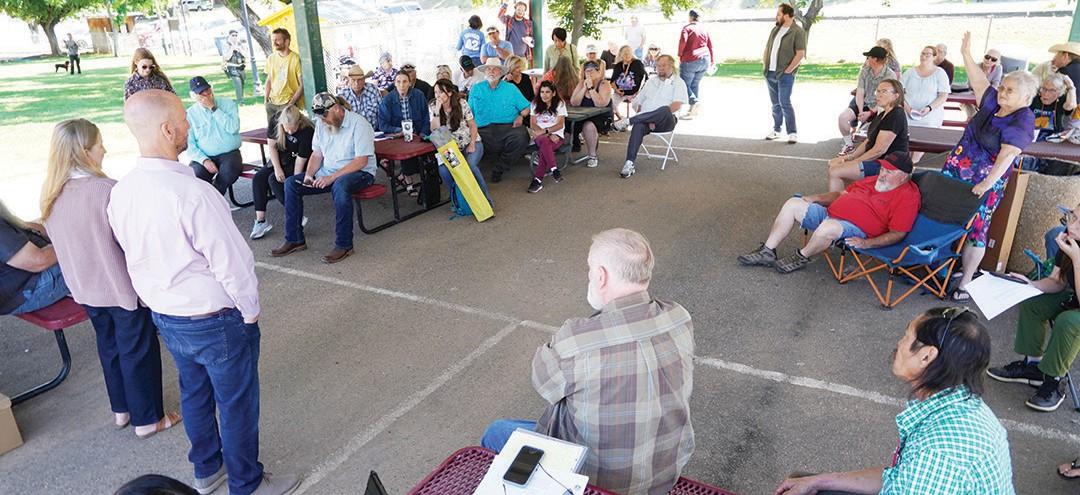

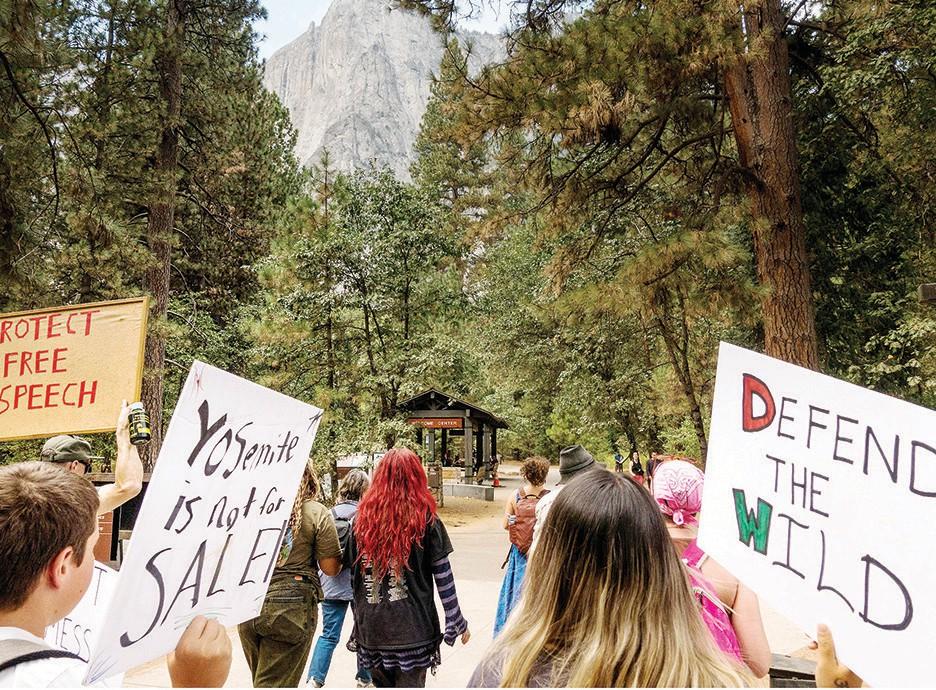
Residents from Coulterville and Lake Don Pedro turned out for heated community meetings over potential rate increases for water and wastewater. Photo by Tom Lyden
In two heated community meetings last Saturday, residents of Coulterville and Lake Don Pedro wondered why county officials hadn’t done more sooner to deal with potentially astronomical hikes in utility rates for water and wastewater treatment.
“We’re here to find out why we are getting screwed for your mess,” yelled Jared Hein, one of nearly 70 residents who gathered in Coulterville Park for one of the meetings.
Coulterville resident Colleen Rhodes gave county officials an eviscerating lecture as she recounted missed opportunities over the last few years to apply for state grants to update the struggling town’s dilapidated water and wastewater systems.
“None of those resources were acted upon by the county. What were you thinking?” Rhodes asked.
County Administrative Office Joe Lynch said the utility rate issue — which also affects systems in Yosemite West and Mariposa Pines — is “one of most urgent concerns in the county. ”
And yet, county officials had no tangible solutions to offer.
The problems are similar in all four utility districts: A small customer base, years of deferred maintenance and skyrocketing costs.
But under California’s Proposition 218, ratepayers can essentially block any rate hike, something several of the districts have done over the last 20 years and are likely to do again, county officials concede.
“Only you can raise your rate, we are not here to impose it on you,” Lynch told the angry crowd.
Meanwhile, Mariposa County has subsidized three of the four utilities with $1.2 million in loans. And that cost is set to skyrocket in the next few years.
Mariposa County Supervisor Shannon Poe, whose district includes Lake Don Pedro and Coulterville, suggested his colleagues on the county board would be unwilling to forgive the loans.
It’s gonna be a ‘ghost town’
Coulterville’s water and wastewater system has a small customer base of 81 ratepayers, and the revenue of $166,000 doesn’t begin to match expenses of $264,000. It leaves an operating deficit of $139,000.
That doesn’t include repayment of operating loans that next year are projected to reach $491,000.
The current average monthly bill for Coulterville is $66 for water and $87 for wastewater for a combined statement of $153 a month.
A consultant hired by the county is recommending a rate increase that would see that combined bill more than double next year to $356.
By 2030, the bill would increase by 500 percent to $758 a month.
Al Butler said those numbers don’t work for a retiree like him on a fixed income.
“I make $1,200 a month,” he said to the Gazette.
“You can see what it that would do to me. It means I don’t eat, can’t buy gas, can’t pay my property tax, can’t buy medicine,” he said.
Many residents view the issue as a existential threat for Coulterville, a severely economically disadvantage community that should theoretically be eligible for all sorts of economic aid from the state of California.
“What happens when half them lose their house and the rents double?” hollered one resident.
“If people can’t pay their bills its going to be a ghost town,” she warned.
How did we get here?
County officials took the blows, but stumbled between blaming previous unnamed officials and making pleas that they were now focused on solutions.
“As soon as we got these rate review numbers, I said we have to let people know. We can’t hide it like its been hidden in the past,” said Lynch, the county’s top official.
But none of these troubles were hiding.
The skyrocketing costs and deferred maintenance of the four utility districts were documented more than a decade ago, in the Pinnacle Engineering Report in 2015. A state audit in 2018 substantially confirmed its findings.
The proposed rate schedule was developed by another consultant, Bartle Wells Associates, using three years of financial reports from the utilities.
The Pinnacle report was so troubling, that Mariposa County Public Works Utilities Manager John Luthey Jr. said after he read it he had second thoughts about taking the job.
“But I love a challenge,” Luthey said.
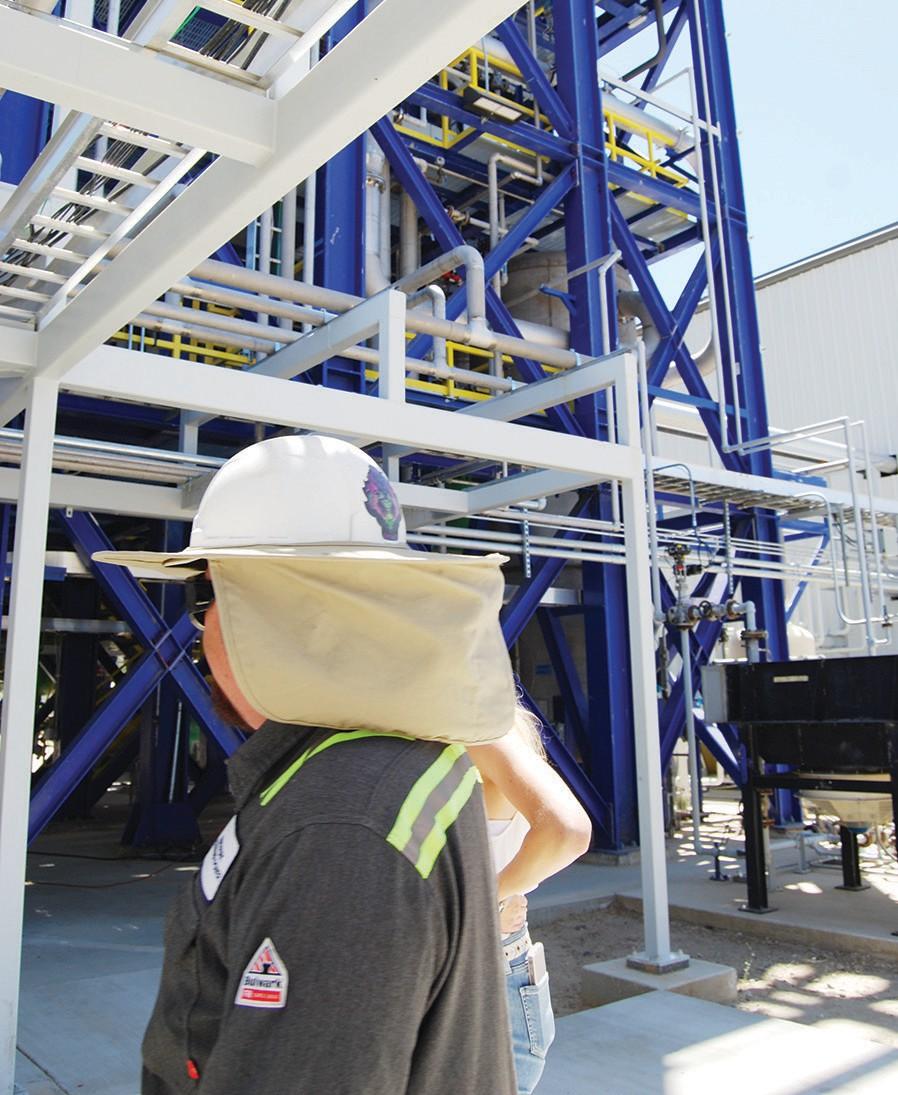
The Coulterville Water Treatment Facility has piping and fittings that are badly corroded, some water meters remain unread because they are buried deep under sidewalks and the entire water system could fail if a break occurred, the Pinnacle report found.
The situation at the Coulterville Wastewater Treatment Facility sounds even more dire. The wastewater lift station has no generator, so if there is a power failure, a manual gas powered pump is the only thing preventing sewer overflow to Maxwell Creek — and then into Lake McClure.
Neither system has remote monitoring or backup power, according to the county, which describes current maintenance as reactive, in “firefighter” mode.
But some community members are critical of the Pinnacle report and its analysis.
“They relied on wrong numbers,” said Rhodes, the community member, who said the report doesn’t use an accurate number of ratepayers. “I have no confidence in any of these numbers,” she added.
Other residents scoffed at the labor requirements for the water and wastewater systems. Labor is 67 percent of the total cost of the systems.
Some residents wondered why it takes two workers to read the meters and why workers are frequently seen sitting in their vehicles.
County officials have said that six people should manage the four utilities, instead they are scraping by with only three fulltime employees.
Looking for solutions?
“We can’t pay a million dollars a year without bankrupting you and without bankrupting the county. We’re not on opposite sides of the issue,” Lynch told the crowd.
At one point, Lynch outlined four solutions: A rate hike, a rate hike with repayment of the county loans, the district could go into receivership or the county could look for alternative financing.
Two previous rate proposals failed in 2018. A partial rate increase was approved in 2019.
With any kind of rate increase likely blocked by the Proposition 218 process, which requires more than 50 percent of the ratepayers to protest an increase, Lynch said he is focused on finding alternative funding.
Rhodes pointed to the California SAFER Drinking Water Program, which directs $130 million a year in grants for safe, accessible and affordable drinking water.
Coulterville was “relying on the county to be the interface for these grants,” Rhodes said.
County officials have repeatedly said the districts are ineligible for loans through the state because they are required to show at least two years of financial sustainability.
Lynch said the county applied for SAFER grants but that Coulterville didn’t qualify as an “opportunity zone,” but he added downtown Mariposa did qualify.
That elicited angry heckling from the crowd.
Rhodes said Coulterville is a severely economically disadvantaged community and should “go straight to the top of the list.”
Rhodes noted that the county gave a much rosier impression of the situation in Coulterville when it submitted its Housing Element earlier this year to the California Department of Housing and Community Development.
“If you guys kill Coulterville, 100 percent you’re going to get sued by Housing and Community Development,” Rhodes said.
“We’re tired of being the bastard children. We’re tired of getting the short end of the stick,” she said.
Rhodes, a former assistant DA in Stanislaus County, suggested that some kind of receivership isn’t an option for the utility district, either. She said supervisors would be abdicating their “duty of care and loyalty.” She said members of the community are consulting with lawyers.
In the end, several residents said they left the meeting frustrated that the county didn’t come to the table with any workable solutions.
“You can chicken dance this all day long,” said Hein. “You mismanaged this. Now its up to you to fix this.”
Lake Don Pedro
County officials got a cooler reception earlier Saturday morning at Lake Don Pedro High School.
The problem in Lake Don Pedro with its wastewater treatment facility are somewhat similar, but a potential solution may be more readily apparent.
The existential fears are exactly the same.
“You’re threatening people’s homes and their livelihoods,” said resident Mike Guenther.
“This place will be a ghost town,” he said.
Lake Don Pedro has 114 customers who currently pay $41 a month for wastewater treatment. Under the proposed rate hike they would pay $258 a month next year and $358 a month by 2030.
Currently, the ratepayers provide $151,000 in revenue, but expenses are $341,000, leaving a $216,000 operational loss.
That amount doesn’t cover the $596,000 the district owes in loans for ongoing maintenance.
Residents blocked three previously proposed rate increases.
Poe, the county supervisor, told the group of homeowners the situation was unsustainable.
“All your doing is kicking that can down the road. This can has been kicked down the road so many times there’s no more can left to kick,” Poe said.
“It sounds like you’re blaming us, which is not fair,” countered Guenther.
Local real estate agent Kim Medeiros said the situation has already had an impact on home sales.
“People are coming into my office in tears asking how are they going to sell their home,” Medeiros said.
“People are telling me I can’t afford to live here anymore, in one of the few places they could still afford in California,” she said.
From dream to nightmare
Lake Don Pedro is a cautionary tale of how ambitious dreams can be thwarted by Mother Nature.
Boise Cascade developed the area in the late 1960s and early 1970s, envisioning it as a potential resort destination.
But due to the shallow bedrock geology of the area, a wastewater treatment plant was needed and the Don Pedro Community Service Area was created in 1969.
Water services are covered by a separate utility that is not involved in the rate hike controversy.
The area was later partially developed by Thomas Porter, the founder and former CEO of The Deerwood Corporation.
Porter, who died in 2018, had envisioned a luxurious recreational area with 250 homes surrounding the golf course, which opened in 1971.
In 2006, two bonds were issued by the USDA totaling $5.7 million to build a new wastewater treatment center.
Development in the area ultimately stalled when the Lake Don Pedro Golf & Country Club closed in 2010, in part due to the high cost of water.
Left in its wake is a desiccated 18-hole golf course, a shuttered clubhouse, 18 adjacent town homes and 100 homes dotting the nearby hills, several with for sale signs.
A couple of years ago, a San Diego based company called Crestline Cove, now known as Surf Loch, bought the old golf course for $2.8 million and proposed a so-called “wave pool.”
Under the plan, a three-acre, in-ground pool would use hydraulic pistons to mechanically generate waves big enough to surf. The company developed a similar project in Palm Springs.
The wave pool project appears to have stalled in the development process.
But the company has already paid back taxes for the golf course and other neighboring properties it purchased at auction.
Lynch, the county’s administrative officer, said they are looking at the legality of using $3 million sitting in a bond account for operation and maintenance of the wastewater system, or perhaps getting “one big new bond” and paying off the old bonds.
It would be an elegant solution to what appears to be an intractable problem.
Lynch told the community he hoped to have some answers about that approach in the next month.
Beginning of the process
If the Mariposa County Board of Supervisor approve initiating a rate increase, a notice will be mailed to all affected property owners, opening up a 45-day protest window. Public hearings will also be held.
It will take more than 50 percent of the ratepayers to block the increase, something that has happened repeatedly in the last 20 years.
The Mariposa County Board of Supervisors could then initiate a receivership process, in which the county would petition the Mariposa County Superior Court to select a receiver, who in turn could select a private company to operate one or more of the districts.
“The big drawback in receivership, any way you look at it, we no longer have any consideration over the rates,” said Guenther, the Lake Don Pedro resident.
“If a private corporation takes it over they tell us what we pay and we have no recourse,” he said.



Responses (0)