


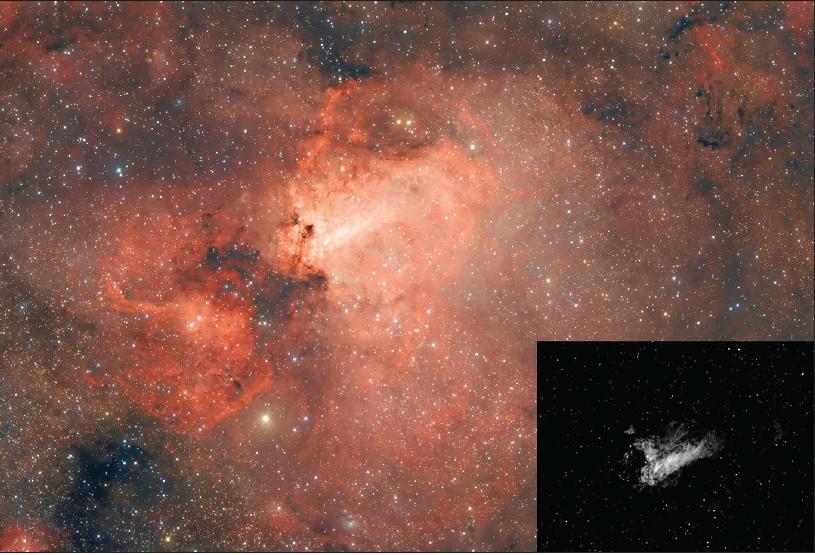

An image of the Swan Nebula (M17) taken by the author from Bootjack. The inset simulates what you would see in a moderate to large telescope.
The year 2026 seems to be just sailing by. So far, in February, we had the Winter Olympic Games, then in April the Artemis II mission took four astronauts around the Moon and just last month we had the Soccer World Cup and celebrated the 250th anniversary of our nation’s birth.
It has been a busy year! Already we find ourselves in August, the month named for the first emperor of Rome: Caesar Augustus.
The word Augustus comes from the Latin word meaning “majestic,” “venerable” or “honored.” Those terms are certainly an apt description of our night sky this month. Read on and I will hopefully convince you that this is an ideal time to get out and reconnect with the universe.
The Milky Way riding high
This month is an excellent time to explore our home galaxy, the Milky Way. As the Earth makes its yearly journey around the Sun, our perspective of our galaxy changes.
In the winter, we face away from the Milky Way’s center — or core — which is hidden in the Sun’s daytime glare, and we see only the outskirts. In the summer, however, we face inward, and the core reveals its wonders to us. August is my favorite time to get out under the stars because the majestic Milky Way arcs directly overhead early in the evening.

Manny Leinz
Many of the night sky’s greatest treasures can be seen by going out in the evening and looking low and generally south, to the constellation where the core — and its gigantic black hole — live: Sagittarius. The name Sagittarius comes from the Latin word for “archer.”
He is often depicted as a half-human, half-horse centaur, drawing his bow. As I look at Sagittarius’ pattern of stars, however, I find it more useful to imagine a celestial teapot, with the “steam” of the Milky Way’s core rising from its spout.
If you have binoculars, or ideally a telescope, there are many gems to see in and around Sagittarius. The constellation is home to a number of so-called “globular clusters,” dense groupings of hundreds of thousands, or even millions of stars tightly bound by their mutual gravitational attraction.

The Milky Way’s core reveals celestial wonders including globular clusters and nebulae in the constellations of Sagittarius and Scorpius
Many of these clusters are believed to be the remnant cores of dwarf galaxies gobbled up by the Milky Way billions of years ago. The brightest globular cluster, to the left and slightly above the teapot’s lid, is M22, or Messier 22, which at a distance of 10,600 light-years, is one of the closest clusters to Earth.
Following the Milky Way above and to the right of the teapot, we find three nebulae: the Lagoon – M8, the Trifid — M20, and the Swan or Omega — M17. These nebulae are regions of mostly hydrogen gas and dust, where new stars are actively forming. All three can be spotted with binoculars as distinct gray patches against the fainter background of the Milky Way.
Telescopes begin to reveal more details of the nebulae structures. Sweeping this entire region with binoculars or a telescope reveals many more star clusters and nebulae for those patient enough to linger.

Venturing to the right, or west, of Sagittarius we come to the constellation Scorpius, the — you guessed it — scorpion. The heart of the scorpion is the red giant star Antares – “rival of Mars” to the Greeks — because its rusty glow was often confused with the red planet.
Just to the right of Antares lies another bright globular cluster: M4. At only half the distance of M22, M4 is the closest globular cluster to Earth. It is visible as a fuzzy star in binoculars, while small telescopes begin to resolve some of its 100,000 stars.
To see my favorite globular cluster of them all, train your binoculars or telescope, and crane your neck, nearly straight up to find Vega, the bright star in the constellation Lyra, the Lyre. Now move to the west about 25 degrees, the distance between your thumb and pinky with your hand stretched out at arm’s length, to find the “keystone” in the constellation Hercules, the Hero.

Celestial gems in the constellations Cygnus, and Hercules including the great globular cluster, M13, and the color contrasting double star, Albireo
The cluster, known as M13, is about one-third of the way between the northwest and southwest stars of the keystone. M13 contains up to a half million closely packed stars and was famously the target of the “Arecibo Message,” a radio signal sent from Earth in 1974 as a demonstration of human technology, rather than a serious attempt to contact alien life. The message will not arrive at the stars of M13 for another 25,000 years!
Why all the Ms?
You may be wondering why all of these celestial objects are labeled “M” followed by a number. The M refers to 18th century French astronomer Charles Messier, who compiled and published a catalog of 110 celestial objects.
Messier was a dedicated comet hunter who discovered over a dozen comets during his career. Frustrated by repeatedly confusing other celestial objects with comets, he published his initial catalog of 45 nebulae, star clusters and galaxies in 1758.

The great globular cluster M13 in the constellation Hercules, taken by the author from Bootjack. Views through moderate to large telescopes can approach this level of detail.
By the time of his final publication in 1781, the list had grown to 103 objects. Today, the catalog contains 110 objects, including seven that were discovered and documented by Messier and his observing partner, Pierre Méchain, but didn’t make it into the 1781 catalog.
The Messier catalog is a useful tool for amateur astronomers, as it provides a guide to the brightest — and therefore easiest to see — celestial objects in the northern hemisphere sky. A right of passage for dedicated amateurs is the so-called “Messier Marathon,” an attempt to see all 110 objects in a single night!
Speaking of comets … and meteors
The nights of Aug. 12-13 are particularly special this year, as they mark the return of the annual Perseid meteor shower. Meteor showers are caused by the Earth flying through the dusty debris left behind by the passage of comets.
The particular comet associated with the Perseids is Swift-Tuttle, independently discovered in July 1862 by the two astronomers whose names it bears.
Comet Swift-Tuttle is huge — its nucleus is 16 miles in diameter — and it orbits the Earth once every 130 years. Its last visit was in 1992, so it will be back in almost exactly 100 years. Mark your calendars!
Anyway, Swift-Tuttle has left behind an enormous amount of dust and ice during its many laps around the Sun, so the Perseid shower is arguably one of the best of the year. And this year, the shower coincides with the New Moon, so skies will be as dark as they get!
Experiencing a meteor shower is easy. Find as dark a place as you can, or at least get away from local light pollution like streetlights or security lights. Bring a lounge chair so that you can recline comfortably facing the darkest part of your sky.
No optical equipment — telescopes or binoculars — are needed; meteors can appear anywhere, so you want to see as much of the sky as possible. You may want to have some snacks and a favorite beverage handy as well, along with a blanket and some bug spray.
The most important thing to bring is patience. I would allow at least a couple of hours of viewing. It takes time, 30 to 45 minutes, for your eyes to totally adapt to the dark so they are most sensitive to dimmer meteors. Plus, the longer you watch, the better your chance of seeing some bright meteors, maybe even a spectacular fireball that briefly lights up the ground and leaves behind a ghostly trail in the sky.
Under perfect conditions you may see 60-80 meteors per hour — better than one a minute, on average! Meteor viewing will be good any time after it is truly dark which about 9:30 p.m. in Mariposa on Aug. 12, but you’ll have the best chance to see more meteors as the night progresses and the radiant — the point in the constellation Perseus that the meteor trails appear to trace back to — gets higher.
The radiant will be highest in the sky just before morning twilight begins which is about 4:30 a.m. Kudos if you are able to stay up that long!
What else is up in the sky this month?
Venus continues to sink lower in the evening throughout the month. Still, it is so bright that it’s easily seen even before the sky gets completely dark. Spot Venus low in the west-southwest half an hour after sunset throughout the month.
Both Mars and Saturn are moving higher in the sky and will be visible as morning objects for the rest of the year. Look for Mars low in the eastern sky before dawn; Saturn will be visible low in the east after midnight.
Finally, don’t miss the near total lunar eclipse on the night of Aug. 27! The eclipse begins before dark, and by 9:13 p.m., 96 percent of the lunar disk will be bathed in Earth’s shadow. By 10:52 the show is over: the Earth’s shadow has retreated and the full Moon shines brightly.
I hope you have a chance to take in the majestic Milky Way this month. There’s a lot to see, from planetary pairings to a meteor shower and a lunar eclipse!
To get help finding planets, stars, and other celestial sights checkout skyandtelescope.org/interactive-sky-chart/ or theskylive.com/.
There are also some great free smartphone apps, including Stellarium, SkySafari and SkyView. As always, if you have questions, comments or suggestions for future articles, you can get in touch with me by email at: celestialdeep55@gmail.com.
You can find my prior Gazette articles — including ones on meteor showers and eclipses — plus night sky photos and more on my website at celestialdeep.space/
Manny Leinz is a long-time amateur astronomer and night sky photographer. He and his wife live part time in Bootjack where they also have an observatory.








Responses (0)