


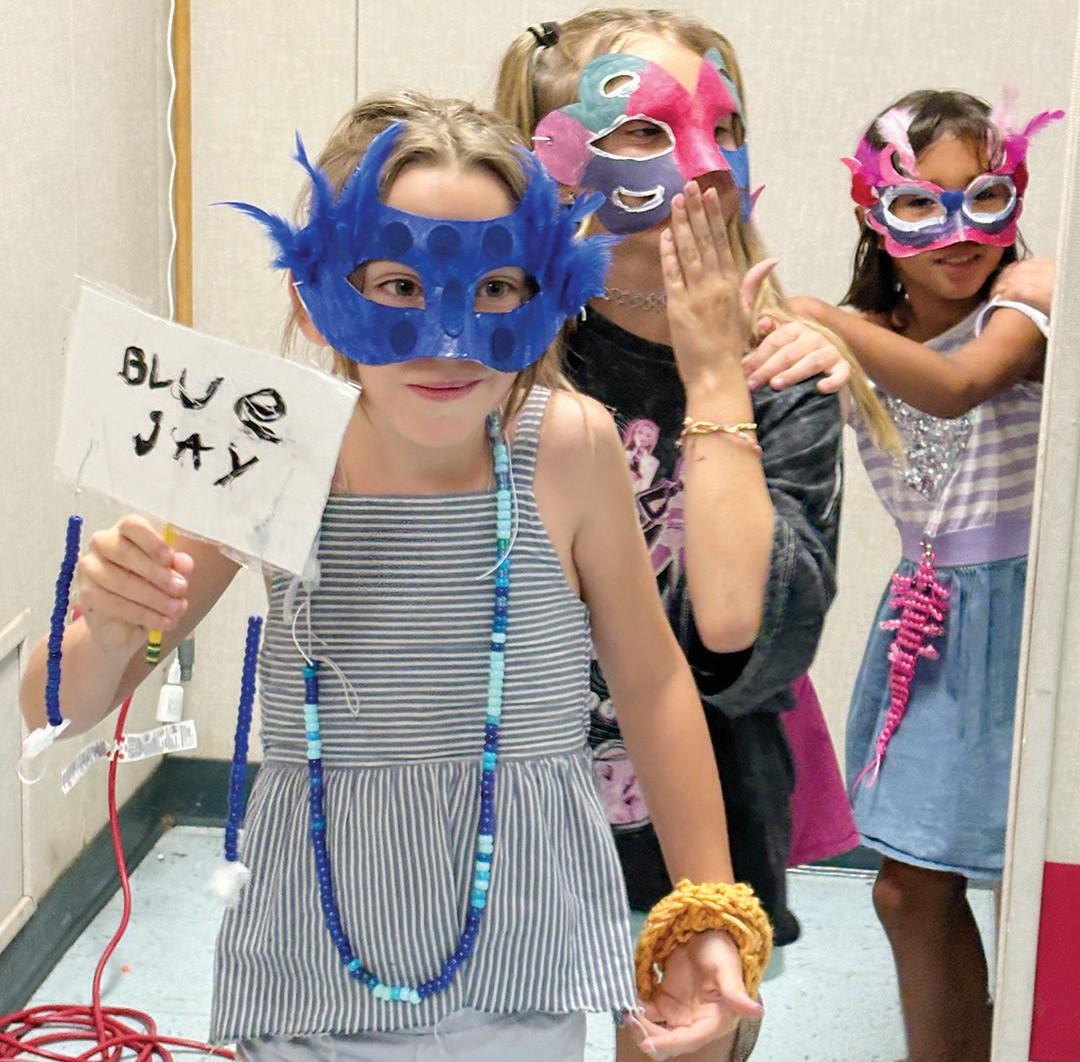

Azura Braselton, Norine McNally and Jaylah Urista lead the parade of third graders as they interacted with the audience before taking the stage. Photo by Greg Little
Technically, it is a “camp.”
However, what goes on during this program is much more than your typical summer program.
The Arts + Nature Summer Camp concluded its six-week run last Friday, and there’s little doubt the 100-plus students who attended left with a lot more knowledge than when they entered.
“There are so many magical moments,” said Andra Kovacs of the Mariposa County Arts Council, one of the organizations that operate the camp.
Besides the arts council, the camp is conducted in coordination with the Sierra Foothill Conservancy and the Mariposa County Unified School District. All are key partners, said Kovacs.
The camp is free for the students who attend. It is for students in TK-6 and programs are geared for each of the age groups.
“There are special experiences,” said Kovacs.
Those experiences are varied. She said there is learning expression, learning “this place” meaning the natural landscapes of Mariposa County and learning “a sense of belonging,” to name just a few.

Camp co-directors Nancy Fluharty (with microphone) and Andra Kovacs speak to the crowd about the community support it takes to run a program of this scale. Photo by Greg Little
Nature at its finest
The camp focuses on natural surroundings — and much more.
Part of the experience, said Kovacs, is having a “social and emotional program built into” the daily processes of the camp.
Whether that is enjoying a concert at Mariposa Elementary School, where the camp is based, or understanding plants along the Mariposa Creek Parkway, the variety is endless. There was even a field trip to Yosemite National Park.
That, said Kovacs, is something many might not think is important, but she said for many people who live in this area, Yosemite can sometimes become an afterthought even though it is one of the premiere parks in the world, not to mention the driver of the economy.
“This is a smaller version of community,” said Clay River, another arts council employee who is involved deeply in the camp.
Kovacs said the fact the camp is based at MES and they utilize other outdoors areas around the community, giving it a special feeling.

A group of students are shown performing on stage during the Camp Family Fest at Mariposa Elementary School. Photo by Cara Goger
“There is so much to process because of the space and capacity,” she said.
In addition, she said there is a feeling among the staff “we have a lot more freedom here” than in a normal classroom setting.
And that’s a major point.
“We have to make sure we are leading from our hearts,” said Kovacs.
As well as their minds.
The camp features daily workshops ranging from art to science to just about anything in nature — and well beyond.
Kovacs said all of the curriculum taught during the camp is to California state educational standards. Yet with it being a summer camp, there is wiggle room to be able to show young people various aspects of learning.
“The whole point is to be teaching in a different way,” said Kovacs.
At crucial intersection

Finn Schneider (5th grade) and Mystery Winsor (4th grade) join Andra Kovacs in playing their camp anthem “The Little Oak Song.” Photo by Greg Little
Kovacs has been involved with similar programs her entire adult life.
“I have worked in similar programs,” she said.
She first came to this camp a few years ago and that’s what led to her position at the arts council. Though she shies away from saying she’s running the camp, noting it’s a partnership, there’s little doubt who people come to with issues, problems and suggestions.
Through that experience, Kovacs feels she has gained insight into what works, what doesn’t and what new twists or innovations might work.
This camp, she said, “is the intersection between art and nature.”
That’s a pretty wide open interpretation — by design.
Whether students are learning basic art skills or understanding animals in nature, Kovacs said the entire process also unlocks the humanity in young people.
“It’s to give them a sense of home,” said River.
As a Native American, River said there is a little different insight, noting for Native people, the “landscape has always been home.”
Camp organizers want to instill in the young people the importance of nature and how it is a natural part of being human.
Lasting memories
Kovacs was asked about how the young people have reacted to this year’s camp.
“There is a passion for camp,” said Kovacs. “It lasts all year long.”
River said sometimes when the arts council is doing a presentation in an area school, the students talk about camp.
“But that’s six months away,” River reminds them.
To no avail.
One of the highlights of the camp happens a couple of weeks before it is over. The “Camp Family Fest” is an hour-long celebration during which parents and guardians get a chance to be entertained by the youth.
River said some of the performances and videos made by the young people show just how talented they can be given the right tools.
“We are under-served here,” said River. “They have no understanding what they are capable of doing.”
But with the help of the counselors and others, that understanding comes to light — for everyone to see.
From a Michael Jackson impersonation to the singing of a catchy song about oak trees, there is no lack of creativity at this camp.
“I am blown away everyday” said Kovacs.
Part of that stems from the fact so many people and businesses get involved with the camp. Many conduct workshops for the students showing them their areas of expertise.
Some help fund programs, like the Mariposa County Library, which established a mini-library at the camp this year. Kovacs said it is “one of the most” visited places at the camp.
That means even more good news: young people are still reading books.
All of that, said Kovacs, teaches valuable lessons to the students, including teaching them to be “future land stewards” of this area.
River said it’s possible many of them don’t realize they can build a life in the place they grew up and the hope is learning at this camp may be the beginning of that road for some.
Kovacs said she believes the fruits of the labor put into the camp may not even be known until years down the road, but that makes is all the more rewarding for those who are organizing the camp and teaching young people valuable lessons.
A good tired
Both Kovacs and River were both noticeably feeling what the prior six weeks had been like last week as the days dwindled for the camp. They acknowledge it is exhausting — and who wouldn’t dealing with that many children of varying ages for such a long period of time.
Yet both also acknowledged that hard things are exhausting, but the rewards are worth the effort.
“There are so many deep friendships,” said Kovacs.
Those friendships are among the people who run the camp as well as those who help in various ways.
River said in many ways, the camp also serves as “professional development” for people, who maybe learn a thing or two and then can apply it in their professional careers.
Kovacs also made an interesting observation about the people who have operated the camp: “We are at camp, too.”
In that vein, she said that’s why “we want to make it fun” while at the same time teaching the young people about so many aspects of nature, science, art — and life.
“There is an entire ecosystem,” said Kovacs, who in this case was not referring to nature but to the many people and community partners who make the camp happen each year.
Whether it is nature or art or simply showing a young person how to interact with others, the annual summer “camp” does that and so much more.

Responses (0)