


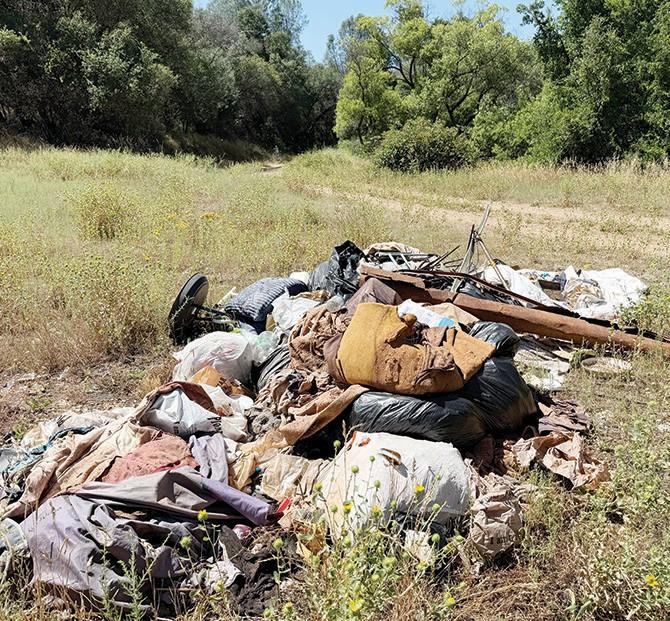

Shown is a former homeless encampment near Mariposa Creek. Before the recent saturation patrols, the county estimated 24 people were living along Mariposa Creek. A sign created by a homeless woman is also shown at left. Photos by Tom Lyden
Walk the path along Mariposa Creek like this reporter did last weekend and you will find a number of trails leading up the hills to abandoned campsites with the flotsam and jetsam of a life of homelessness: Mattresses, blankets, cooking supplies, grills, food containers and trash.
Lots of trash.
But you may also find people living complicated lives, often by choice, that defy the stereotypes and cliches.
Social service workers have a term they use to describe such individuals: Self-determining adults.
Take the man with a machete.
I encountered him walking along the trail with a young woman and their two pit bull mix dogs, carrying most everything they own.
The man, 52, tan, taut and shirtless, with a machete sticking out of the belt of his sagging pants, said he has lived in Mariposa for 16 years.
He recently found a job, he said, but it doesn’t pay enough for him to make rent, even if he wanted to.
The woman, 23, is from Tennessee and said she was escaping the conformity of her former life and her family’s rigid expectations.

The two are friends and said they stick together for protection and to look out for one another. They declined to provide their names for publication.
Both said they are without a home by circumstance and choice.
“I support the sheriff, but what they are doing now is inhumane,” said the man about the recent law enforcement crackdown along Mariposa Creek.
“They (deputies) said if I’m caught out here again, I’ll be arrested.”
“They used to let us kind of police our own. So if there was an issue in the community, the sheriff would let us know that it needed to stop,” he said.
But that sort of uneasy detente with law enforcement changed on May 23 after the sword attack at the nearby Creekside Terrace Apartments.
The manhunt and saturation patrols that followed apparently forced many of the people who lived in the encampments to pack up and move out.
At least for now.
The young woman took me up the hill to a former homeless encampment she has been cleaning up.
It is something she does to pass the time, she said.
It began when she was picking up “rigs,” the hypodermic needles used to inject drugs that users had left behind. She was afraid one of her dogs would be stuck by a needle.
The encampment was surrounded by the detritus of the unhoused, but also full white trash bags and piles of recycling.
Despite her clean-up efforts, she was recently issued a citation by deputies that she hung on a tree branch with a message.
“This is not a camp. It’s a cleanup project I do for fun. Please leave us alone,” she wrote.
She added a post-script with the attached citation: “Here’s my information so you can f**k me over with another court date.”
While giving this reporter a tour she held a long knife by her side, apparently cautious about the stranger she had just met, or perhaps anyone else she might run into.
A walk talkie she held squawked. It was the man with the machete.
“Are you okay,” he asked. “I’m fine,” she said.
The couple said they pack out what they pack in and they don’t start campfires.
“The two of us are not back here trashing the place,” the woman said.
“The problem is you get people from the city who come up here and try this. They don’t know what they’re doing and they start fires.”
The outsiders are also bringing up fentanyl and heroin, they said.
“I quit running and gunning and doing all that a few years ago, but I used to sell drugs out here,” the man with the machete admitted.
“And when fentanyl and heroin would come up, we’d push the guys out. We didn’t want it here. It does different things to people than meth does. I mean, not that meth is great, but the heroin and fentanyl, they’re killers,” he said.
“It’s brutal out here,” he added.
So why stay? Why not go to the shelter, or try to find housing through social services?
Been there, done that, they said.
“There’s more drugs at the shelter, and mental illness, too. I don’t want to be a part of that,” he said.
And Creekside Terrace Apartments?
“That may be the most dangerous place of all over at Creekside. How many stabbings in that place the last two years?”
As for the machete he carries, he said it’s a tool for his life in the woods. He recently saw a bear and a mountain lion. He has killed his share of rattlers too.
“This is what I love to do. I prospect, I look for gold, crystals. They’re kind of interfering with my pursuit of happiness. And I’m not hurting anybody.”
They see themselves as people who live off the land, not unlike the early settlers or the indigenous people who roamed the same creek bed.
The young woman said, “People think we’re crazy for it. But people try to dictate everything, everywhere.”
“You can’t dictate to us if you can’t find us.”


Responses (0)