


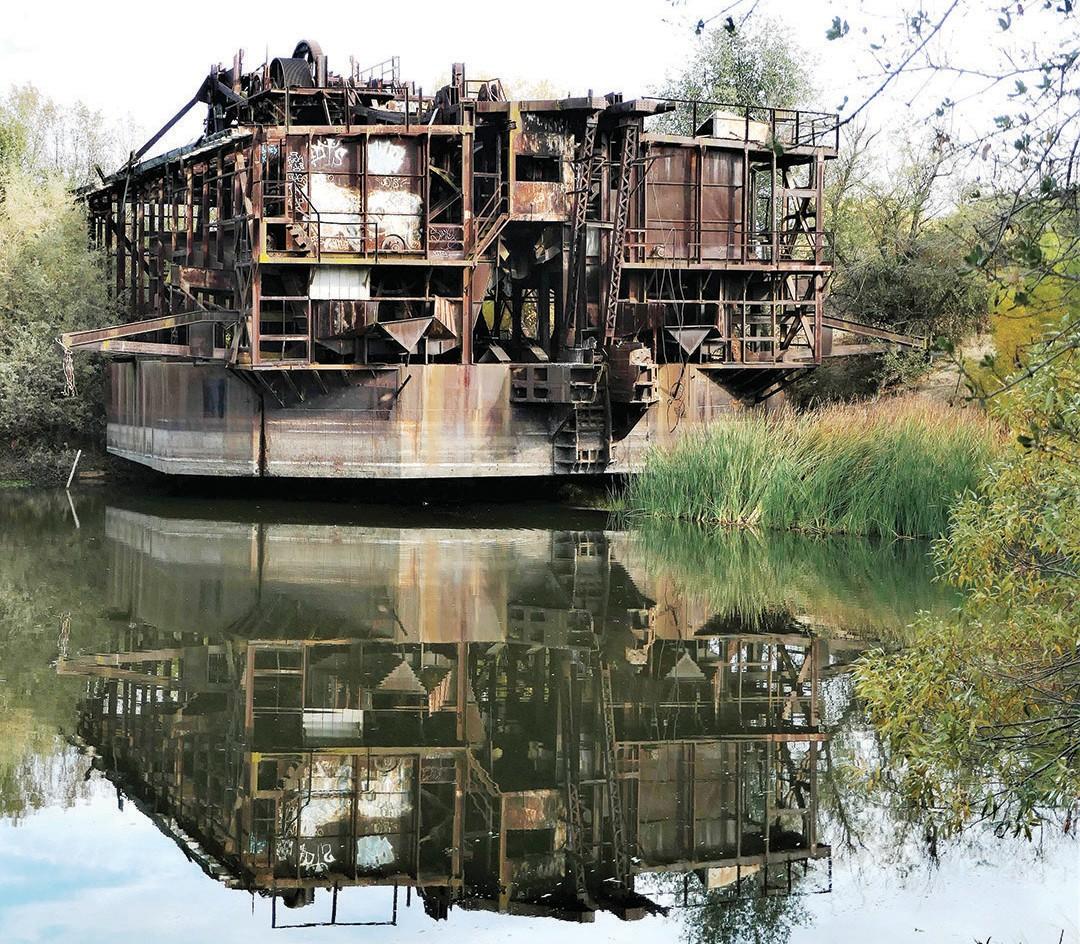

The Tuolumne River dredge that weighed 2,500 tons powered by electricity in use 1938-1951. This is what it looked like in 2020, heavily vandalized over the years. Photo by Linda Shepler
About 120 miles long the, California Mother Lode region is an historic gold rich area along the western Sierra Nevada foothills, stretching across multiple counties and featuring significant mining history.
Despite its importance in the story of California, few know about it or have visited the area except a few highly publicized areas such as Mariposa, Sonora and Yuba River environs.
I decided to dig a little deeper and realized the Mother Lode is an ancient gold bearing belt in the Sierra Nevada foothills spanning about 150 miles from southern Mariposa County environs to northern Yuba and Sierra counties.
The Mother Lode encompasses 13 counties, though the heart of Gold Country is often described as covering eight counties. Before long, I realized the extent of my knowledge was puny.
Beyond Mariposa, I knew very little. But as luck would have it, the universe opened up and led me to the wee town of La Grange in Stanislaus County.
It started when I stumbled across an old photograph of a gigantic gold dredge working the Tuolumne River on the outskirts of a tiny town called La Grange in neighboring Stanislaus County. Made me chuckle because of the old rock song of the same name by a popular bearded band called ZZ Top. A French name seemed odd and set me off on a wonderful journey to find out more about this settlement.

Author Sharon Giacomazzi talking history with La Grange resident Pam Penrose. Photo by Linda Shepler
On the outskirts of tiny La Grange I found the plaque marking the site of the famous gold dredge that began operation in 1938 and floated on a self-created pond. I had to see it and shamefully ignored the “No Trespassing” sign and presence of dozens of bee hives.
When I saw the famed dredge so badly vandalized I was shocked and saddened by its condition. Once about four stories tall, its remains thrusting out of the river pond were still impressive.
A mile or so past the plaque, I reached La Grange, population 116, elevation 259 feet. The community is small and very conducive to strolling about to feel its pulse and see exhibits, graveyards, church and schoolhouse.

The dredge bucket, 120 of them that dug 70 feet deep to recover gold. Photo by Linda Shepler
I found the setting to be very photogenic. A walk along Main Street is especially interesting. There’s something about old buildings that always grabs the eye.
If you visit on a Sunday, the museum will be open at eleven. Don’t miss the opportunity to go inside and chat with the docent. Because of its early and significant history, La Grange is a registered historical landmark No. 44. The saloon has great food and western small town ambiance.
In the beginning it was a wild town as were most early gold rush settlements. Originally established by French people and called French (sand) Bar, it was later renamed La Grange, “the farm or the barn” after the massive 1851-52 flooding of the Tuolumne River.
By 1854 there were more than 100 buildings in town. It flourished as a mining and agricultural center in Stanislaus County for few years. In the early years it had a large Chinese population.

The Catholic Church in the old cemetery is worth a visit. Photo by Linda Shepler
Typical of boom towns fueled by gold, the population dwindled when it petered out. The men were not interested in farming or ranching and left for other strikes to get rich quick. Or so they thought.
In case you didn’t notice, driving into La Grange, there is another very important historic feature in full view but not accessible to the public. The La Grange Dam was constructed in 1893 to divert water from the Tuolumne River into a canal system for agriculture downstream.
It was not designed to capture and hold water. This diversion dam has an unusual “face.” Instead of concrete, its surface was beautifully built with local natural stone which you can see if water is not pouring down during spring runoff.
Gold rush survivor La Grange and surrounding landscape are certainly worth a drive to explore and photograph a piece of our California heritage that is off the beaten track.
Because of its very low elevation, plan your visit in spring, late fall or even early winter. There is an excellent video I encourage you to watch: History Hunter, 1852 Gold Rush Town Forgotten by History.

A painting of the dredge in the museum. It cost $540,000, powered 120 buckets and floated on a self created pond. Photo courtesy of La Grange Museum
Directions: Forty-two miles from Mariposa, drive Highway 49 north to Bear Valley and turn left at the sign for Hornitos. Do not drive into town, proceed toward Snelling on Merced Falls Road. Turn right on La Grange Road and follow it to Highway 132 east in La Grange.
Sierra native Sharon Giacomazzi is the author of Sierra historical hiking guidebooks and articles for outdoors publications. She can be reached at sharong@sti.net. “Feet are like dogs, they are happiest when going somewhere.”

Diversion dam built in 1893 faced with natural stones. Photo courtesy of La Grange Museum

County jail, 1856-1862. Still standing in town. Photo by Linda Shepler

Sharon Giacomazzi

March 2026 photo of the dam not for storage but used for irrigation. Photo by Linda Shepler

The original Hammond and Bates1800s store building. Photo courtesy of Western Mining History.

Responses (0)