


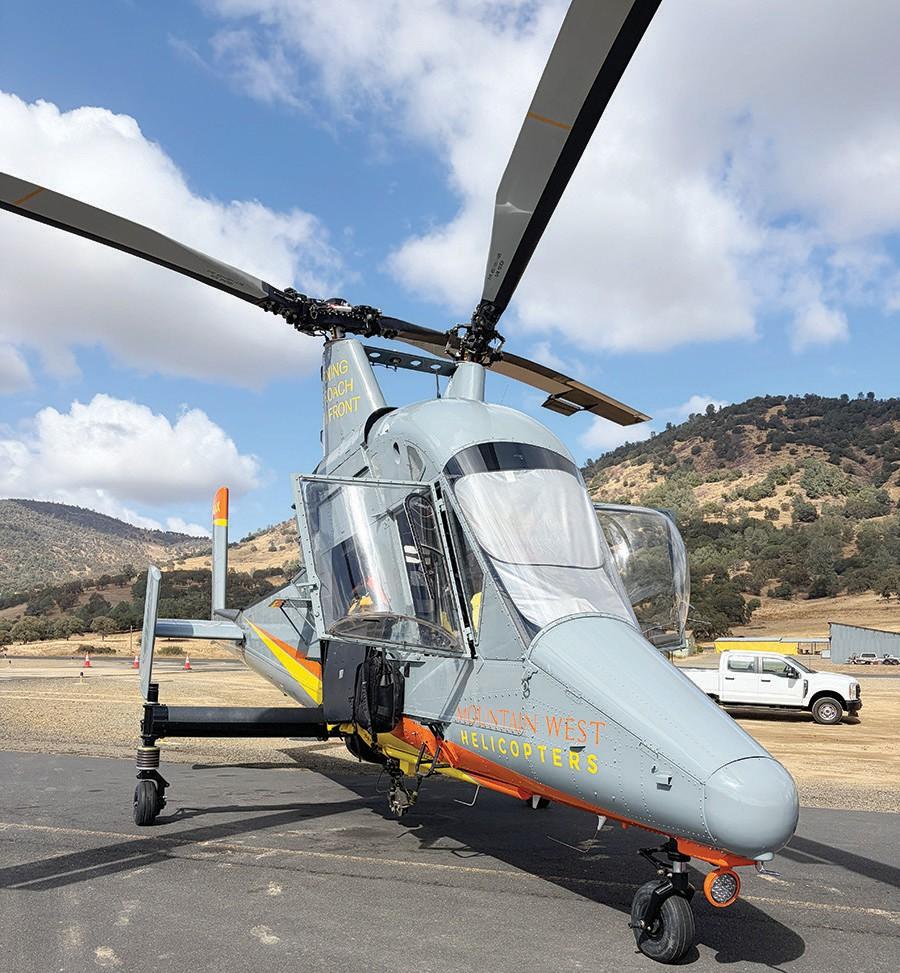

K-MAX helicopter shown grounded at Mariposa-Yosemite Airport. Photos by Sara Solano Aguirre
Every evening, helicopters fighting the Dome Fire have 30 minutes after sunset to be on the ground. The crew at the Mariposa Yosemite Airport calls it “pumpkin time.”
Travis Wilkerson, qualified deck coordinator at the helitower, explained that night vision qualified aircraft are mostly restricted for the military and their operations differ from the federal government level. So when the light fades, the aircraft stop.
Wilkerson went into how orders and communication work within the crew to the other divisions and branches.
In their trailer, the crew works 16 hour shifts and surrounded by computer screens, radios and waves of information, they have to document and even write on the trailer’s walls to make communication run smoothly on base.
“Each helicopter aircraft has a national tail number, right? And so we will shorten it by just the last three digits of that tail number. So Seven Mike Whiskey… K-MAX…Pad 15… And this is just a visual representation of your layout,” Wilkerson said.
 4.jpg" alt="Dana Ensminger, Heli base manager, is shown taking a call in a helibase trailer." width="830" srcset="https://www.mariposagazette.com/wp-content/uploads/images/2026-10-22/27p2-830x1024.jpg 830w, https://www.mariposagazette.com/wp-content/uploads/images/2026-10-22/27p2-243x300.jpg 243w, https://www.mariposagazette.com/wp-content/uploads/images/2026-10-22/27p2-768x947.jpg 768w, https://www.mariposagazette.com/wp-content/uploads/images/2026-10-22/27p2-400x493.jpg 400w, https://www.mariposagazette.com/wp-content/uploads/images/2026-10-22/27p2-81x100.jpg 81w, https://www.mariposagazette.com/wp-content/uploads/images/2026-10-22/27p2.jpg 900w" sizes="(max-width: 830px) 100vw, 830px" loading="lazy" />
Dana Ensminger, Heli base manager, is shown taking a call in a helibase trailer.
Picture this scenario:
Radio caller: “Hey, what ship (helicopter) is Bob on?”
Airbase radio operator: “That’s waiting until X-ray. He’s on Seven Mike Whiskey”
In this case, the helitower crew is saying that the helicopter that Bob is on is grounded and waiting for an X-ray inspection. As for “Seven Mike Whiskey,” it is a military abbreviation for a special kind of helicopter, most commonly known as a “Black Hawk.”
He explained that night vision qualified aircraft are mostly reserved for the military and their operations differ from federal government level.
So how does communication actually work? According to Wilkerson, it goes something like this:
Division: “Hey man, look, I’m seeing that you’re coming up on day 13. You guys are spiked out on the hill. We’re looking to get you guys out of here by 14:00 tomorrow. Does that sound okay?
Day 13 Crew: “Sounds good.”
Then, the following steps will take place:
1. Divison places order with designated areal supervision
2. Order comes back from helitower as a 213 or general message
3. Helitower crew gets the information
Aerial supervision order: “Hey, Bear Creek Hot Shots needs to get extracted off heli spot one at 14:00.”
4. Order gets printed out
5. Helibase manager puts order on the mission board
6. Crew makes decision to choose a helicopter
Helibase tower: “Pad three, we got a mission for you. Are you ready to copy?
Parking Center: okay, wait, we got a ship extraction starting at 14:00 at heli spot one.
“And so that’s how that whole chain of command works like that,” Wilkerson explained.
How the base ended up at the Mariposa-Yosemite Airport
“This is a public airport, and it’s meant for the public. And so when we have large incidents like this, where we know we’re gonna have a ton of aircraft,” said Dana Ensminger, helibase manager at the helitower. “Generally, I prefer, especially out in the region that I work in, most pilots would prefer it too, is that we do not operate out of airports.”
Although airport facilities such as toilets and food are nice, “we kind of stuff things up, so we prefer to just use our public land,” Ensminger said.
Most of the time, the first aircraft on scene or the Forest Aviation Officer will make the decision of whether to use public land, park land make a land service deal, or use the nearest airport. Also, Ensminger said that in other cases, a Unit Aviation Officer will find a location that works best for both the aircraft and the public. “If it’s private land, you do a land use agreement, if it’s a public airport, like this, you work with airport managers, if it’s a private airport, you also do a land use agreement and if it’s on public land, it’s free,” Ensminger said.
Starlink changes how the fire is run
Satellite internet has changed daily operations on wildfires over the last couple of years according to Sean Collins, Public Information Officer with California Interagency Incident Management Team 4.
“Starlink is our best friend right now,” Collins said.
Requests for sling loads and other missions that once had to be radioed in and written down now arrive through web forms on phones or computers, he said.
“Rather than someone trying to write it all down, get on a radio and you have to keep having breaks because you can only speak on the radio for so long, and then the other person’s got to notate that down,” Collins said. “Now, a lot of it comes in on a form, and it’s all web database.”
Division supervisors now carry small Starlink dishes on their vehicle dashboards, White said, and the incident team can order them. “We’ll order a bunch of Starlinks. They come in and they give them out to people,” he said.
Weather information arrives the same way. Field observers place Remote Automated Weather Stations, known as RAWS, near the fire. The stations send data by satellite link to the base, where incident meteorologists, who usually come from the weather service, produce daily forecasts and five-day outlooks, according to Collins.
They can also produce “spot” forecasts. “Dependent on where a lead is, they can actually hone in on a very small area and give a forecast for that particular moment in time,” Collins said.
Helicopter palette
In the helicopter world, there are three types.
Type one, type two and type three helicopters all share one thing in common: they are married to their fuel trucks.
Ensminger said every helicopter on base has to provide their own fuel service trucks by contract because it is not always the case that they are operating out of an airport. Once they’re in the air, their designated trucks follow them on land using tracking systems, and their crews usually consist of a ground contact, drivers and mechanics. They rely on their agency representative to help coordinate where to set a fuel station when the aircraft is running out.
“People order the helicopter for the helicopter, not the people. I don’t mean anything anymore. All I’m here to do is make sure that thing keeps working. Working today for the people,” Ensminger said.
Type ones are the biggest and have the highest water carrying capacity, type twos are mediums, with a lower capacity and type threes are the smallest and most agile, with the lowest capacity. See related story on the different types of helicopters and their crews.
Every morning there is a quality briefing and a green amber red (GAR). It works like a risk assessment tool that evaluates things like crew status, their fatigue and rest, and fitness, training and qualification levels. They also evaluate environmental hazards and specific aviation parameters like wind, visibility and temperatures.
Thinking about the end
“So now we’re already thinking about, how can we scale this back? How can we demobilize, right? And then, at the same time, what do we need to do to leave this place better than we found it?,” Ensminger said.
They are aware that some people rent hangars and they made sure to position their helicopters in a way so as not to block people from accessing them.
Also, he said, the Mariposa-Yosemite Airport uses a local common traffic advisory frequency that’s specific to the airport. “Pilots, anytime they come in or out, whether there’s a tower or not, they’re supposed to call out on that so that they can coordinate with other aircraft,” Ensminger said. “And we monitor those. So we’ll hear them if they’re coming in the land.”
Last Monday Oct. 12, the fire had reached 73 percent containment. Ensminger said that within the next three following days, they will be releasing more aircraft to be left with four helicopters by Wednesday of that week. The temporary flight tower will also be saying farewell and crews will be doing pavement maintenance.
“That’s the end goal of every incident, right? You want to leave the incident, you want to leave the forest, as good or better than you found it,” Ensminger said.


Responses (0)