


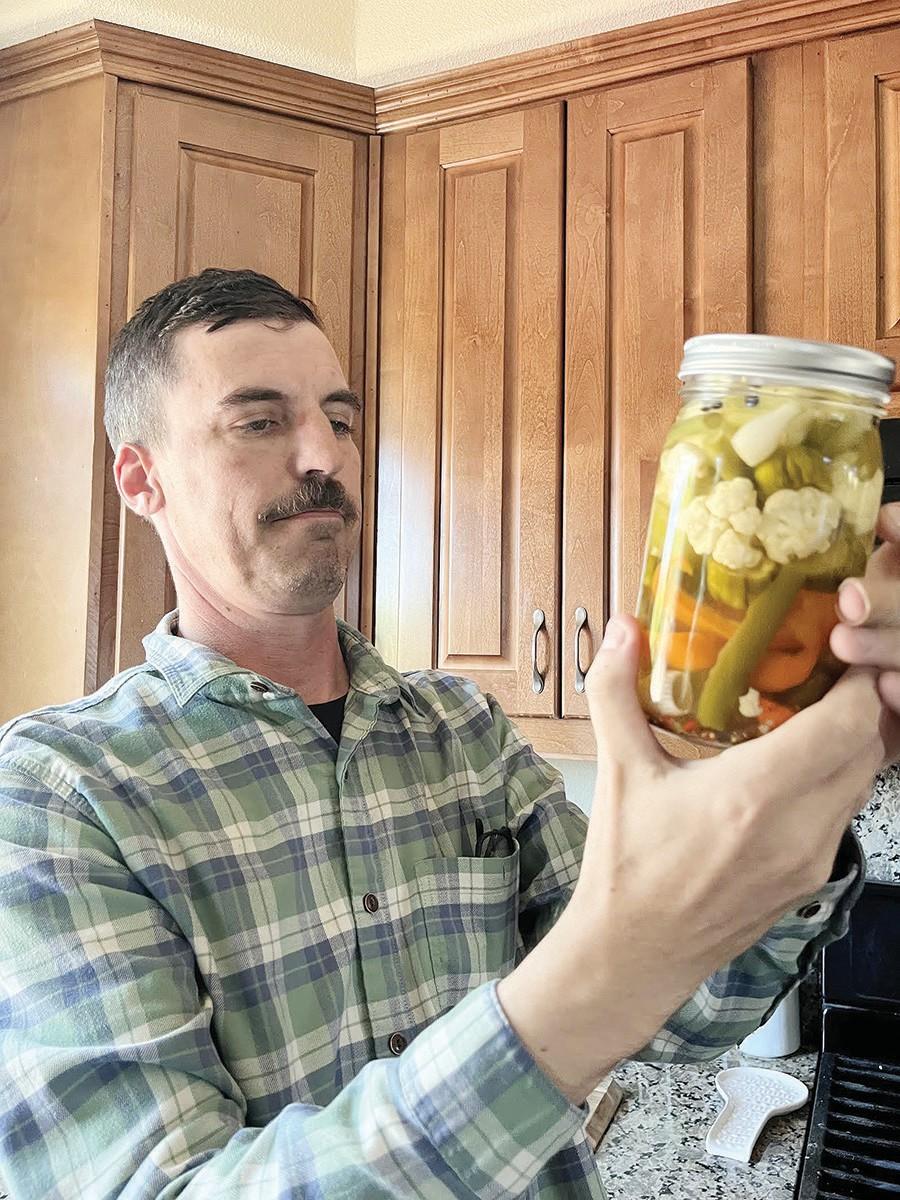

Maxwell Rygiol, Community Education Specialist with the UC Master Food Preserver Program of Mariposa County, is shown with a jar of mixed refrigerator pickles like the ones participants will make at the Aug. 8 workshop.
With grocery prices, along with everything else, skyrocketing, a program in Mariposa County can help anyone save money on food.
“We teach safe, tested methods,” said Maxwell Rygiol, Master Food Preserver Coordinator for the Cooperative Extension Service in Mariposa County.
Food preservation can take many forms, said Rygiol, from your traditional canning to freezing, refrigerating and dehydrating, just to name a few. Smoking foods, too, can be a form of preservation, like making beef jerky.
Even fermentations fall into the category with items like sourdough bread and sauerkraut.
Rygiol has been associated with the local Extension Service for six years, but it wasn’t until last November that he took over as Master Food Preserver coordinator.
He called the program “challenging” because of budget considerations, but that hasn’t stopped him from trying to get out the word and conduct workshops for residents of the county.
A native of the Santa Cruz area, Rygiol attended UC Santa Cruz and said he has been a lifetime gardener, which piqued his interest in this position. He lived in Merced for a time but now has a place in Mariposa County where he is starting his own elderberry farm.
On a mission
Rygiol said the “main mission” is to help people “safely preserve food. And to reduce food waste.”
Food security, too, is part of the mission and Rygiol noted the high percentage of people in Mariposa County who live paycheck to paycheck, which is becoming even more difficult with the rising costs of food, fuel, housing and more.
Another factor that has helped raise more interest in food preservation, interestingly, was the Covid-19 pandemic.
Even visiting nurseries, Rygiol noticed more people during that time. He believes many of them learned a lot about growing their own food during the pandemic and have carried that through as part of their ordinary lives.
That’s where the food preservation knowledge can be so helpful.
“There’s also the foodie aspect,” he said, like that sourdough or a canned bruschetta he’s working on.
A huge focus of the program, he said, is making sure people understand the proper techniques. Rygiol said there are a “wide variety” of techniques, from simple layering and freezing something to major undertakings involving pressure cooking and much more.
In fact, in a brochure offered from the Extension office, there’s an entire page dedicated to “Myths, busted.” It outlines “three things you’ve heard about summer canning that aren’t quite right.”
Rygiol said many people don’t realize how important it is to make sure preserving of food is done correctly. When it’s not, it can be harmful and that’s what his program is trying to emphasize.
Any recipes for preservation coming from his office have to be certified through recognized programs that are based on extensive research, including from universities, the United State Department of Agriculture and others.
“Growing” the program
Rygiol said one of his main goals is to get more people involved with the program.
As it stands, there are 11 volunteers who conduct the workshops and Rygiol is hoping to grow the program, so to speak. As he said, most people have heard of the Master Gardener program but the Master Food Preserver program is not nearly as well known.
Rygiol admits it is a “big commitment” but feels retired people or others who have the time could greatly benefit from the knowledge and help others in the community.
The chance is coming soon as a required information session will take place on Thursday, Sept. 10 and it will be online. From there, applications for the program are due by Nov. 15 and classes will be from January through June of 2027.
It is 50-plus hours of training, he said, but the bulk of it can be done online. There are periodic in-person labs as part of the training. Those will be held in Catheys Valley at McCay Hall.
Once people complete the course, they are then certified to be trainers at workshops hosted by the UC program.
Information about the program can be found on the website of the Extension Service at ucanr.edu/county/mariposa-county. You can also email mrygiol@ucanr.edu or call (209) 966-2417. Rygiol said they are happy to give detailed information and assist people with enrolling.
Which is all part of the overall mission. They are also helping people with preparing for entries to the Mariposa County Fair. Forms are due pretty quickly on Friday, Aug. 1 at 5 p.m.
Entries for food preservation at the fair are free and include various categories like jams, jellies, pickles, canned and dried foods and more. Entry forms are online at mariposafair.com and Rygiol said Extension officials are willing to help anyone through the process.
There’s also a pickle workshop coming up focusing on refrigerator pickles. It will be held on Saturday, Aug. 8 at McCay Hall in Catheys Valley and the entry fee is $10 and space is limited.
Rygiol said no canning equipment is required. To register, visit ucanr.edu/county/mariposa-county/mfp-workshops or call the number above.
Outreach objectives
Rygiol said he is trying to find groups in the county which would be interested in hearing about the program. They are going to be doing a program soon for the TOPS (Take Off Pounds Sensibly) group.
He said they are willing to go to any groups to speak about the program and people should contact the office to get more information.
“We are always looking for more,” said Rygiol .
They are at the local farmers market every other week, he said, with information about food preservation and more.
Rygiol said the art of food preservation can be learned by anyone and no experience is necessary. What is necessary is the willingness to learn and put it into practice.
For example, he said preserving zucchini is a lot more involved than some other foods. Those take pressure cooking and certain steps.
For peaches, he said, there “are a lot of different ways” they can be preserved and Rygiol can help people learn those techniques.
A lot of that can be important, he said, when local residents harvest their gardens. In many cases, there is too much food that ripens all at once. By utilizing preservation, he said that food can last for a long time — and save on food budgets.
“There are little tricks,” he said with some methods, and all of that is available from the Extension Office in Mariposa County.
One concept Rygiol is trying to figure out is how he can form a program similar to Plant- A-Row, which is where people donate their excess garden harvests to others.
“Their mission works with ours,” he said.
Because of the many people who are low income in the county, Rygiol believes there is a real need and such a program would greatly benefit a lot of the population.
That also leads to the issue of food security, which is a growing concern not just locally, but globally.
Even when people purchase food from grocery stores and other retailers, he said when in season, products are much cheaper.
Take corn on the cob, he noted, which is “cheap” during the harvest season but then skyrockets in the off season. If people know the techniques to preserve that corn, it can be an item for the dinner table for months.
He does “highly recommend” people consider getting a vacuum sealer system. Rygiol said those pay for themselves quickly and make the process of preserving food that much easier.
Units vary in price and size, but for beginners, they can generally be purchased in the $50 range.
Changing times?
So has technology changed how food preservation works in this day and age? Rygiol said the answer is yes and no. For instance, dehydraters and freeze driers have improved greatly with advancements in technology and are beneficial for many people.
On the other side of the coin, he said many of the techniques “haven’t changed a lot” over the years as people still utilize Ball Jars as well as water bath canners.
“As research advances, we learn more,” he said.
He also noted there is “a lot of free information out there,” and his office is willing to guide people in the right direction.
As part of the effort, Rygiol said they are interested in feedback from the public. “What do people want to learn?”
In addition, he’s willing to hit the road because “I want to meet people where they are at.” That gives him a feel for what people want in addition to surroundings and what they have to work with in various settings.
In the overall scheme of things, Rygiol said preserving food dates back to the beginning of humankind. Even the early humans found ways to preserve food — something that was most certainly life and death in that era.
Since then, the preservation of food has been ongoing. Many recall “grandma” in the kitchen canning all types of foods and then storing them in the root cellar. Times may have changed some since then, but the concepts remain the same.
And that’s what the program Rygiol runs is all about.
The bonus in rural Mariposa County?
“It ties in with agriculture,” he said.


Responses (0)