


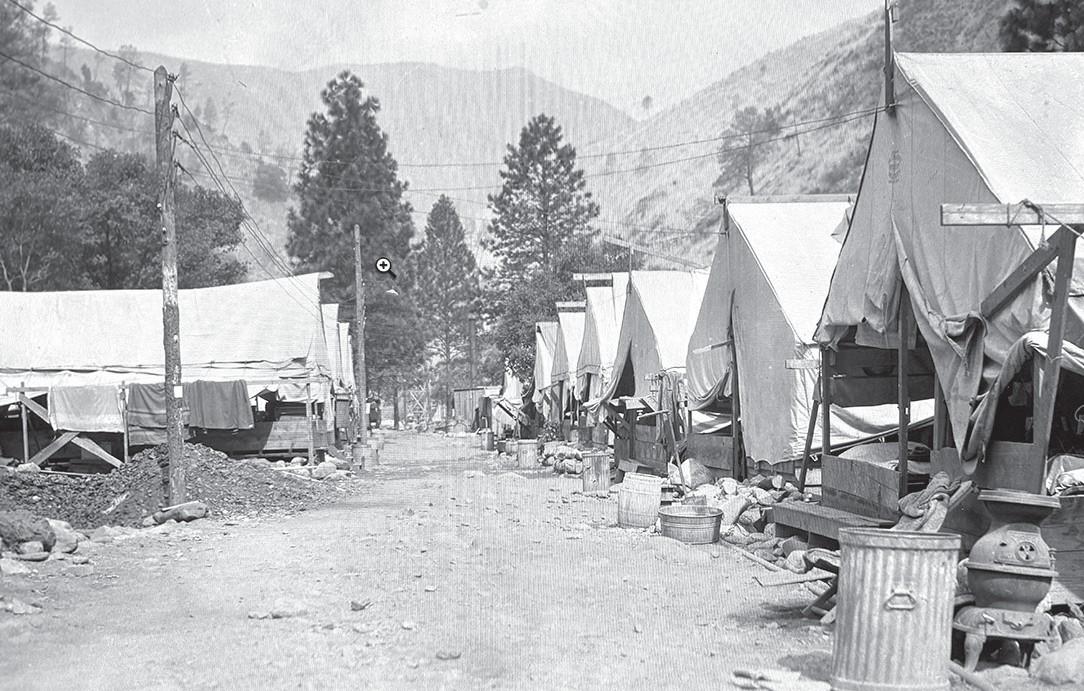

One of the lesser known facts about the construction of Highway 140 is that prison labor was used building the roadway, as shown in this photo. This camp was located near the South Fork of the Merced River. Photo from National Park Service archives
Mariposa County has celebrated the 250th anniversary of America and just last week the annual county fair.
But another big celebration is just around the corner and the community is invited to take part.
The 100th anniversary of Highway 140 will be celebrated on Tuesday, Sept. 22 in Mariposa, including a parade of historic vehicles and a ceremony at the Mariposa Museum and History Center.
“What started as a relatively small idea for a media event has turned into something much bigger,” said Noel Morrison of the Yosemite Mariposa County Tourism Bureau, the lead organizer of the event. “A community celebration, a historical research project, a growing archive of local stories and a yearlong opportunity to tell the story of one of the most important corridors in Mariposa County.”
The event will kickoff at the office of the Mariposa Gazette, located near the entrance of town, where a parade of classic vehicles will be lined up. That happens at 11 a.m. That part is being organized by the Mountain Road Rattlers Car Club.
The vehicles will then, appropriately, take Highway 140 through Mariposa and stop near the other end of town at the museum. There, a celebration will take place to honor the 100th anniversary of the highway.
Various dignitaries are expected to be on hand, including Yosemite National Park Superintendent Ray McPadden. The lineup of guests is still being organized, but those invited included Caltrans officials, county officials, elected representatives, local service organizations and more.
Organizers said members of the public are encouraged to dress in period clothing from the 1920s and 1930s.
A true legacy project
The development of Highway 140 has many facets, from easier access to Yosemite to more tourism dollars flowing into Mariposa County.
By the 1870s, communities across the region were trying to find ways to establish routes into Yosemite Valley to lure that growing tourism market. The Coulterville Road and Big Oak Flat Road were completed just 28 days apart in 1874. The Mariposa Road through Wawona was completed the following year.
By the early 1900s, automobiles were beginning to transform travel to Yosemite and in 1924, the California Highway Commission began construction of a new route designed to provide more practical, year-around auto access to the park.
On July 31, 1926, the new road officially opened with much fanfare as the “All-Year Highway.”
The road is built along the scenic Merced River and runs through the foothills and the dramatic canyon that continues to draw throngs to this day. It also provided a year-round connection between Mariposa County communities and Yosemite Valley.
The road also had a unique feature still quite popular: The Arch Rock Entrance to Yosemite which travelers pass under just after the entrance gate to the park.
Quick change
Construction of the highway had a huge impact in the way visitors experienced Yosemite.
Park visitation increased from 274,209 visitors in 1926 to a whopping 409,430 in 1927. At the same time, railroad travel declined sharply as automobile tourism because the dominant way to reach the park.
That single change would have lasting consequences for Yosemite and the communities along the historic route. It is undisputed the highway changed Mariposa forever. The same can be said for Catheys Valley, Midpines and El Portal, which all benefit from Highway 140.
Tourism is the number one economic force in Mariposa County and the construction of the highway etched that in stone — literally.
The legacy of the redbuds
It was more than 60 years ago when local resident William Brady had an idea. That idea was to make the drive to Yosemite more beautiful.
Brady had developed a way to successfully germinate California redbud seeds and then shared the idea with the chamber of commerce and what was then the Highway 140 Association.
Once that happened, the seeds were sewn, so to speak.
A nationwide appeal went out for empty coffee cans. Thousands of those cans arrived in Mariposa by parcel post.
Volunteers then filled the cans with redbud seedlings and they were eventually planted along Highway 140.
It was an extraordinary vision back then and the fruits of their labor show today.
Every year, the magenta redbuds become the first symbol that spring is coming to the foothills. It provides a memorable experience for people traveling along Highway 140 to Yosemite.
Morrison said that inspiration was one of the central ideas of the celebration concept.
“You’re not simply driving through a pretty landscape,” she said. “You are driving through a landscape that generations of people intentionally shaped and cared for.”
A call to action
As part of developing the celebration, Morrison said they began working with museum officials and put out a call through the Mariposa Gazette asking residents to share their photographs, documents and stories.
“The response has been something very exciting,” she said. “We’ve been uncovering stories.”
Many people have contributed photos and, maybe more importantly, stories related to Highway 140.
“We realized that the history of this highway isn’t just sitting in a textbook,” said Morrison. “It’s sitting in family albums, attics, garages and memories throughout this community.”
Organizers hope this gathering of history can one day become an exhibit at the museum to even further preserve this history of historic Highway 140 — the “All-Year Highway.”



Responses (0)