


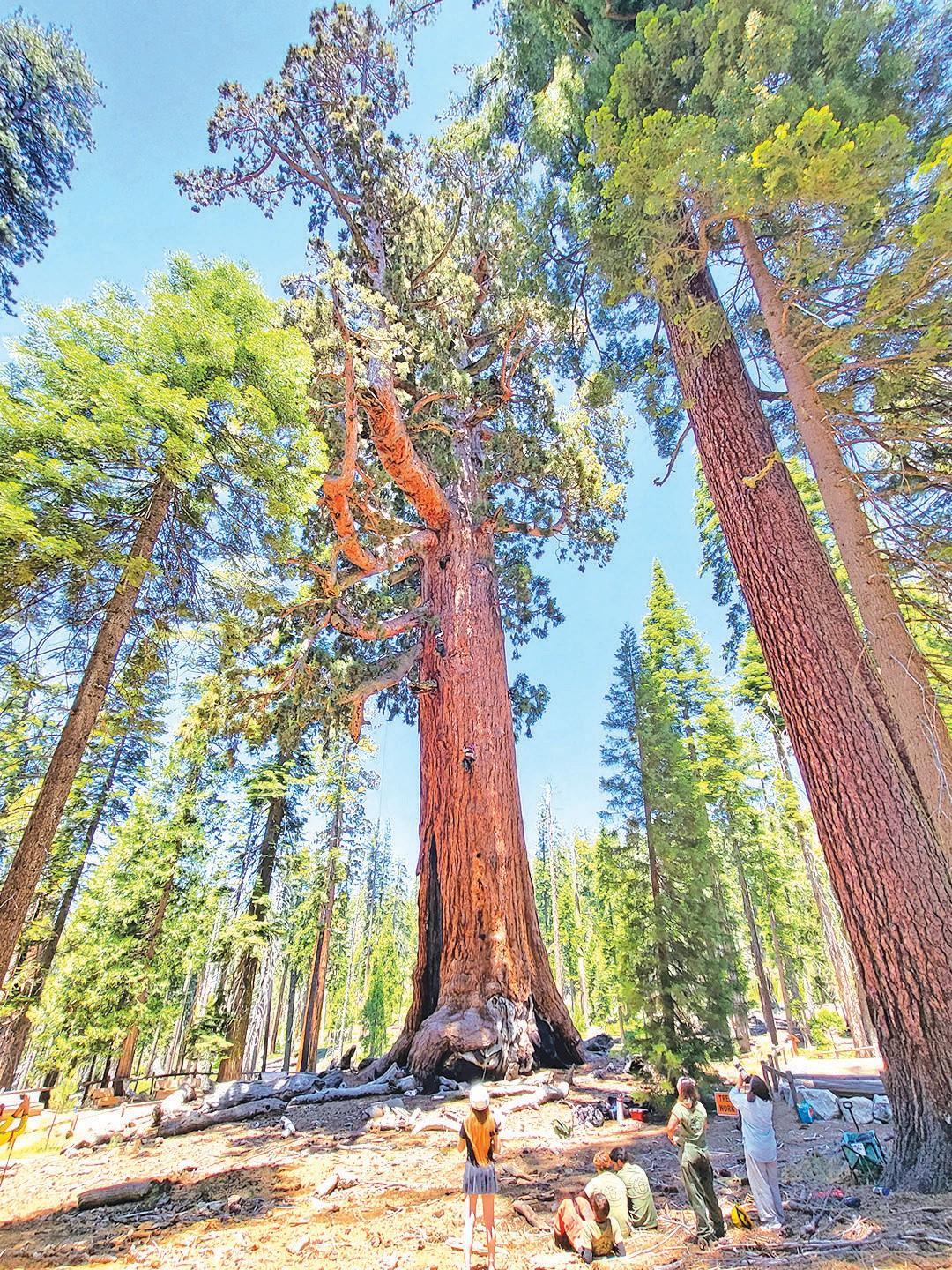

Above, this photo depicts just how large the Grizzly Giant is as Erin Burk and Wendy Baxter can be seen making their climb while onlookers watch. Left, Lawrence Schultz is shown as he begins his ascent to the canopy. Photos by Amanda White
All eyes were on one of the most famous sequoias in the world last week for much more than just a photo.
On June 17, researchers and conservationists gathered as one of Yosemite’s most beloved sequoias was scheduled for a health checkup.
“We’re working with the Ancient Forest Society to study how the giant sequoias are responding to stressors,” said Garrett Dickman, a forest ecologist with the National Park Service.
A surprise visitor in the canopy
A drought during 2012 to 2016 took a heavy toll and countless trees didn’t survive. The mighty sequoias stood their ground and survived, but they were left in a weakened state.
“They’ve been looking at how water moves through the tree, which is kind of like blood flow,” Dickman explained.
“It’s like how blood moves through body when we’re sick.”
At almost 3,000 years old, the Grizzly Giant is one of the largest trees in Yosemite’s Mariposa Grove.

The giant mammoth stands at 209 feet in height and has a massive width of 96.5 feet at the base.
Along with the flow of water, the researchers have been monitoring beetle activity.
“They started noticing that insects were attacking the giant sequoias out on the leaves. We had never really seen that,” Dickman said.
These beetles are typically seen on the ground but not in the canopy.
“We now know they’re bark beetles. They can attack trees, especially in a weakened state,” continued Dickman.
“So we’re trying to figure out what happens to these trees if they’re getting attacked by these bark beetles. We don’t have any way to respond to it but we’re much further along and we think now that the beetles are more of a symptom rather than a cause.”
Taking a look
Anthony Ambrose, Wendy Baxter, Erin Burk and Lawrence Schultz from the Ancient Forest Society scaled the behemoth to take a closer look at the health of the tree.

Wendy Baxter is shown with cones she collected while up in the canopy.
“We were inspecting for beetle activity and just doing a general health inspection,” Baxter explained.
“We did find bark beetle activity up there but the tree is defending itself. The tree is healthy.”
The group collected samples of foliage as well.
“That’s just a stress measurement so we’ll be looking at that,” said Baxter.
“We also collected cones to see if the tree is producing cones and it is. It’s a healthy, vibrant tree.”
Stewardship
For over a century tribes have been excluded from conservation efforts but new partnerships are aiming to change that.
Also on site for the check up were the Tuolumne Band of Me-Wuk conservation crew, the Southern Sierra Miwuk Mehsu crew and the Yosemite Conservancy.
“We’re out here starting with the little bit of fuels and vegetation treatment in order to be able to get back to that traditional ancestral way of bringing low, slow burning fire back into the landscape,” said Landscape Stewardship Director with the Southern Sierra Miwuk Nation, Tara Fouch-Moore.

Erin Burk and Wendy Baxter begin their ascent. Photos by Amanda White
Fire is inevitable and the Grizzly Giant can use close to 1,000 gallons of water per day.
“If we restore the conditions this tree has lived through for thousands of years, we’re going to free up more water to be available for this tree and it’ll better fend off insect attack,” Dickman explained.
“The science these researchers are coming up with is in very real time. They’re validating and accelerating what we’re doing in terms of stewardship.”
The Yosemite Conservancy and CAL FIRE have been instrumental with fuel reduction.
“The conservancy has provided the financial support for this inspection and a lot of the research,” Dickman said.
“We’ve also been receiving grants from CAL FIRE to remove material from the grow in anticipation of fire. Fire is just part of it and we all want to be prepared as best we can.”

Erin Burk pauses to take notes during the Grizzly Giant health check.
It takes all of us
“This is an opportunity to care for the forest with so many different people,” Dickman said.
“We’re all caring for something much bigger than ourselves.”
At about 3,000 years old, the Grizzly Giant has existed in the lives of over 100 generations.
“People love these trees. To be able to be part of this and the continuation of stewardship is incredible,” said Dickman.
“My job is to make sure future generations get to receive this gift. It’s pretty special.”
Responses (0)