


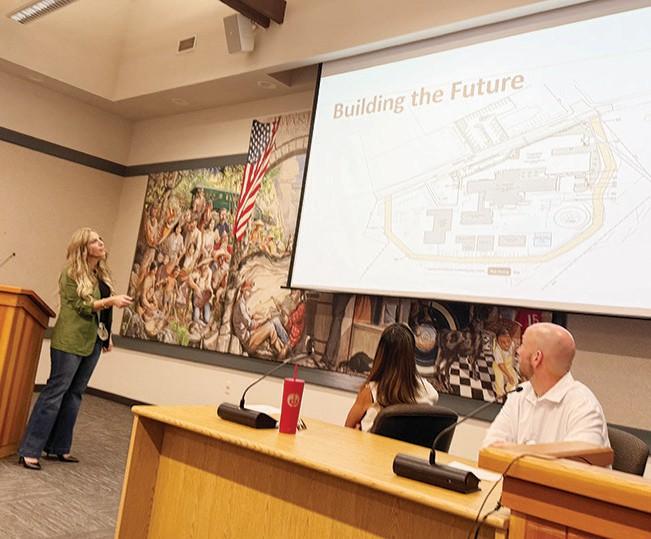

John C. Fremont Healthcare District CEO Stacey Kuzak goes over the latest plans for the county’s critical access hospital during a Healthcare Town Hall on Saturday, April 18. Also shown are Mariposa County Supervisor Jenni Kiser and Mariposa County CAO Joe Lynch. Photo by Tom Lyden
A Healthcare Town Hall last Saturday focused mostly on the fate of Mariposa County’s critical access hospital, and for this reporter called to mind an old doctor’s joke.
“You’re losing a lot of blood and need a transfusion,” the doctor says to his patient. “What’s your blood type?”
Patient: “B positive.”
Doctor: “I’m trying to, but like I said, you’ve lost a lot of blood.”
There is an obvious and well intentioned effort by the hospital and county leaders to stay positive about prospects for the John C. Fremont Healthcare District (JCF). And from a patient care perspective, there are certainly positive stories to share.
But financially speaking, the hospital has lost a lot of blood.
Numbers released Monday show JCF had an operating loss of $929,000 in March, and has lost $5.54 million in the last nine months.
JCF is also burning though its cash on hand quickly. Unrestricted cash decreased by $2 million from February to March as expenses continue to outpace collections.
“Thanks for trusting us and coming back to us,” CEO Stacey Kuzak told the group, many of them seniors, who attended the forum on April 18.
“It’s been a journey, and there is a long way to go.”
“We have a lot of things that were not up to industry standards,” Kuzak said of the organization.
Since she became CEO five months ago, JCF has had five surprise inspections from CMS — the Center for Medicaid and Medicare Services — a feared federal regulator known for its exacting inspections.
“That’s a lot in a little bit of time,” she said.
The district is now laser focused on “how we can get cash in the door,” she said.
Kuzak candidly acknowledged the district had a “revenue leakage” problem she is still figuring out.
Kuzak recently discovered significant problems in the billing process due to a mix up in National Provider Identifier (NPI) numbers that are used by healthcare providers and insurers to bill properly.
Kuzak said earlier this month the NPI confusion meant there was $2.6 million in claims that still needed to be processed.
At the town hall, former JCF trustee Suzette Prue, who knows her way around the district’s spreadsheets, said in the past year JCF has actually lost $6 million in cash collections due to problems with its billing company and revenue cycle consultant, Warbird.
Prue asked Kuzak, who did not dispute the $6 million figure, about plans to address the collection problems.
Kuzak said JCF is working with Warbird to address the issues and later clarified the figure represented a mix of rejected claims and improper billing.
Kuzak expressed disappointment with Warbird, but also appeared reluctant to criticize the consultant publicly. At least, for now.
JCF’s chronic billing problems take place during an especially precarious time for rural healthcare, which is faced with delayed and declining reimbursements from government and private insurers and other federal budget cuts.
There are 2,000 rural hospitals in the United States and 40 percent operate at a loss, according to the Chartis Center for Rural Health, a healthcare analytics and consulting firm.
Since 2005, more than 100 rural hospitals in America have shut down and more than 80 have eliminated in-patient care, reported Reuters.
Mariposa County Administrative Officer Joe Lynch told the town hall gathering that county government, the school system and the hospital are three pillars that make for a healthy community where people want to stay and raise families.
JCF’s recent financial losses will be a significant concern for the U.S. Department of Agriculture (USDA), which is considering whether to give JCF a loan for construction of its new hospital.
JCF is required to have a new hospital to meet California earthquake standards by 2030.
The district is currently working on a financial feasibility study as it applies for the USDA loan. The USDA has changed some of its conditions for the loan.
Meanwhile, the hospital is seeking 12-month forgiveness in loan repayments from the California Department of Health Care Access and Information (HCAI).
But JCF leaders fear HCAI might look at the district’s available cash on hand and presume the district is in good shape to repay the loan. The problem is the district appears to be burning through its unrestricted cash reserves at an accelerating pace.
The district has $9.3 million in Measure O funds that are restricted exclusively for design and construction of the new hospital. In 2022, voter’s approved Measure O, a 1 percent county wide sales tax for 40 years to fund construction of the new hospital.
After construction of the new hospital is completed in 2030, the plan is for the old hospital to be redesigned and repurposed to support money making expansion of services. Kuzak said some of the ideas under consideration included women’s health, pediatrics, some limited oncology, outpatient physical therapy and more specialty care.
But all of that is aspirational. First, JCF needs to get through the next few months.
At the end of Town Hall, Kuzak said something clearly meant to provide a measure of comfort to those anxious about the hospital’s future.
Kuzak said the hospital will still be here 10 years from now.
Her statement seemed to hang in the air for just a moment: Was she offering a prediction, a promise or just a shot of B-positive?
The momentary silence was broken by a round of applause.





Responses (0)