


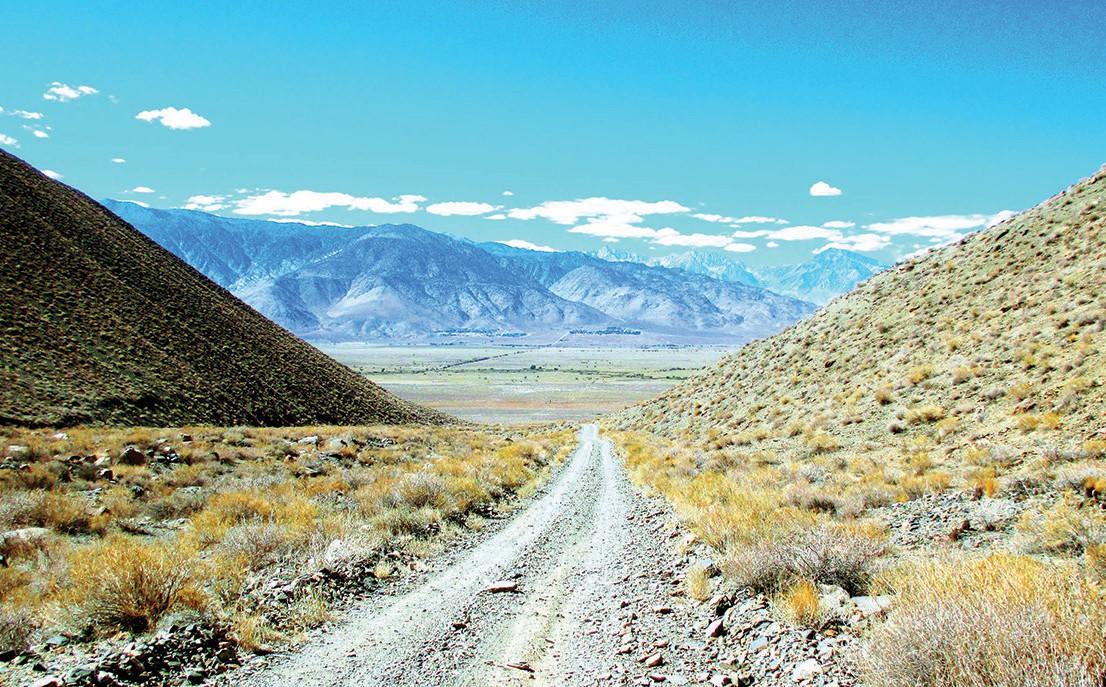

Austin’s “long brown lonely land.” Photo by Sharon Giacomazzi
For a between the lines understanding of the silent, latent character of Owens Valley in the Sierra’s rain shadow, you need to read “The Land of Little Rain” by Mary Hunter Austin.
Her love and intimate knowledge of this haunting, secretive landscape is revealed in elegant and limpid prose. Written in 1903 in the hamlet of Independence, Austin’s powerful word pictures allow us to see California’s gaunt high desert through a new lens.
What John Muir was to the mountains of the Sierra Nevada, Mary Austin was to the desert.
She shows a “land that doesn’t come at you all at once,” that it takes a bit of wooing to reveal itself. And, few are the tourists that take the time.
I admit that I was one of them. The majority of travelers believe a desert environment is something to endure, something to hurry through on the way to somewhere else.
Mary Austin’s description of this “long brown and lonely land” are both marvels of accuracy and elegant nature writing. Her writing is deeply rooted in her sense of place and captures the essence of the land and its inhabitants.

Sharon Giacomazzi
Though she claimed not to be an historian, Austin left us vivid snapshots of Owens Valley that are still fresh and vibrant. “The Land of Little Rain,” now a classic, gave her instant fame in literary circles.
After the death of her father and sister when she was 10, Mary was emotionally on her own. Her mother didn’t understand her unique personality, ignored her and lavished affection on an older brother.
At age five she knew she wanted to be a writer, and it became her focus after her sibling and father died. Austin began writing poems and immersed herself in academics. In I868 she graduated from an eastern college with a degree in science.
She moved with the family to California and fell in love with desert country. Mary wedded Stafford Austin in 1891 and experienced many marital difficulties while with him. Because of his failures, inability to keep a job and raising a mentally disabled daughter, Austin returned to writing and teaching as a source of income.

Iconic photo of Mary Austin. Submitted photo
Many of her early works were about Native Americans and the desert. As her success grew, her marriage fell apart. She left Stafford in 1905 and divorced him in 1914.
From 1892-1903, she lived in the house in Independence that is now privately owned and identified by an interpretive plaque. Her former home is a state historical landmark. Visitors are welcome to stroll by it, take a photo of the exterior. No admittance.
Mary Hunter Austin was a prolific novelist, poet and playwright. Thirty-two books and 250 articles bear her name.
Additionally, she was renowned as an outspoken early feminist, lecturer, birth control advocate, defender of the environment, Native and Mexican rights and a dedicated environmentalist. Additionally, she was a staunch water warrior and worked tirelessly to prevent Los Angles from draining Owens Valley dry, a battle she and many others did not win.

Adult Mary Austin, 1868-1934. Submitted photo
Because of her intimate knowledge of Owens Valley, Indian affairs and the little understood desert environment, geologists, collectors of Indian lore, botanists and explorers came to her for information.
President Teddy Roosevelt sought her opinions about forest lands and grazing. Unfortunately, outside of the literary arena not everyone understood or appreciated her genius, talents and strong opinions. Mary’s frank speech, solemnity and unhappy personal life drew criticism from the people of Owens Valley.
Mary Austin certainly did not live the typical life of a woman in her era. One biographer stated “she sought in nature a place that was not domesticated and that did not domesticate women.”
Austin’s land pulsates spiritually, aesthetically and even erotically…sometimes she celebrates borderlands as a place to think beyond the confines of gender, creating a feminine land that conjoins women and nature not as victims but powerful allies.

Austin family home in Independence. Private residence now an historic site. Submitted photo
From 1904-1934 she lived in Carmel, New York and Santa Fe and became a part of an elite Bohemian clique of writers and artists. While beginning a new novel in Santa Fe she suffered a heart attack and died in her sleep.
Ever the iconoclast, her ashes were placed in a mountain cave. Nine years later she became the namesake of a World War II ship, the SS Mary Austin. Mt. Mary Austin, 13,051 feet, is one of very few peaks in the Sierra Nevada to be named for a woman.
She is like no other nature writer that I have read, and I have read stacks of them. Her choice of words, descriptions and phasing are so different from my experience reading about people, places and things in the Sierra.
It was she who totally changed my opinions and view of the desert. I am so grateful for that because since I read “Land of Little Rain” I can not view this landscape as a lifeless environment.
Sierra native Sharon Giacomazzi is the author of Sierra historical hiking guidebooks and articles for outdoors publications. She can be reached at sharong@sti.net. “Feet are like dogs, they are happiest when going somewhere.”

Her first book gave her instant fame in literary circles. Photo by Linda Sheppler


Responses (0)