


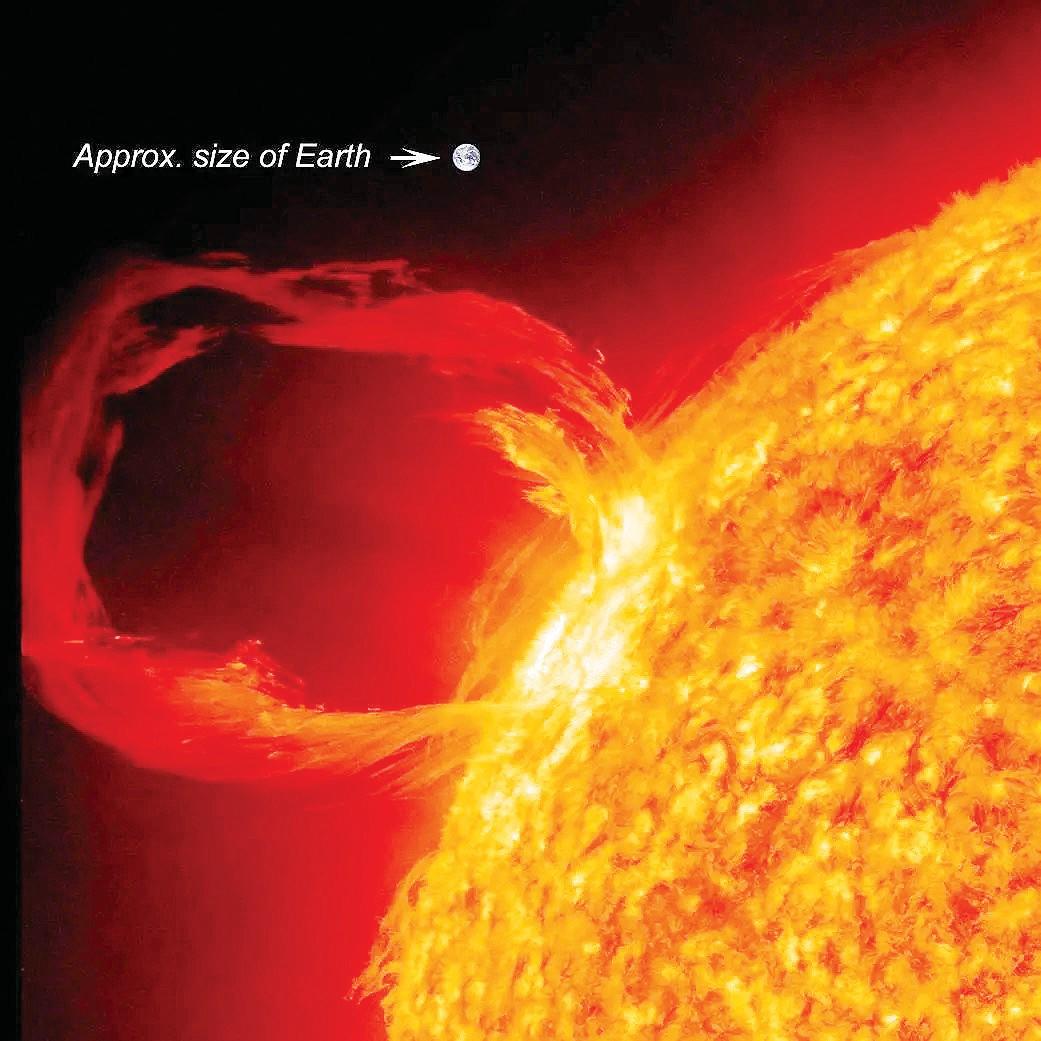

A solar prominence. See tiny image of Earth for scale. Photo courtesy NASA
Have you ever seen the northern lights? If you live in Mariposa, there’s a chance you have.
During the past two years, several powerful solar storms have produced spectacular auroras visible much farther south than usual. The night of May 10-11, 2024, was particularly memorable, with brilliant displays appearing in our skies and across much of the United States.
Perhaps you saw or photographed them yourself. But what causes these mysterious lights?
The answer is 93 million miles away, in a star that we see every day but probably don’t think of as a star at all: our Sun. We are all quite literally living with that star.
I borrowed part of the title of this article from an ongoing NASA program that studies how changes in the Sun affect Earth, our technology and human activity both on the ground and in space.
Unlike the billions of other stars scattered across the night sky, our Sun has a profound influence on nearly everything that happens on Earth. It provides the energy that powers our climate and weather, drives photosynthesis of plants and supports nearly all life on our planet.

Manny Leinz
Occasionally, it also sends enormous blasts of energy and particles our way. So let’s take a closer look at the star in our backyard.
Our ordinary, extraordinary Sun
The Sun is a fairly ordinary star — a middle-aged, yellow-white star about 4.6 billion years old. Like all stars, it is composed mostly of hydrogen and helium.
But the Sun’s energy doesn’t come from “burning” hydrogen the way wood burns in a campfire. Deep in its core, where temperatures reach millions of degrees, the nuclei of hydrogen atoms fuse together to form helium.
A tiny amount of mass is converted into energy in the process, according to Einstein’s famous equation, E=mc². And what an enormous amount of energy!
Every second, the Sun converts hundreds of millions of tons of hydrogen into helium, with about four million tons of mass converted directly into energy. That energy eventually reaches the Sun’s surface and radiates into space as sunlight.

A massive coronal mass ejection. Photo courtesy NASA
Only a tiny fraction of that sunlight reaches Earth, but it is enough to warm our planet and provide the energy to support life as we know it. Without the Sun, Earth would be a frozen, dark ball of rock. Fortunately, our star has been remarkably dependable for billions of years. But dependable doesn’t mean quiet.
The Solar cycle
If you’ve ever looked at the Sun through solar glasses, you may have noticed dark spots scattered across its surface. These are sunspots, regions where intense magnetic fields emerge from inside the Sun and restrict the flow of heat to the surface.
They appear dark because they are cooler than the surrounding solar surface. Sunspots come and go, and their number rises and falls in a roughly 11-year cycle. This is actually a cycle of the Sun’s magnetic field, which becomes increasingly tangled and eventually reverses polarity before beginning the cycle again.

The current cycle began in late 2019. The Sun reached its solar maximum — the most active part of the cycle — in 2024–25. Even though activity is now declining, we can expect plenty of solar activity for the next several years. And sunspots are only part of the story.
When the Sun gets angry
The Sun has a complicated and constantly changing magnetic field. This magnetic field produces various phenomena that can effect us here on Earth.
Solar prominences are great looping arcs of hot, electrically charged gas held above the Sun’s surface by magnetic fields. They can remain suspended along magnetic field lines for days or weeks. Sometimes the gas falls harmlessly back to the Sun’s surface, but other times massive amounts of its magnetized electrically charged particles are launched into space in a spectacular coronal mass ejection, or CME.

Auroras on the night of May 10-11, 2024, captured by the All Sky Camera at Celestial Deep Observatory (a single frame from a video on the website.)
If one is aimed toward Earth, we may get a brilliant aurora — and sometimes much more. CMEs take several days to reach the Earth, but solar flares, consisting of high energy X-rays gamma rays, and ultraviolet light, travel at the speed of light, and so can reach us in as little as eight minutes.
Collectively, all of these phenomena are known as “Space Weather,” and they can have a profound effect on us here on Earth. A strong CME or solar flare can interfere with radio communications, disrupt navigation signals and potentially damage satellites. It can also heat and expand the upper atmosphere, increasing drag on satellites in low Earth orbit, reducing the time they can operate before inevitably burning up in the atmosphere.
Astronauts are particularly vulnerable, and they can receive harmful levels of radiation during major solar events. This is an important consideration for future missions to the Moon and Mars, where astronauts will spend more time outside the protective environment of Earth’s magnetic field.
The effects can also reach the ground. A sufficiently powerful solar storm can potentially damage transformers and disrupt electrical grids.
On Sept. 1, 1859, British astronomer Richard Carrington was observing the Sun when he witnessed an extraordinarily bright flash from a group of sunspots. The so called “Carrington Event” was one of the most powerful solar storms ever recorded.
Auroras appeared nearly as far south as the equator. The night sky became so bright in some places that people reportedly could read by the auroral light.
Telegraph systems — the high-tech communications network of the day — were disrupted, with sparks and fires reported at some telegraph stations. More recently, in 1989, a less severe solar storm caused a major blackout in Quebec.
Imagine something similar to the Carrington Event happening today. Modern society is vastly more dependent on technology than it was in 1859.
The effects could be long-lasting and financial losses could easily reach into the billions of dollars. Fortunately, events of that magnitude are rare. But the Carrington Event reminds us that our star is capable of reaching across the vastness of space with considerable force.
The Sun’s influence is not limited to solar storms. Every day, ultraviolet radiation from the Sun reaches Earth. Some of this radiation is blocked by the atmosphere and ozone layer, but enough reaches the surface to cause sunburn and, over time, increases the risk of skin cancer to those not taking adequate precautions.
The Sun also influences Earth’s climate. Its energy drives our weather and water cycle and provides the energy that ultimately supports nearly every ecosystem on Earth. And the Sun itself is not perfectly constant. Its energy output varies slightly over its approximately 11-year cycle, but these changes are far too small to explain the rapid warming observed over recent decades.
The scientific consensus is that modern global warming cannot be explained by changes in solar activity. Human activities, particularly the increasing concentration of heat-trapping greenhouse gases, are the principal cause.
The fate of our star
Our old reliable Sun will eventually turn against us — but fortunately, not anytime soon. The Sun is roughly halfway through its life as a “main-sequence” star. In about five billion years, after its hydrogen fuel is largely exhausted, it will expand into a red giant.
By then, Earth will have long since become uninhabitable as the increasingly bright Sun heats our planet.
Eventually the Sun will shed its outer layers into space. What remains will be a small, extremely dense white dwarf — the hot remnant of the star that once warmed our planet and made life possible.
But that is a very distant future. For now, we can simply step outside on a sunny day and appreciate the extraordinary object hanging in our sky.
The Sun is a star, just like the countless stars we see on a clear night from the dark skies around Mariposa. It is vastly closer than any of them, however, and its influence reaches into almost every aspect of our lives.
It gives us light and warmth. It powers our weather and our ecosystems. It can paint the night sky with auroras, disrupt our technology with enormous solar storms, and provide the energy that sustains life itself. It’s worthwhile to consider that although we are all inhabitants of Earth, every day we are living with a star.
What’s up in the sky this month?
Venus continues to sink lower in the evening throughout the month. Spot it low in the west-southwest half an hour after sunset for the first two weeks in September, before it is lost in the glare of sunset.
Venus will return as a morning “star” by mid-November. Both Mars and Saturn are moving higher in the sky and will be visible as morning objects for the rest of the year. Look for Mars in the eastern sky about an hour before dawn; Saturn is nearing opposition — opposite the Sun in the sky — on Oct. 4 so it is visible all night in the constellation Pisces.
The King of Planets, Jupiter, makes its triumphant return to our morning sky by mid-month. Spot it very low in the east by mid-month, an hour before dawn. Watch Jupiter rise steadily higher through the rest of the year.
Mercury, sadly, will be invisible to us for the remainder of the year. The little planet is lost in the Sun’s glare until February, when it will make a brief evening appearance. I hope you have a chance to get out under the stars this month, and also maybe safely catch some rays from our Sun.
To get help finding planets, stars, and other celestial sights checkout skyandtelescope.org/interactive sky-chart/ or theskylive.com/.
There are also some great free smartphone apps, including Stellarium, SkySafari and SkyView.
As always, if you have questions, comments or suggestions for future articles, you can get in touch with me by email at: celestialdeep55@gmail.com. You can find my prior Gazette articles, plus night sky photos and more on my website at celestialdeep.space/ .
Manny Leinz is a long-time amateur astronomer and night sky photographer. He and his wife live part time in Bootjack where they also have an observatory.







Responses (0)