


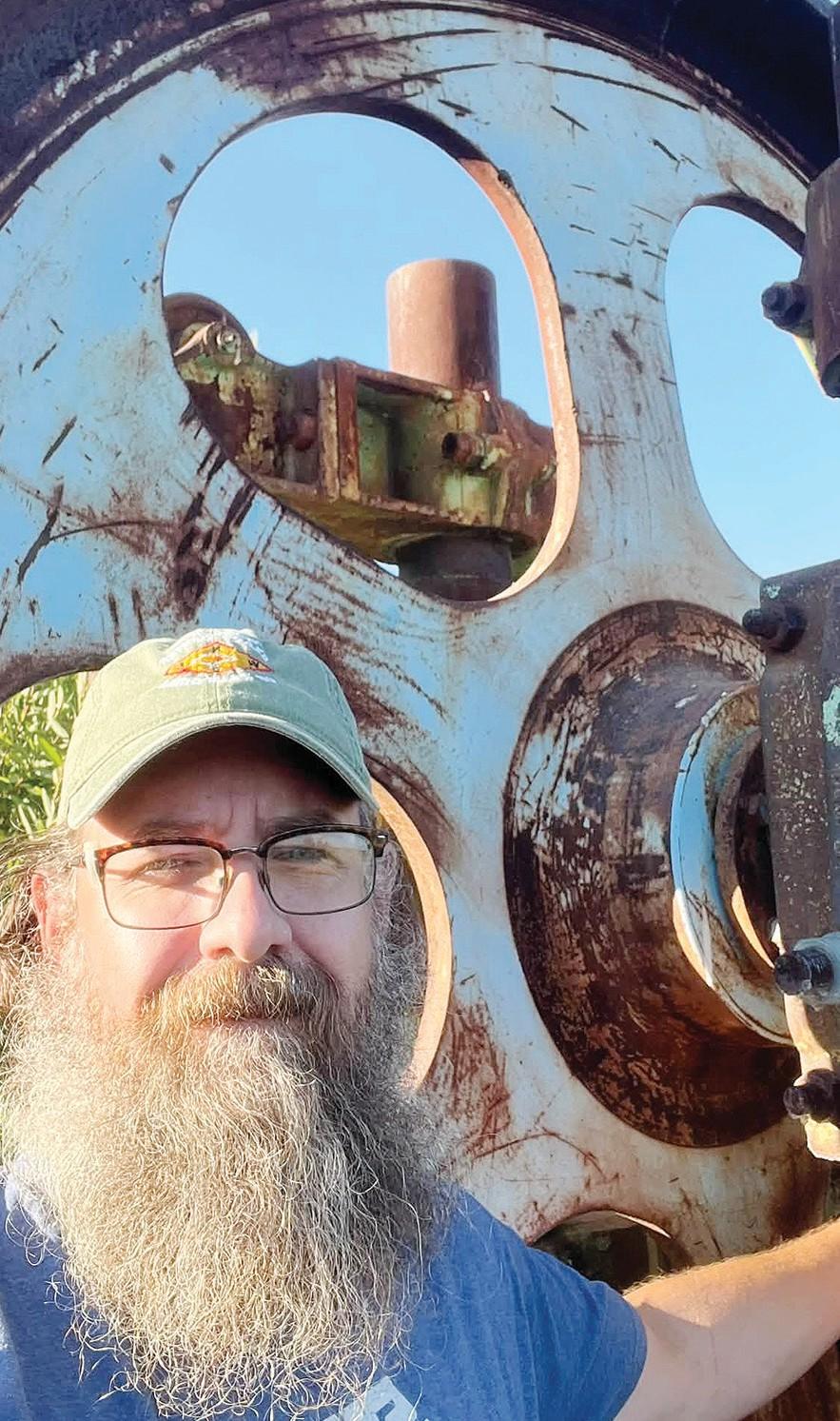

Joe Ellis is pictured standing on a saw head at the North Fork Mill site.
It turns out, contrary to Thomas Wolfe who famously said, “You can’t go home again,” you can go home again — at least if you’re Joe Ellis.
On Aug. 16 Ellis gave a great history talk to scores of interested people in the Bass Lake Homeowners Association at The Pines Resort. He’s previously lectured at Fresno Flats Historic Village and Park and has another such event coming up soon.
This may be your grandpa’s history but it’s far from dull when Ellis tells it.
North Fork’s own Ellis, like many, moved away from Eastern Madera County post-high school some 30 years ago and now, he’s back and making local history accessible again.
Ellis comes by it naturally.
“My parents Kathy and Phil Ellis started the North Fork History Group over 30 years ago and my dad used to take me artifact hunting when I was a kid,” he shared.
“My parents were also part of the committee that made the Center of California a monument. My dad passed away seven years ago but I see his name pop up often in my research as he collected some of it back in the 1990s — plus he was in the papers himself as a deputy.”

Joe Ellis, age 2, shown at the Bass Lake Government Center in 1978.
Ellis explained there are two Ellis families in North Fork. One of those came to the area around 1880 but Joe’s branch arrived in 1947 from Minnesota when his grandfather started work at the mill. His father was born not long after.
Joe’s dad Phil Ellis met his mom Kathy in Ukiah and he later went on to graduate from the police academy. The couple moved to Madera in 1966. And in 1971, he was offered an opportunity to move to Eastern Madera County when they needed more deputies.
The road to North Fork
Phil and Kathy made their way to North Fork where he became the resident deputy and worked out of the now-defunct Bass Lake Government Center.
“They had a dispatch radio in the house and the county installed a dedicated phone line. In those days the deputy’s wife was expected to be his dispatcher and was paid $25 per month for the privilege. Mom said no thanks.”

Construction of the Crane Valley Dam is shown in 1909.
Phil Ellis began his career with Madera County as a patrol deputy and spent the last half as a detective. Following retirement from the department, he bought a small portable saw mill and started a lumber company. Phil spent the next decade as a logger.
But back when he was a deputy and not long after the 1976 Chowchilla kidnapping in which three armed men hijacked a school bus, Joe’s dad thought it would be a good idea to have his children photographed and fingerprinted in case they ever went missing.
So when Joe was two years old, his dad took him to the courthouse. His 12-year-old brother understood what was happening but toddler Joe was too little and thought he was getting arrested.
What may have been traumatic as a kid left Joe with one of the best childhood photos ever, in which he’s seen crying with a booking slate hanging around his neck for ID.

Shown is the “pizza dropper” engineered by Joe Ellis, pictured.
As Joe grew, he and his father spent time together exploring the Sierra.
“He started showing me history all around as a teen. We spent summers on Peckinpah Ridge, over at the train tracks, looking at petroglyphs on the back side of the mountain — it all made an impression on me, definitely.”
The North Fork History Group got its start, in part, to save a marriage.
“When my dad retired from logging he was driving mom crazy being around the house so she said, ‘Why don’t you go off and start a history group?’ So they did that together with people including Vince Smith and his wife Ginny.”
I’ve been everywhere, man
Young Joe Ellis left North Fork not long after high school graduation in 1994 and spent the next decades “all over,” he said, with careers ranging from engineering in the entertainment industry to video production and professional puppet wrangling.
And, importantly, he’s the proud father of two boys: Hunter, 19, and Cullen, 14.
Ellis moved back to North Fork in 2024 and the community is better for it. The pull of history was never far from his field of vision.
“I always enjoyed watching history documentaries and I would sometimes read a modern biography of someone like Henry Ford or Howard Hughes. And when I moved back, my mom had some history folders on the counter. I was looking through them and one was a story about Tex Bliss.”
Ellis, a relaxed and engaging natural storyteller, explained Tex Bliss was a miner and old school lawman in the 1920s and 30s. As town constable in North Fork, he was known to wear suspenders and tuck his gun down the front of his pants.
One story goes that a man named Norris Smith was in trouble with the law. He’d killed somebody in a DUI and decided to pick a fight with Tex Bliss during a dance at the town hall.
“He tells Tex he’s going to get his shotgun and kill him. ‘No, you are not,’ Tex said. Not long after, Norris Smith walks into the dance with a shotgun.”
And what happens next depends on who you talk to or where you hear it.
Such is lore, said Ellis.
“I got eight different accounts from eight different sources,” including transcripts of interviews with eyewitnesses.
“In four of the stories, Tex shoots Norris right between the eyes. In four others, it’s in the chest. Some people said Tex had to borrow a gun because his wife had his for some reason. But Tex doesn’t want to stop the party so they drag Norris out and call the coroner in the morning. And there are multiple versions in a lot of these stories because that’s how it happens over time.”
So much more
Sitting in the North Fork living room holding history in his hands, a chronophile was conjured.
“This is amazing,” he told his mom. “What else do you have?”
Kathy obliged by giving him more and different material to read from the North Fork History Group collection — and that was all it took.
“I started reading and within a few hours I said ‘I’m going to write a book!’ and I haven’t put it down since. I’ve spent hundreds of hours doing research and field work, going out and taking pictures of locations to compare how they used to look and just seeing everything with my own eyes.”
While social media can be a bear to deal with, Ellis said Facebook has been a huge help as he posts on a page called North Fork Locals. Since Ellis began posting, the group has grown from about 4,000 to more than 12,000 members.
He’s been given archival material including two vast collections of power company images which inform the research for one of the books Ellis is writing on the history of the Crane Valley Hydroelectric System, the “hardest working water” and “the water that changed the world.”
“The Crane Valley System wasn’t the first but it did have some firsts. It was the first plant built in 1985 and the first to have transmission distance that long — 37 miles from the San Joaquin River Powerhouse to the substation in downtown Fresno. And everybody working on it was a novice — nobody had any idea what they were doing.”
Ellis collected thousands of images and knows the detailed history surrounding the company from teetering on bankruptcy to boom when Albert Graves Wishon was hired in 1903.
“He was a visionary, a smart dude that took one powerhouse and changed the world. By 1920 the company was huge. I’m fascinated by it and nobody has written about all of it.”
The connections
Beyond the facts of history Ellis began to notice something interesting in its sharing.
“There is an unexpected consequence of the work I’m doing posting all these historical photos. It’s connecting people. That wasn’t my intention but I can’t count how many times I’ve seen people connect in the comments of my posts, reconnecting with old friends and family and even making new connections. There is something to that that I can’t stop thinking about. Even with myself, I’ve made several new friends and connected with old ones. It feels good.”
Ellis noted he’s dating Bass Lake Chamber president Melissa Jones because she saw his history posts and they connected on Facebook.
“She was one year behind me at YHS but we didn’t know each other back then. She actually thought I was an old man posting until she looked at my profile because why would someone young post history stuff?!”
Occasionally as he’s researching, Joe will run into things collected by his dad.
“He would be really proud of me because he was a detective and I’ve been doing some detecting, making connections and figuring things out.”
There’s no shortage to the stories that are catching his attention, Ellis said.
For example, he solved the riddle of why there was a mysterious canal running through a friend’s property (it carried water for the power company) and located a scrapbook documenting the building of the dam at Bass Lake from the Eastern Fresno Historical Society.
Difficult history
But not all the history is good or kind. Research includes what Ellis believes to be a racially motivated killing in 1948. He’s slowly assembling the pieces together on that and other events.
“I’ve recently learned about cylinder recordings that were made from 1913-1918 of Mono people telling their myths and legends. Some of them were recorded by people I’m researching. One rabbit hole I’ve gone down is searching for evidence of bounties paid for Indigenous scalps. That was in the Gazette in 1882.”
But the weirdest and grossest story of all could be the one involving the hogs and human waste.
“They didn’t have septic systems installed in Crane Valley when they were building the dam and, with 2,000 workers, the engineers said they needed one. But A.G. Wishon had experience with a hog farm and he knew the animals would eat human waste. So they brought in a hog farm, disposed of the waste and had bacon, too.”
The talented raconteur will speak next at The Pines Resort on Oct. 11 for a final event celebrating the 125th anniversary of Bass Lake and the making of a new time capsule by the Bass Lake Chamber of Commerce.
Ellis will talk for about 30-45 minutes and then they’ll open up for group discussion because “people love to tell their stories.”
If you’re one of those people, Ellis wants to hear from you.
“I would encourage people to approach me with their stuff. If you have North Fork history and you want to preserve it, contact me.”
Find Ellis on Facebook under “EllisTheHistorian,” www.facebook.com/EllisTheHistorian.
Responses (0)