


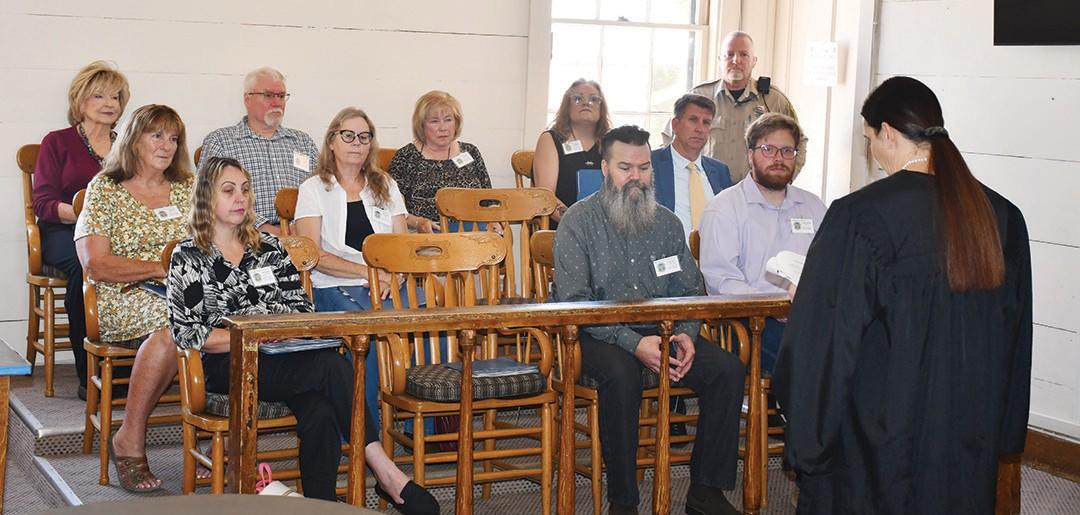

The 2026-27 Mariposa County Civil Grand Jury was seated last week at the courthouse. Mariposa County Judge Anita Starchman Bryant is shown in this photo giving the jury instructions just prior to the formal swearing in ceremony. Shown, front from left, are grand jury members, Kerri Mcilroy, Bryan Schear and Michael Matheson; middle, Lydia Clary, Kathy Maxwell and Kent Jones; back, ack: Colleen Rhodes, Sean Werle, Rebecca Mock, Genei Baker and Terry Barrett (bailiff who is standing). Though a bailiff, Barrett was also sworn in as a member of the grand jury. Photo by Nicole W. Little
Last week, the 2026-27 Mariposa County Civil Grand Jury was seated during a ceremony at the courthouse and overseen by Mariposa County Superior Court Judge Anita Starchman Bryant.
But a couple of weeks prior, the report from the 2025-26 grand jury was released by the court. The unusually short report consisted of just 18 pages, much shorter than reports in previous years.
The focus was varied for the grand jury and included reports from the county jail, school district and other entities.
The civil grand jury system in California charges 11 local citizens to serve as a watchdog link between local government and the public. The report indicates that three of the original 11 jurors left the grand jury and were replaced to restore the panel to its full capacity.
The grand jury’s mandate is investigative and civil, the report states, and state law requires “strict confidentiality.”
The charge includes institutional oversight, democratic integrity and a required formal response from government bodies.
The report stated during the tenure of the grand jury, a total of six complaints were received. It does not specify the nature of the complaints, only saying the grand jury “responded to the complaints, if possible, in a timely and appropriate manner.”
Mt. Bullion Conservation Camp
The grand jury paid a site visit to the Mt. Bullion Conservation Camp, which at the time still housed prisoners who perform duties for CAL FIRE.
The camp, in 2004, became an Adult Conservation Camp to bolster the firefighting program in California. It was operated jointly by CAL FIRE and the California Department of Corrections and Rehabilitation.
The grand jury members visited the camp in November 2025 and at the time it was still operating as a firefighting camp utilizing inmates. Since that time, the camp has been shuttered and the prisoners were relocated to Fresno.
CAL FIRE has plans in the works to convert it strictly to a firefighting camp for its employees. The plan would bring back crews who are now stationed in the Atwater area to Mt. Bullion. That conversion is ongoing and no specific timeline has been given as to when it may be completed and reopened.
The grand jury found the camp to be operated professionally but did state this in its report: “The primary concern expressed by staff was the impending closure itself, as the camp has operated for 22 years and its closure may reduce available low-security rehabilitation opportunities.”
Election observations
Grand jury members also observed last year’s special election in November which focused on redistricting in the state.
The grand jury members had nothing but high praise for the elections process, which is overseen by Mariposa County Clerk Courtney Morrow, also the Registrar of Voters, and her staff.
“The election was conducted by the Registrar of Voters alongside a unified team of eight employees, whose protocols and procedures were impressive and demonstrated a clear commitment to election integrity and operational efficiency,” wrote the grand jury.
The jail
The grand jurors also paid a visit to the jail, also known as the Mariposa County Adult Detention Facility.
Like grand juries past, the members concluded the jail is operated with professionalism but they also pointed out the physical issues with the older facility.
The grand jury wrote that over time, California law and protocols have changed, requiring local jails to “manage longer-term inmates and expand its medical and behavioral services to support a population with increasing mental health needs.”
The members said the staff at the jail “exhibited a level of professional conduct and operational efficiency.”
However, they also found “the aging infrastructure, as repeatedly noted over the last 10 years of Mariposa County Civil Grand Jury reports, requires a concerted plan for repair.”
Two items noted by the jurors were the condition of the roof and, more notably, the door-locking security system.
They said the leaking roof issues have “plagued the building” for years and could potentially lead to water damage and compromised infrastructure.
The members also said beyond the physical shell of the building, the “grand jury identified critical vulnerabilities within the electronic door systems.”
They said the “recurring malfunctions” of the systems “introduce a substantial layer of operational risk … Any failure of these components compromises the access control required by staff to ensure the safety of both the custodial personnel and inmate population.”
The members did note that while they were present, there was ongoing construction to update the aging HVAC system, calling it a “positive step.”
In the report, the grand jury members found formal findings relating to the roof issues, the security issue and the fact it found the jail was understaffed by two female employees. They were told by the administration retaining female staff levels is an ongoing problem.
It was also noted in the spirit of transparency, three members of the grand jury recused themselves from this investigation “to avoid any perceived conflicts of interest.”
The dump
The grand jury also reported on the issue of the dump, also known as the Mariposa County Solid Waste and Recycling Facility.
The jury members said their “primary concern” about the landfill is the “incomplete” implementation of the 2024 Solid Waste Management Plan, or CORE report, which is designed to stabilize the facility’s financial baseline and extend the potential operational timeline of the facility.
It also noted the Mariposa County Public Works Department, which operates the facility, has failed to formalize long-term contracts with Yosemite National Park, the Merced County Landfill and Recology, which is the county’s contracted waste hauler.
It said the lack of long-term contracts “deprives” the Solid Waste Enterprise Fund “of foreseeable, high-volume scale fee, forcing the county to rely on spot-market volume.”
An enterprise fund is designed so government entities, like the landfill, operate from the fees collected and not from general fund dollars.
The report also cited the fact the county has had to raise the rates for people who bring bags of trash to the landfill, “shifting an unfair financial burden directly onto local ratepayers and severely undermining the facility’s self-sustaining mandate.”
It concluded the county has an “urgent” requirement to minimize the deficit of the closure fund and said “infrastructure goals have not kept pace with the plan’s broader strategic benchmarks.”
The schools
The grand jury also conducted research into the Mariposa County Unified School District, the largest employer in the county.
The people on the grand jury focused their attention on the school district website, saying they “conducted multiple visits” to the site between December 2025 and February 2026.
They wanted to assess the following:
• ADA compliance to assess any barriers
• Transparency benchmarking which involved searches for mandatory documents like budgets, audits, Brown Act compliance and more.
• Security and privacy assessment
They concluded the current website “reflects a reactive rather than proactive approach …”
They felt the individual school websites were accessible and informative, but said the district website (including the Mariposa County Office of Education) “are lacking accessibility and information.”
Jurors said the “primary challenge” was with an unsearchable file-naming convention “by treating the website as a file cabinet rather than a dynamic communication tool.”
Members reported there are “indications” the website “may not fully meet federal ADA and Section 508 standards. This creates a risk of excluding a segment of the population and potentially exposes the taxpayers to legal liability.”
In the case of the Brown Act, which is California’s public records law, the grand jury said the district uploads school board agendas as “non-searchable scanned images, which directly violates California’s Brown Act requirement for searchable, platform-independent public postings.”
They outlined several other issues, as well, including what they said is a “lack” of consistent school branding “which can lead parents and staff to dangerous phishing scams that mimic official sites.”




Responses (0)