


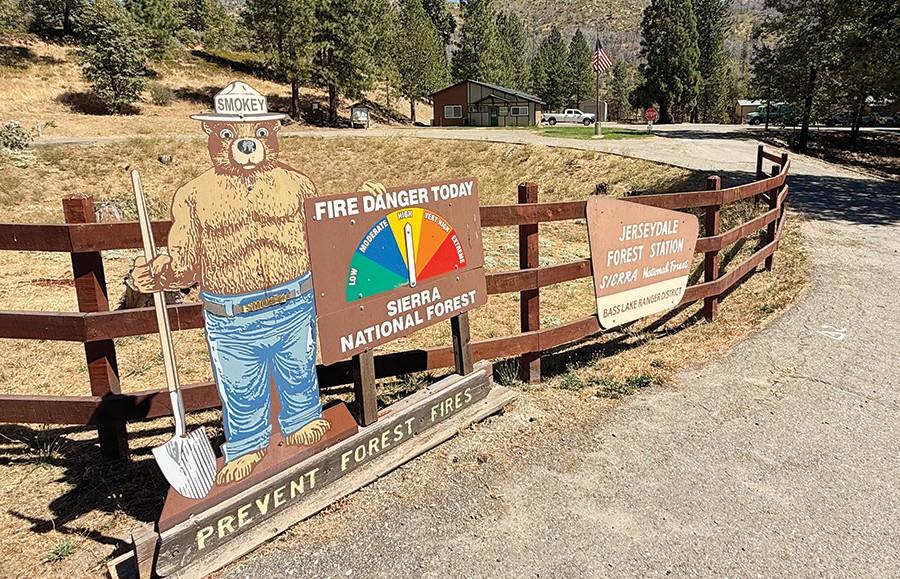

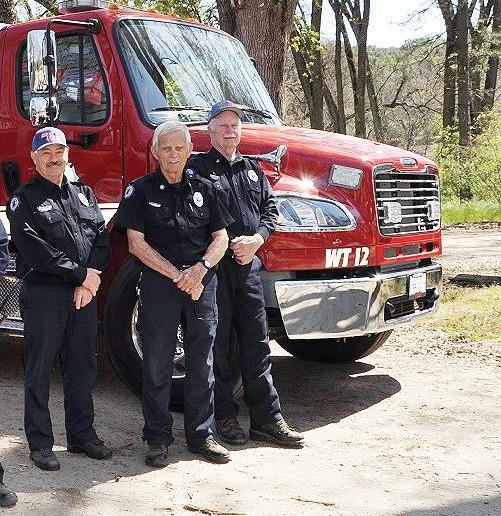
The Jerseydale Fire Station is operated by the U.S. Forest Service. An influential rating agency — Insurance Services Office (ISO) — won’t consider CAL FIRE or USFS fire stations in its risk analysis, meaning higher premiums for homeowners. Photo by Fred Ohlerking
Like many of her neighbors in Jerseydale, Victoria Scott got a shock when her fire insurance through the California FAIR Plan came up for renewal.
It went up by 140 percent, from $4,200 to $10,000 a year.
Even for the FAIR Plan, California’s insurer of last resort, that kind of increase hardly seems fair.
In fact, it feels particularly cruel.
“I can’t do nothing,” Scott said. “I can’t just sit here and watch the neighborhood fall apart.”
She believes many of her neighbors, especially those on a fixed income, will soon be left with a desperate choice: Move from the forever home they love, or “go naked,” without fire insurance.
Beginning Oct. 15, those on the California FAIR Plan will see premiums increase by an average of 29 percent.
In Mariposa County, which insurers consider to be at an “extreme risk” for wildfire, the FAIR Plan rate hike could be anywhere between 40 percent to 100 percent of current costs.
Dig deeper into the numbers, broken down by zip code and neighborhood, and an even more complicated story emerges; one with big implications for those who still have private insurance.
The story involves an influential data company, a county that relies heavily on volunteer firefighters and a state-mandated insurance pool designed to shoulder the burden of the unfortunate few, now underwriting an entire industry.
FAIR for whom?
The FAIR Plan is insuring more than $2 billion in residential property in Mariposa County, according to zip code data from the California FAIR Plan Association compiled by the Mariposa Gazette.
In 2025, there were 3,259 residential lines under the FAIR Plan in Mariposa County, a 94 percent increase in four years.
Many of those homeowners had little choice.
In recent years, seven of the 12 largest private home insurers reduced or stopped writing new policies in California altogether.
It the process, it fundamentally shifted the financial burden of wildfire risk in California.
The FAIR Plan transformed from a backup plan for consumers who can’t get fire insurance in the private market, to a high-risk pool of policies funded and financially backed by those same insurance companies.
About 5 percent of all single-family homes in California are now insured under the FAIR Plan.
Researchers at Stanford University earlier this year traced the crisis “to a collision between rapidly escalating wildfire risk, a Covid-era inflation spike and a regulatory framework rooted in Proposition 103.”
Passed in 1988, Prop 103 was aimed at a surge in auto insurance premiums but it also prevented home insurers from charging rates that accurately reflect the actual and projected risk.
In other words, if insurers can’t charge a customer based on the true risk, the only option is to dump the policy.
Lucky, and good
Fingers crossed, Mariposa County has had a fortunate fire season, so far.
Mariposa County CAL FIRE Division Chief Cole Periera doesn’t believe it is just luck. He credits the unified response from Mariposa County, CAL FIRE and the U.S. Forest Service.
“These are relationships we’ve been building on for years,” Periera said. He added that many of the top commanders of these organizations have known each other for decades and have excellent working relationships.
Under a “cooperative service model,” Mariposa County pays CAL FIRE up to $4 million a year for command, control and dispatch services.
CAL FIRE is an all-risk agency, meaning they respond to all fire emergencies, including structure fires, but are primarily responsible for protecting natural resources from vegetation fires.
The Mariposa County Fire Department (MCFD), which relies heavily on 59 volunteer personnel, has primary responsibility for protecting life and property.
Together, they operate as a consolidated organization, with CAL FIRE providing “comprehensive emergency fire protection for the county,” according to the agreement. That includes residential, commercial and wildland fire response.
It is a model that’s become more common in the so-called “wildland-urban interface” that describes so much of Mariposa County, especially in places like Jerseydale, where the Sierra National Forest is quite literally in their backyard.
But not everyone is sold on the model, or even understands it, including those within the insurance industry.
Who is ISO?
Most people have never heard of Insurance Services Office Inc. (ISO). It is a data and analytics company, with a very forgettable name, that plays an out-sized role in how much homeowners pay for fire insurance.
It is the central resource for risk ratings in the insurance industry and is a subsidiary of Verisk Analytics, which along with another company, CoreLogic, are the biggest players providing risk analysis to insurance companies.
ISO has a fire score for every home in America. Its analysis is based on reviews it conducts every five years.
The rating is on 10-point scale, with a 1 meaning the home is in an area with top-tier fire protection and a 10 indicating the area doesn’t meet minimum fire standards.
The higher the score, the higher a home’s fire insurance.
The scoring system has two separate classifications, both for homes within five miles of a fire station,
The first classification is for home’s within 1,000 feet of a water supply, like a fire hydrant, and the second classification is for homes beyond 1,000 feet of a water supply.
Mariposa County’s prior ISO evaluation was in 2018, the latest report was published May 1.
Mariposa County’s overall score stayed the same: 5/5Y.
It is the standard, median score, one shared with nearly 8,745 other fire departments in the U.S.
But that scoring system has a very important catch: Any home located more than five miles away from a fire station is considered “not protected,” and automatically gets a score of 10.
The worst possible rating.
And that score just considers “structural fire suppression.”
Insurers will also layer on top of that a wildfire risk score. Most of Mariposa County is considered an “extreme risk” for wildfire.
A costly distance
ISO does not take CAL FIRE and its hybrid “cooperate service model” with Mariposa County into consideration in its analysis.
When ISO looks at Mariposa County it sees a mostly volunteer firefighting organization, with apparatus — like fire engines, ladders and water tenders — spread throughout the county.
The ISO analysis doesn’t consider the resources of the U.S. Forest Service (USFS) fire crews, known for their avocado green fire engines, either. The Stanislaus and Sierra National Forest constitute more than 16 percent of the county’s total land area.
In some areas, the latest ISO report sent insurance premiums skyrocketing and will continue to do so as policies come up for renewal.
Consider what happened to Victoria Scott in Jerseydale.
Three miles away from Scott’s home is the Jerseydale Fire Station at 6440 Jerseydale Road, operated by the U.S. Forest Service (USFS).
For many years there were two volunteer Mariposa County firefighters who lived in the area and responded to Jerseydale fire station when called out.
But those two volunteers, a husband and wife team who were former firefighters, moved away a few years ago and as far as ISO is concerned, the area’s fire protection left with them.
USFS removed its fire engine as well in 2021.
This summer, the ISO fire score for Scott and her neighbors in Jerseydale went from a 5 to a 10, the very worst rating.
This, despite the fact there is still a fire station three miles away. But ISO doesn’t consider USFS a responding agency for a residential fire.
As far as ISO is concerned, the nearest fire station is now Station 29 in Lushmeadows, seven miles away.
In Scott’s case, it didn’t even matter that she has a hydrant within 1,000 feet
CoreLogic, the other data service, also considers the area “not protected.”
“Your insurance policy is covering the house,” Scott said. “If there’s a wildfire to the left, and a house to the right, in the eyes of the ISO their (USFS) main focus is the wildfire and not the house.”
But Scott believes ISO is misinterpreting firefighting terminology and may be confusing the “cooperative service model”with the concept of “mutual aid.”
“They’re all going to respond. The safety of people and lives is number one. Any one of those entities (MCFD, CAL FIRE, USFS) is going to come,” Scott said.
Changes coming
CAL FIRE Chief Periera has talked directly with ISO and is trying to educate them about the county’s “cooperative service model.”
And some significant changes are on the way.
Beginning Oct. 1, the county will be returning an engine to the Jerseydale station.
More broadly, next month MCFD will be changing its Computer Assisted Dispatch (CAD) and how calls go out to volunteer firefighters.
As Periera explained, currently each fire station is designated as a Company. But under a new structure, Companies will be organized geographically and include multiple stations.
So, when an emergency call is dispatched within a Company area, all the firefighters assigned to that company will be paged out for a response.
Volunteers can respond to the closest fire station, retrieve the appropriate fire apparatus, like an engine or water tender, and respond to the incident.
“It will better demonstrate that Mariposa County Fire operates as a countywide fire department, rather than as isolated single-station departments, and helps move us back toward a more unified countywide approach,” Periera said.
Periera said the changes should better capture the “response capability” in the area.
Unfortunately, ISO won’t be changing its score for Jerseydale anytime soon, even if the county gets a much needed volunteer for the Jerseydale station.
Chief Periera said ISO wants one year of recorded responses as a “proof of concept” before reevaluating its score.
In the meantime, the county is always looking for volunteer firefighters to fill in gaps in coverage.
Several stations, including Catheys Valley and Greeley Hill, are operating with limited staffing or no volunteers assigned at all.
Scott, of Jerseydale, even thought about becoming a volunteer firefighter to “man the truck and save the neighborhood,” as she put it, but was unable to make the time commitment.
A former firefighter, like the volunteers they had before, would be ideal, she said.
Others wonder if the county has become too reliant on volunteers.
Sharon McSparin lives in Mariposa Pines on Hites Cove Road in what she thought would be her “forever home.”
A senior on a fixed income, she worries insurance will force her to leave.
“I feel like for what we pay in property taxes here that the country should make sure we have firefighters and fire coverage,” she wrote in a message to the Gazette.
“If they collect property taxes they should provide fire trucks and firefighters in the area,” she said.


Responses (0)