


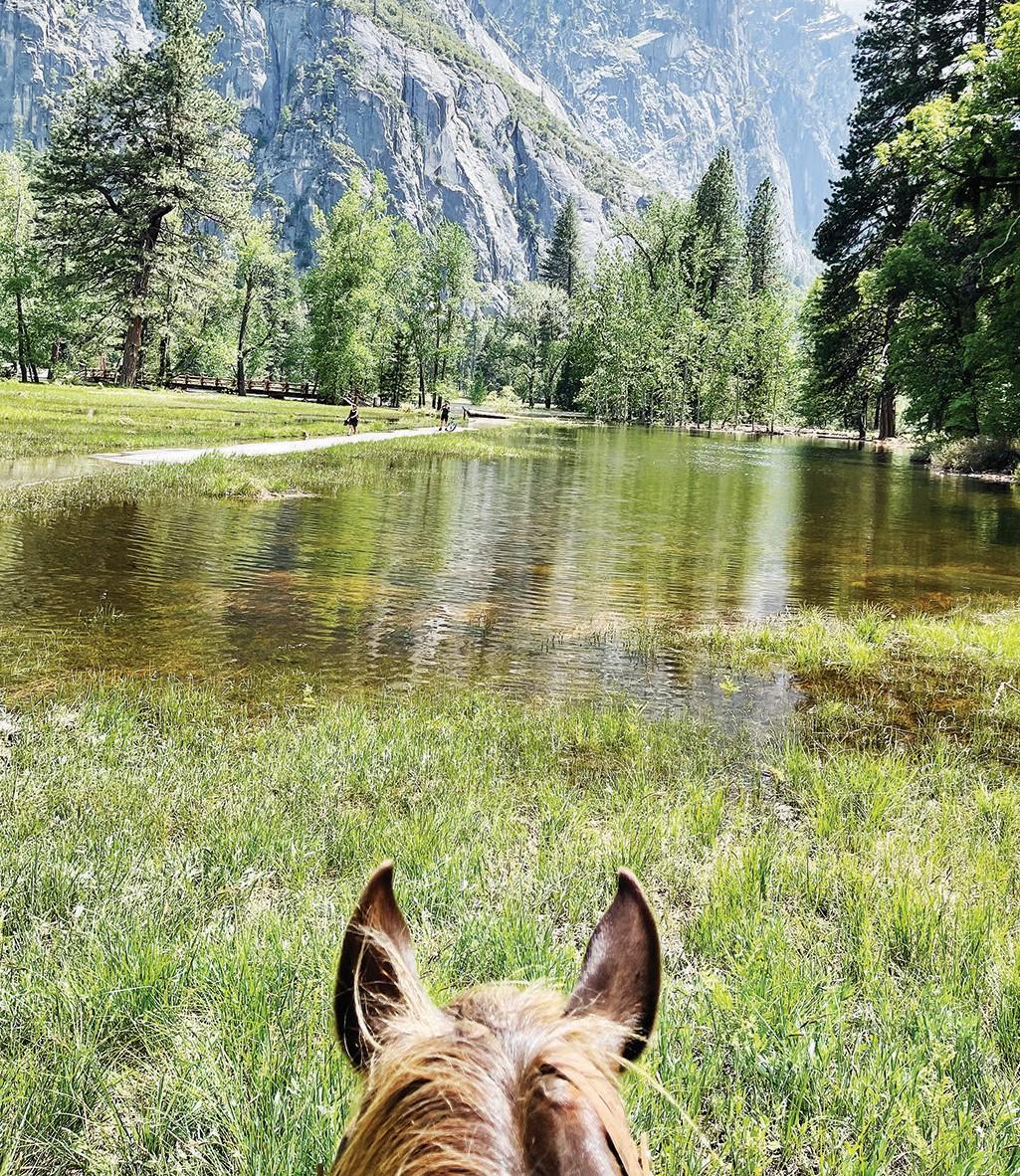

There’s nothing quite like the view from horseback of iconic formations at Yosemite National Park. A local equestrian group is trying to find a way to have better access to the park. Photo by Tom Barnett
There’s little doubt horses have been intertwined with Yosemite National Park since, well, the beginning.
The park was “discovered” during the westward expansion on horseback. Since that time, horses have been an integral part of the park, from ceremonies to packing excursions to the simple joy of riding by equestrian lovers.
“This is how the park was settled and how it was policed,” said Tom Barnett of North Fork, a member of the Mariposa Mountain Riders group and an avid horse lover and rider.
“The tourists love to see us,” said Wendy Brown-Barry of Mariposa, also a member of the club and a lifelong horse rider and lover.
But in the past few years, the horse enthusiasts say the National Park Service has given them no solid answers on an issue that dominates Yosemite — parking.
In the case of horse enthusiasts, parking is on a different level than for the average visitor. Parking for them means a big truck with a large trailer that transports their horses.

This is the sign at the parking lot at the stables located in the Curry Village area of Yosemite.
For many years, spaces were reserved at what is known as the Yosemite Valley Stables, which are located in the area of Curry Village. The stables, sometimes referred to as the Curry Stables, once used by the park service but now closed, are located a little northeast of the main Curry Village parking lot.
The area not only has the stables, but it’s also an area where there is housing for employees of Aramark, the concessions operator for the park service in Yosemite.
For the horse riders, it’s the ideal location. Even though the stables are closed, there are still areas where they can tie up their horses as well as park their vehicles and trailers.
Or their was.
“We’re not being heard at all,” said Barnett.
The Gazette did get a brief response about the issues in the form of a email from the Office of Communications of the Department of the Interior. No name was attached to the response.

Tom Barnett of North Fork is shown on his horse at the Ahwahnee Hotel in Yosemite National Park. Submitted photos
“Yosemite National Park is evaluating designated parking spaces for equestrian trailers in the East Valley. At this time, that discussion is ongoing and no permanent decisions have been made,” stated the email.
In addition, Jennifer Cressy, communications director for Rep. Tom McClintock, said their office would be inquiring about the issue after they were contacted by the newspaper.
A solution is needed
Barnett said he has been trying for around two years to get some answers from Yosemite officials, but to date, that has not happened. Though he has had some responses and provided the emails to prove it, the answers given seem to change by the month and year.
And the bottom line, he said, is the current stance of the park service is there is no designated parking for equestrians and their rigs.
Both Barnett and Brown-Barry believe the park service should be obligated to at least hear their concerns and come to some sort of agreement. But to date, that simply is not happening.
Barnett said the stables area is the ideal location, which would make sense because it housed horses for years. He said the “loading and unloading” of the horses can take place easier in this area of the park.
But he produced a photo taken just last week that had a sign posted at the entrance of that area reading, “Passenger vehicle parking only.”
Barnett said he has been trying for quite some time but doesn’t believe anyone associated with the park service or Yosemite is actually listening — or want to listen.
“We don’t have a voice,” he said.
In fact, he said during a major planning meeting several years ago in Oakhurst, he brought the issue up to then superintendent Cicely Muldoon, but no solutions ever came from the discussion.
On that day when Barnett drove his truck and trailer to the stables parking area where the sign was present, he said it was 10:30 a.m. on a Monday morning and the lot was full. He said there were 38 vehicles in the lot — all passenger vehicles.
On top of that, he said, in the past, there were designated hours for parking in that lot, closing at around 8 p.m. Now, he said, many people parking there have backcountry permits and leave their vehicles for days because the lot has no more set hours.
The lot, he said, is about a quarter-acre and it is perfectly setup for equestrian use. He also noted there is an Aramark housing area that uses the same entrance and said that has not been a problem in the past.
What is the direction?
Barnett brought with him to the interview a copy of Department of the Interior Order No. 3426, released in April 2025 and signed by Secretary Doug Burgum.
That order, highly touted at the time by the department, is entitled: “Ensuring National Parks Are Open and Accountable.”
In the order, it states areas managed by Interior “remain open and accessible for the benefit and enjoyment of the American people and to ensure that the National Park Service will provide the best customer service experiences for all visitors.”
It also states that Interior works “to extend benefits of natural and cultural resources conservation and outdoor recreation throughout this country and the world.”
In another section, the order vows that “all Americans have the opportunity to visit and enjoy our nation’s treasured places.”
Brown-Barry said this issue goes back years, into the 1990s, when the Merced River Plan was being debated. She even testified in Washington “trying to save recreation.”
“Here we go again,” said Brown-Barry.
For Barnett, he said there has to be a way to compromise. He said for the most part, it’s in the spring and fall when most equestrians utilize the park. He specifically said April, May, October and November are the key months. Much of that, too, is during weekdays, he said.
That, he said, should be the basis for people who are willing to compromise but he is not getting any responses from park officials about even having a meeting.
“We need to all get together at a table,” he said.
So many aspects
Barnett said it was 2004 when “I took my first ride in Yosemite.”
He told himself, “This is why I want to live here.”
Since that time, Barnett has ridden all over the park, from Yosemite Valley to the High Sierra — and just about everywhere else.
But these days, he said, just getting into areas is difficult. One good example is around Fish Camp where fires and windstorms have devastated the area. Barnett said the U.S. National Forest Service allows approved private groups to do trail clearing.
However, the National Park Service does not, he said, meaning access has been greatly curtailed when it comes to Yosemite.
Brown-Barry said the stables were closed a few years ago, though the structure remains.
“When the stables closed, we were told we could use them for private use,” she said.
But as Barnett noted, at that time, it was Aramark who controlled the operations of the stables. Now, that has changed.
He produced an email from Rachel Jacobs of Aramark dated Oct. 30, 2025, in which she said “the park service now has the right and manages the land we discussed…”
That land, he said, includes the parking area at the stables.
At one point, he said park officials told Barnett that parking was still closed at the stables, but now, he said, general parking is being allowed.
Further, Barnett produced other emails from park officials suggesting some of the turnouts on Northside Drive might be suitable for loading and unloading horses.
Both Barnett and Brown-Barry said the vast majority of horse owners will not even think about using turnouts as they are dangerous and vehicles are close by on the roads, some going well above the speed limit. Barnett said he had a near miss in a turnout area once and will not risk it again.
Brown-Barry argues the stables, which are more than 100 years old, are “historic” and should be preserved under the directives issued by the park service. She said the Wawona Hotel is another example of a historic building that has been closed for years with little hope of saving the place for the future.
She believes that goes against the park service’s own directives.
Barnett also pointed out that through all of this back and forth with park service officials, he noticed a subtle change on the Yosemite website when it comes to equestrian parking.
That change was an added sentence: “Stock can be unloaded and loaded at any stock camp, designated stock area or any concessions stable.”
But as Barnett noted, that leaves few options.
The stables located in the residential area in Yosemite Valley are operated by the park service and used for their horses and the Wawona stables are operated by Aramark but are used for concessions and have little parking.
That only leaves the now-closed stables area, which Barnett said are consumed by private vehicles.
A long tradition
Riding horses is a tradition older than Yosemite itself.
In the early days, that was the mode of transportation. And over the years, horses are intertwined with park operations and tourist interaction.
“We’re the best ambassadors,” said Barnett.
Brown-Barry told a story about her interactions with two young people from Los Angeles.
She was in Fish Camp when she met two boys who were in high school and had driven all the way from LA overnight to see the sunrise at Yosemite.
“They had never touched a horse before,” she said.
Brown-Barry said that’s an example of how horses can make an impact even on young people from LA who were able to see and feel a horse for the first time.
As for what’s next, Barnett said he thinks park officials should realize the equestrian community needs a voice at the table. He said many other groups, like climbers, Native Americans, bicyclists, hikers and more have been involved with decisions.
“Everybody gets a voice but us,” he said.
“Having stables in the park worked for decades,” said Brown-Barry.
Barnett said there is one underlying factor he thinks is driving the entire issue. “Money.”
He believes park officials are focusing more on getting as many people into the park rather that looking at the entire picture. Those people, he said, generate money, which benefits the park and the concessions operators.
Barnett believes that is one of the driving forces behind having no reservation system in Yosemite this year. He didn’t give an opinion either way on the reservation system, but said the money is a lure for those in charge.
Still, he said, that should not preclude officials from at least hearing out the concerns of the Mariposa Mountain Riders and many other equestrian groups who have enjoyed the park for generations.
“I would like to sit down with the stakeholders and discuss the issue,” said Barnett.
He’s also wide open to “some sort of compromise,” which he understands happens anytime there are disagreements and decisions have to be made.
For both Brown-Barry and Barnett, the equestrian community is a glowing example of how good conservation can work, and has over the years.
The goal of the equestrian organization is to protect the land, preserve horsemanship, engage with the public and keep public lands open for everyone.
Barnett said many people don’t realize that it was the equestrian community which created the “Leave No Trace” principle that is the standard today for nearly all environmental groups and causes.
As Brown-Barry pointed out, to this day the park service keeps and utilizes horses and mules inside Yosemite. She believes that very fact should be a major reason why the public should be able to do the same.

Responses (0)