


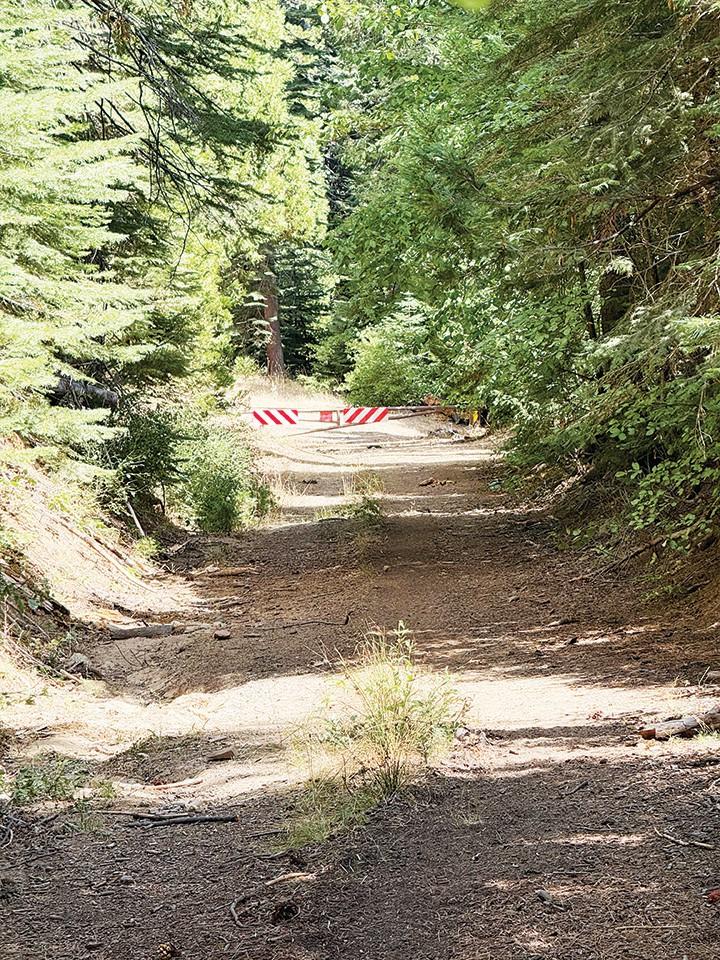

The locked gate near the entrance to the 83-acre Hazel Green Ranch in Mariposa County, on the border of Yosemite National Park. Photo by Tom Lyden
A secretly negotiated land swap between Yosemite National Park and a Las Vegas developer erupted last weekend into a political firestorm.
The land swap, which was still being negotiated, would create a quarter to half-mile easement from Highway 120, within Yosemite, to an 83-acre property just outside the park’s boundary in Mariposa County.
The private developer wants to build high-end luxury homes.
Sanctuary at Yosemite LLC, which is controlled by Las Vegas-based Kingsbarn Realty Capital, purchased the Mariposa County property two years ago for $2 million.
Known by locals as the Hazel Green Ranch, the acreage sits right along the border of Tuolumne County and Yosemite National Park.
It is so tantalizing close to Yosemite Valley, and yet by vehicle, it seems so very far.
Despite its next door proximity to the park, the only current access to the property is from Old Yosemite Road, a treacherous stretch of dirt road that is 18 miles from the Big Oak Flat Entrance to Yosemite.

This map shows the proximity of the land to the Big Oak Flat Road.
The easement envisioned by the developer would allow a quarter to half-mile road to be built to any future housing development.
It would, essentially, be a short private driveway directly into the park, bypassing the entrance gate.
Strange bedfellows
Since the story broke last week, it is looking less like a short cut and more like a very long political battle.
The talks were first reported Aug. 28 by the online news site NOTUS, with the headline, “Trump Quietly Working to Give Part of Yosemite to a Private Developer.”
The story was framed as one of political influence.
Kingsbarn CEO Jeff Pori has given small political contributions to Republicans and has connections to Trump Administration officials. The report quoted anonymous sources who said the deal was a top priority for Trump loyalists inside the U.S. Department of Interior and National Park Service.
The story quickly went viral last Friday, picked up by the New York Times, LA Times, Washington Post and even People Magazine.
But come to find out, it is a well known Democratic deal maker, Lanny Davis, who said he has been orchestrating much of the deal as the attorney for Kingsbarn.
“No one has ever accused me of being pro-Trump. It’s a lie,” said Davis, a well known D.C. attorney and former consigliere to the Clintons.
Davis was also an attorney for Michael Cohen, Donald Trump’s former personal attorney, who testified against Trump.
In a series of colorful conversations with the Mariposa Gazette, Davis acknowledged he has been quietly negotiating the potential land swap with officials “on the ground” in Yosemite National Park, the National Park Service (NPS) and U.S. Department of Interior.
Federal law prevents the sale of national park land, but a land swap would allow the developer to give NPS land of equal or greater value somewhere in California.
In exchange, the developer would get an easement for a road leading to the private development that could be a quarter to half mile long, depending on where it would intersect with Highway 120.
That arrangement, by itself, is not unusual. There are several private homes and communities, like Yosemite West and Foresta, that are within the boundaries of Yosemite.
Davis said a potential parcel has been identified for the swap, and notices were submitted to the U.S. Congress, but he said no land transaction has occurred.
A spokesperson for the U.S. Department of Interior said no final decision has been reached and that anonymous allegations were being used to “manufacture a political narrative that simply is not true.”
“There has been no political pressure to reach a predetermined outcome, and claims suggesting the department is secretly working to hand over National Park Service land to a private developer are false,” the Interior spokesperson said in statement.
‘A Back-room deal’
It does, however, sound like the parties were getting very close to a deal.
“This story was leaked by an environmental group. It’s false and misleading,” said Davis, who was clearly agitated as the story was taking off last Friday.
News of the behind-the-scenes negotiations brought a torrent of criticism from environmental groups.
The Sierra Club called it a “corrupt back-room deal.”
The National Parks Conservation Association suggested any agreement would be challenged in court, and that NPS was “now working in overdrive to turn over land to a private developer.”
But Davis, who is legendary for his combativeness, said their argument “exposes the hypocrisy of environmental groups,” who would rather have the carbon footprint from a 36 mile round trip rather than construct a short road into the park.
But that may also miss the point.
That short road would go through a forest of Dogwood, Ponderosa and Sugar pines and firs. It would also be near the trail head to the Merced Grove with its 20 giant sequoias.
SJ Joslin, a Yosemite biologist who was fired last year by the park service, said the area is also habitat for the Spotted Owl, the Great Grey Owl and Fisher.
“What a road in that area means is habitat fragmentation and the potential for fire near the Merced Grove,” Joslin said.
Even a short road could potentially open a vast stretch of land within the Stanislaus National Forest to private development.
“It opens a whole can of worms,” Joslin said. “And even if someone has the best intentions now, what about in 100 years?”
Previous litigation
Mariposa County government officials contacted by the Mariposa Gazette said no plans for a housing development of any kind have been submitted for the Hazel Green Ranch property.
Two county officials, who were not authorized to speak, said they were unaware of negotiations between Kingsbarn and NPS/Yosemite.
But the idea of building a shortcut from Hazel Green Ranch into Yosemite is not a new idea.
The previous owner of the Hazel Green Ranch, Russell B. Geyser, had the same thought when he tried to build a resort on the property.
Since 1998, Geyser had been trying to convince NPS it should allow him to build a road to Highway 120, according to court records.
Former Yosemite Superintendent Don Neubacher told KQED, “We said we didn’t have the authority, and we thought it would be illegal to give it an easement. Now all of a sudden the Trump Administration is really pushing this.”
After talks with NPS collapsed around 2007, Geyser filed a federal lawsuit against the U.S. Department of Interior.
In 2012, the Ninth Circuit U.S. Court of Appeals dismissed his case.
He lost in large part because Mariposa County waved any right to the existing road that runs through the property.
With the county essentially abandoning the road, the court decided Geyser didn’t have any right to an easement.
So close, so far
Hazel Green Ranch exists in a kind of liminal space. It’s not in Yosemite, and yet is indistinguishable from it.
It’s been that way for more than 170 years.
In 1848, the U.S. acquired the land around Hazel Green in the Treaty of Guadalupe Hidalgo.
In 1857, the site became a stop along the Coulterville Free Trail, the first road into Yosemite Valley.
By 1870, a more substantial wagon road was constructed from Coulterville, through Hazel Green, to Yosemite Valley.
In 1888, the government gave 120-acres that encompass Hazel Green to James Halstead, who operated a hotel and stagecoach on the property.
It became a destination along the Coulterville & Yo Semite Turnpike, and eventually developed into two separate roads to and from Hazel Green.
In one direction it turned into Crane Flat Road, which goes east to intersect with Highway 120. The Coulterville Road forked south, as it passed through the Merced Grove and then continued to the Yosemite Valley floor.
In the early 20th Century, Halstead sold the property to the Curry family.
In 1938, the Curry family sold 40 acres to the federal government for the realignment of Highway 120, which left the two, 40 acre parcels of private property that exist today, an 83-acre island of private property, surrounded by public lands.
The long way
Today, on the Yosemite side of the border, there is a pullout along Highway 120 and a path that leads to the acreage.
On the other side, in Mariposa County, there is a locked gate at the entrance to the property.
The journey to get to the property is through approximately six miles of steep, deeply rutted and claustrophobic dirt roads, with plenty of downed trees along the roadside.
Driving a Jeep, the Gazette reporter wondered a few times if he should turn back.
The road from the property exits at the Tuolumne Family Camp, and several other tourist resorts. From there, it is another 12 miles to the Big Oak Flat Entrance.
But the Gazette took the long way last Saturday.
From the town of Mariposa, the drive went through Coulterville and Greeley Hill, and then led to a maze of dirt mountain roads that snake through the Stanislaus National Forest.
The journey winds along the original road into Yosemite, and through the untouched wilderness of Northern Mariposa County.
For hours along those back roads, there wasn’t another soul visible.
It was a reminder that their are still vast stretches of land in Mariposa County that remain undeveloped, in large part because they are still relatively inaccessible.
That could always change.
It may all begin with a short road.


Responses (0)