


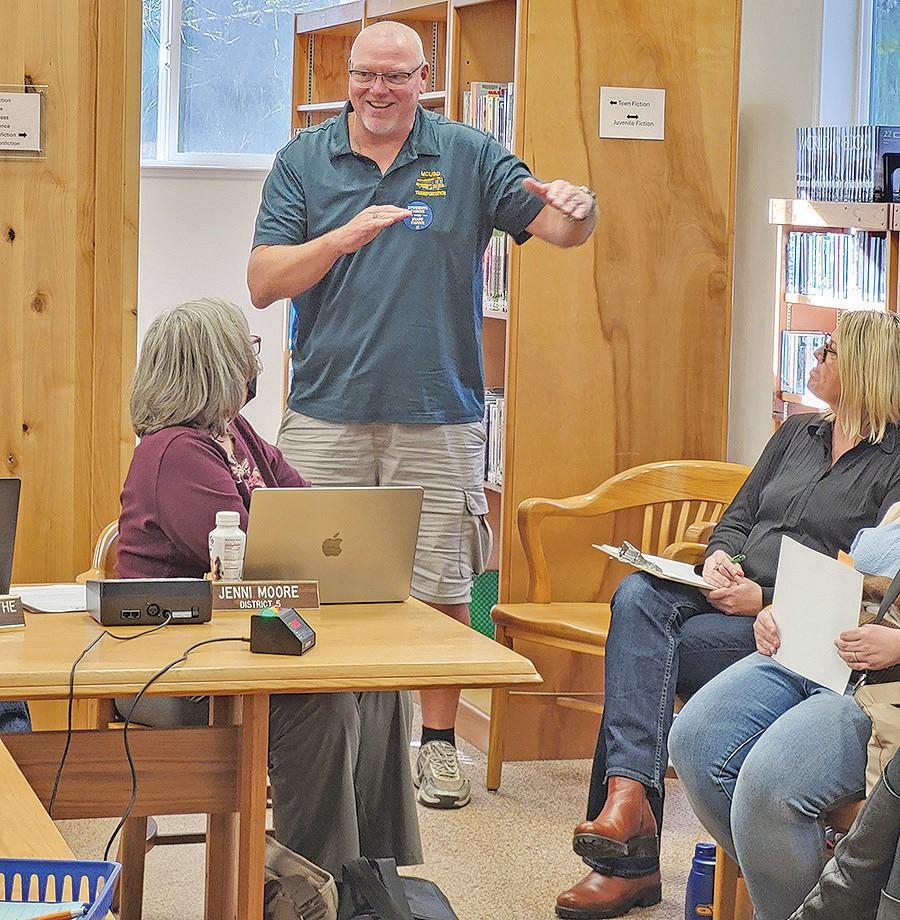

Timothy Burkett is pictured speaking during public comment. Photos by Amanda White
It was a packed house at Greeley Hill Elementary earlier this month as a large number of people made the drive to attend the monthly school board meeting on April 16.
The library at Greeley Hill Elementary quickly filled as many classified employees and supporters came to advocate for a higher pay raise for Mariposa County Unified School District’s classified staff.
Pay rate negotiations have been ongoing for what will be a year in May between the district and the local chapter of the California School Employees Association (CSEA).
Classified staff
Classified staff are school employees in positions that do not typically require a teaching credential or state certification, providing essential support to students, teachers and school functionality.
These positions include roles such as paraprofessionals, secretaries, custodians, bus drivers and food service workers among others.
Many classified employees feel unsupported by the district as the cost of living continues to rise along insurance rates.

Many MCUSD classified staff gathered at the school board meeting on April 16 to advocate for higher pay.
Public comment
Michelle Look, Yosemite Valley School Secretary, thanked the district for having an evening meeting, as she had lost an entire days pay by coming to advocate for higher wages during a scheduled day time school board meeting.
“I’ve never worked in a job where talking to the stakeholders in charge of my salary is unexcused,” she explained.
Look shared she loses money every year by staying with MCUSD.
“Not only are you my employer, you’re also my landlord. By raising my rent year after year, this year being 7.7 percent while not raising my wage, I am making less money year after year while gaining more responsibility.”
Look expressed that “you can go work at the bike stand in Yosemite National Park and make $3 more an hour.”
Look felt that aids within the district are some of the most valuable employees.
“Aids are the ones who are helping your kids learn how to hold a pencil, help them with their ABCs and making sure they are safe.”
Timothy Burkett is a bus driver and has been working in the district for 13 years.
“I love this job. I wouldn’t want to do anything else. I would love to finish my career here,” he said.
“Financially I’m struggling. I don’t know if I’m going to be able to continue working here.”
Another man, Chris, expressed his appreciation for the district but feels “it’s getting harder and harder to work for the district.”
Chris explained the importance of classified staff.
“Without all of us you don’t have a district,” he said.
“We play such an important role to all these kids. Every year seeing people leave because they can’t afford to be here, that’s a big problem. Why do we have to fight you guys so hard? We’re just asking to make enough to feed our families. Without us you have nothing.”
Another classified staff member, Carla, shared her disappointment of the district not increasing their offer at all after hearing many staff members share their stories and hardships.
“As you know our insurance went up by over $200 a month. A couple weeks ago, right before our last round of negotiations, we found out that in six months our rates will go up by another $225 a month,” Carla said.
“With this trend we can look at the same rising costs the following year. This is not sustainable. I, along with so many others, feel like we’re being forced to leave jobs we love because we can not afford to continue to make thousands of dollars less every year while the cost of living skyrockets.”
Cici Jackson explained she has been with the district since 2006.
“Every year I’m having to cut more and more,” she explained.
“I have three jobs at the moment just trying to stay afloat. My insurance is limited and it doesn’t cover dental or vision which means I have had to delay treatment with a variety of things. It’s getting harder and harder to stay in this job.”
CSEA report
Stormi Smith, CSEA President, spoke with intention as she addressed the room.
“I just want to take a moment to thank our classified staff for being so dedicated and diligent and patient with us as we continue to negotiate with the district,” Smith said.
Smith explained her frustration that after speaking with the district and sharing stories, “nothing is changing and the offer hasn’t move much at all.”
“Our staff are struggling financially and are facing dire need of leaving the district. We’re 147 employees. These people are being financially affected by the decisions made by the district.”
Smith urged the board and the district to really take an active approach to recognize classified staff.
“This is hurting us. I hope that when you’re sitting here you’re making eye contact with these individuals because they are the ones that are also keeping the district going. It is time. It is time to acknowledge them and make a difference for them.”
Negotiations continue
As most classified positions do not require a degree or certifications, the instructional aides are required to have a No Child Left Behind (NCLB) certification or an AA degree.
“The aides are one of the lowest paid positions,” Smith said.
“These are the people who jump in and help with everything and they are relied on so heavily.”
While negotiations continue, the current salary schedule for classified staff reflects the 2024-2025 board-approved salary schedule (up 1.5 percent from the previous year) until collective bargaining negotiations for the 2025-2026 school year are completed and a negotiated agreement is approved.
The wage adjustments currently in place are included solely to comply with the state minimum wage requirements.
For reference, classified staff in the step one and step two categories are currently listed with a pay rate of $16.50 an hour until negotiations are completed.
“The latest offer was 2.5 percent,” Smith said.
“That’s in addition to everything else that’s been offset. We would need something more significant.”
The process
The negotiating process, which typically occurs on an annual basis for local school districts, “is one of the most important responsibilities we undertake each year,” said superintendent Jeff Aranguena.
“Many factors are considered to ensure any proposal makes the best possible use of available resources, prioritizes wage investments here in Mariposa and remains fiscally responsible and sustainable over time.”
The district reviews the budget, the state’s budget, revenue projections, rising operational costs, multi-year financial obligations and the need to maintain long-term stability for both students and staff.
“We know these decisions directly affect the people who serve our schools every day and we approach them with that responsibility in mind,” Aranguena explained.
“Our goal is to navigate negotiations in a way that preserves programs and services, protects positions that families in Mariposa rely on and still allows for thoughtful investments in wages and other district needs.”
Remaining committed
“We are committed to reaching agreements that honor our employees, support students and remain sustainable for the future, rather than making commitments that may be difficult to maintain in later years,” continued Aranguena.
“Any funds through the negotiations process need to come from within the existing budget unless additional revenue becomes available. In practical terms, that could require reducing, delaying or reprioritizing expenditures in other areas such as staffing, programs, services, materials, deferred maintenance or other operational needs.”
The affects
Within small rural districts like Mariposa, budgets are often especially tight and decisions in one area can have a direct impact on another.
“We understand that these choices affect real people, real jobs and the services our students depend on, which is why they are never taken lightly,” Aranguena said.
“Each year, the district must thoughtfully balance compensation investments with its responsibility to preserve student services, maintain safe operations and remain financially stable.”
Even though finding the balance can prove to be difficult, Aranguena explained the district has worked to “avoid largescale layoffs, where agreements later require staff reduction,” or other cuts.
“Our goal is always to find a path that continues to invest in our employees, protects programs, avoids layoffs whenever possible and meets the state’s requirement to maintain a balanced budget. It is challenging work each year, but it is work that matters deeply to our staff, students and community,” Aranguena explained.
“We understand that both stable full-time positions and meaningful investments in compensation matter to our hardworking employees and the school community we serve.”
Rising costs
There is no doubt that rising costs across California have made life more challenging.
“We will continue to advocate in Sacramento for the increased funding our schools and communities need. While competing with larger Central Valley districts can be challenging, we remain committed to finding thoughtful and realistic ways to support our employees, strengthen retention and ensure Mariposa remains a place where people want to serve and stay,” Aranguena said.
“I would like to share that we are very pleased to have reached an agreement with our MCTA partners that makes meaningful progress in improving wages for our dedicated staff while also strengthening health benefits. We are also proud to report that we have made similar investments in support of our confidential employees.”
Recognition
“I believe it is important to recognize the tremendous effort shown by both CSEA and the district’s negotiating team. Together, they have worked diligently to make progress on a significant number of proposals brought forward by the CSEA team,” said Aranguena.
“While the scope of those discussions has contributed to a longer process, it has also led to many meaningful changes that reflect the priorities and concerns shared by our CSEA partners. Throughout this process, the collaboration has been thoughtful and focused on making Mariposa a better place to serve students.”
As negotiations continue, Aranguena is confident in the process.
“Mariposa has a strong history of negotiations that, through patience and collaboration, have resulted in meaningful investments, balanced budgets and thoughtful long-term decisions,” he said.
“I have great faith in the continued efforts of both parties and in our shared ability to reach solutions that honor our employees while sustaining the future of our district.”




Responses (0)