


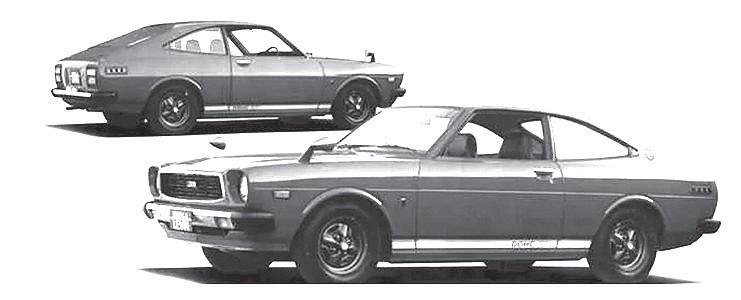

1977: Base MSRP, $2,968; to speed, 90-100 mph; mileage, 31 mpg.
I really enjoyed reading Amanda White’s article about how cassettes have given rise to MP3s and all the other things that are so different now versus when she was growing up.
Her story is all-too-familiar to many of us, and we are amused when we realize how the young people today have no experience functioning in a world that had dial-type telephones, TVs that had to “warmup,” standing in line to get cash at the bank or writing letters to your friends because long distance phone calls were expensive.
We all have anecdotes to share that contrast the world of today with that of the past we personally experienced.
There is another aspect of this story as well: what was it that drove this change?
That is a story I would like to tell, having been there as an insider that built much of what has made this possible. Before I tell the story, let me say a little about my background.
Since graduating with my electrical engineering degree in 1977, I have been actively working in the semiconductor industry in product development: I design ICs and help my customers use them to make products we use every day including computers, printers, WIFI routers, network switching equipment, robotic vacuums and many other kinds of products.

2025 (scaled by 16 million): Base MSRP, $2.97; Top speed, 1,400-1,600 mph; mileage, 31,000 mpg.
The key thing that has made this computerized, interconnected, media intensive world conveniently available in the palm of your hand is the unprecedented reduction in the cost of digital electronics made possible by shrinking the area needed to build an electronic function on board an integrated circuit. We semiconductor guys call it “technology scaling” or just “scaling.”
In 1965, one of the co-founders of Intel Corporation, the late Gordon Moore, wrote an article where he observed that every 12-24 months you can “cram twice as many circuit elements onto a chip for the same cost or lower.” That influential article gave us what the world calls “Moore’s Law.”
When I entered the semiconductor industry in 1977, the most common computer memory chip held 1024 “bits” of information. To put that into perspective, it takes eight of those bits to encode one character from your keyboard.

Richard Crisp
In 2025, just 48 years later (24 of those two year periods), the most common memory chip holds 16 billion bits. That is 16 million times more bits than they did in 1977 and tracks the 24 month “doubling cadence” exactly.
As for cost: in 1977, that 1024 bit chip cost about $2.50 and in early 2025 the 16 billion bit chip cost about $2.50. In 1977 gold was about $150 per ounce while today it is around $4000. So, in hard currency terms, today’s chip is far cheaper.
It can be difficult to attach physical significance to scaling by a factor of 16 million, so let’s look at two “real-world” analogies: In 1977, a new compact car cost $2,968, got 31 miles per gallon and would go 90-100 miles per hour. A 2025 car that had scaled by 16 million might cost 1,000 times less, get 1,000 times more MPG and go 16 times faster (1000 x 1000 x 16 = 16 million). Specifically it would cost $2.68, get 31,000 miles per gallon and go 1,440-1,600 mph.
Another example: 1977, two people marry and start having children. Forty-eight years later in 2025 they now are a family of 32,000,000 (2 x 16,000,000) and still live in the same house.
This unprecedented cost reduction, and scaling it has enabled, has completely changed everything. Film cameras are rare, if you use cash, you get it from an ATM, you shop online and pay at the pump for your gas.
You can video conference for “free” with an associate in Europe or Asia over the internet, you can find your lost cows by streaming video from a drone and you watch streaming video off the internet. Satellite internet is portable too; in the outback mounted on an RV or backpacked and powered by a solar panel.
I expect to examine in some detail a number of things transformed by scaling in coming articles. Who knows, I might give a slideshow talk at the Mariposa County Library sometime in the future if there is interest.
So let the Gazette hear from you.
Richard Crisp is an electrical engineer who has worked on pioneering technology throughout his career. He is a resident of Mt. Bullion and can be reached at richard.crisp@etron.com.






Responses (0)