


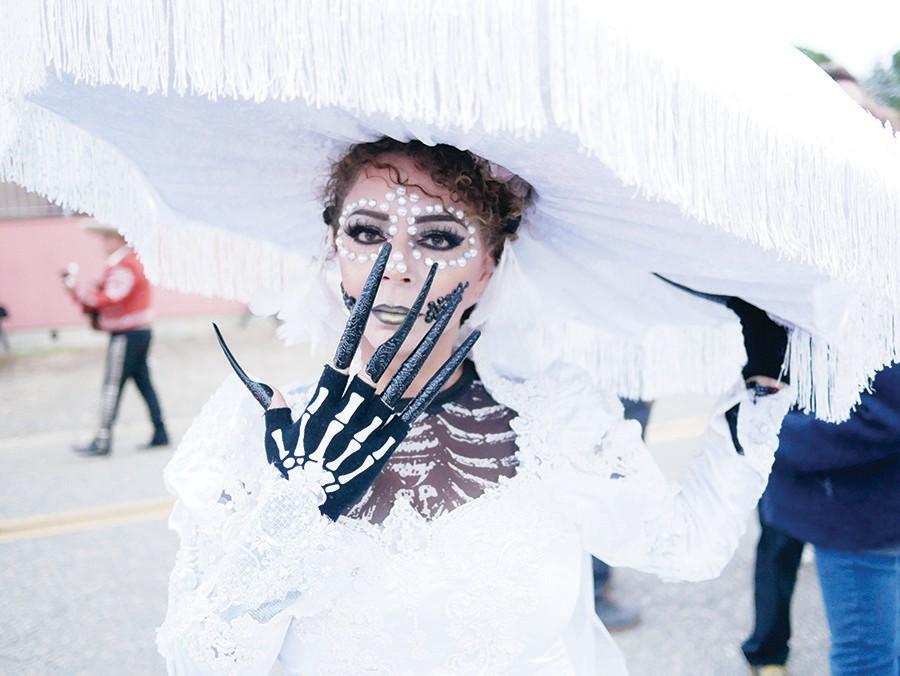

Leticia Zaragoza dressed as La Catrina. Photos by Sara Solano Aguirre
The smell of orange marigolds traveled through the Hornitos Plaza to the St. Catherine’s Cemetery in the hands of those celebrating All Souls Day.
Before dark, on Nov. 2, people gathered dressed in black, white and orange tones in one of the two times a year the St. Catherine’s Catholic Church opens for the public.
Strings of a guitar were the introductory sound people could hear before reaching the plaza. A mariachi sang lively tunes with sad lyrics, while also providing suspenseful sound effects as children took turns trying to break a piñata.
Candy bars aside, a special family handed out marigolds from the trunk of their vehicle, flowers that were intentionally grown to honor the death of their son who served in the Afghanistan war.
Skies were cloudy, but on the horizon, people could see the clear light of a descending sunset and as it got dark, hundreds of candles lit up.
The guitar tunes died down and Father Rodolfo Esmero of St. Joseph’s Catholic Church in Mariposa addressed the crowd from the balcony of the Golden Stag Hall.

During Mass to celebrate All Souls Day at St. Catherine’s Catholic Church.
He laid out the importance of this hundred year tradition and asked the people to proceed quietly throughout the procession, walking with intention to honor loved ones who have passed and praying for souls that might still be in purgatory.
Then, a singer with La Catrina’s painted face sang a song as a final send off to start the procession.
Slowly, people made the trip from the hall to St. Catherine’s Cemetery, where the final stop would be the grave of Doña Candelaria de Sapien, who helped keep the Día de los Muertos tradition alive before she passed.
Before, they used to have wax candles throughout the procession and into mass, but due to insurance of the church and safety regulations, the Roman Catholic Diocese of Fresno decided that battery operated candles were the better choice.
However, some community members found the wax candles to be a “more beautiful” image throughout this celebration.

From left, Kaitlyn Benz, Olga Powell and Lauren Delfin dressed as Catrinas. Photos by Sara Solano Aguirre
Yet, as steps grew closer to the graves, the candles were not the only source providing light.
The Church’s bell rang a handful of times as most were reaching the top of the hill, accompanied by light shining from the church’s open doors and side windows, which, once you reached the top, made the scene one-of-a-kind.
Graves were adorned not just with flowers, but lights, where you could see the names of people coming from all over the world in the late 19th century: Italy, Spain, young and old and even a baby, whose grave was modeled after a crate.
There was an overwhelming feeling of sentimental and historical richness, a sparked curiosity of each person laying in the same place, a wondering and hope that their souls have found rest.
Each flower reached its destination and the graves soon shared the same aroma.
After the procession, mass followed.
There is something special about a 160ish year old church.

Grave of baby Otto Ty Baria, from July 25, 2019 to July 9, 2021.
Inside, its walls are painted white with the Via Crucis hanging on wooden frames on each side.
The floor is carpet and seating is tight, but in this case, everyone managed to fit.
Fr. Esmero offered the mass to the lost souls and any that needed prayer to exit purgatory.
Moments of quiet prayer and reflection sealed the night.
Hands-free, people made their way back to the plaza and shared an enchilada dinner with family, neighbors and loved ones.
The church closed its doors and turned its lights off, but the warmth of those who visited remained.

Mariposa Parlor No. 63 of the Native Daughters of the Golden West placed a bronze marker plaque on the historic St. Catherine Catholic Church. Members from left, Karen Baladad, Esther Holm, Patti Murdock and Pat Campi.

Kids pick up candy from the piñata they broke.

People walk in the procession from Hornitos Plaza to St. Catherine’s Catholic Church.




Responses (0)