


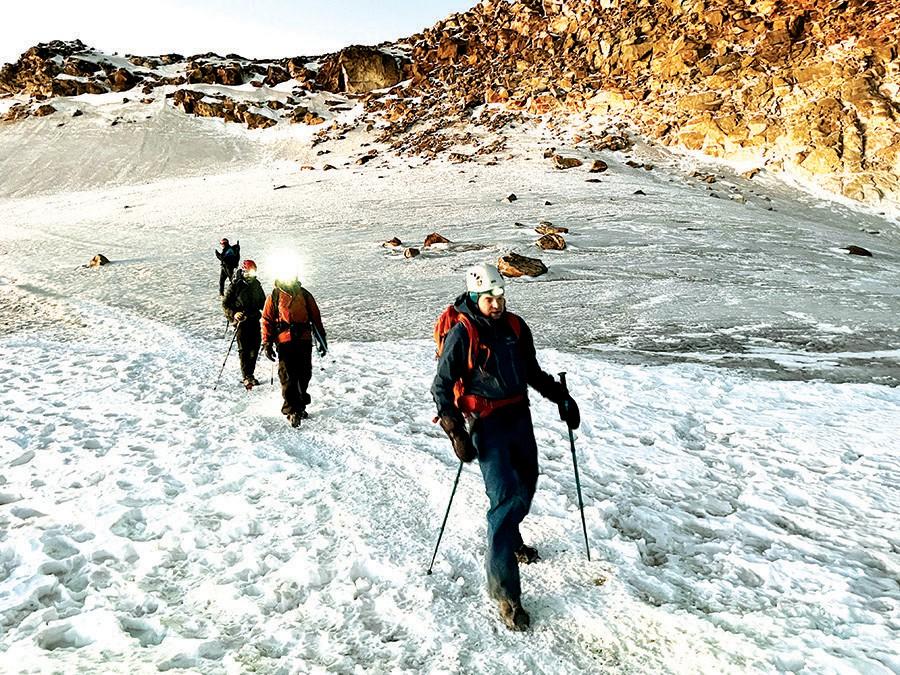

Climbers cross a glacier near Izta’s summit.
¡Vamos! We rose before dawn to climb La Malinche in Mexico’s Malinche National Park.
The volcano offers a unique experience to a Californian like me. At 14,567 feet, it stands taller than any peak in my home state. Pine trees grow on its shoulders at elevations thousands of feet higher than on Sierra Nevada mountains.
But the thing I’ll remember most about the ascent is the company I enjoyed, and not just my fellow climbers. In a first for me, a pack of wild and friendly dogs followed us to the summit and back.
Though I’ve stood upon hundreds of mountain summits, only a few times have I climbed outside the western United States. I’m not qualified for dangerous peaks like Mount Everest or K2, but an international climbing experience intrigued me.
Then a few years of Spanish classes elevated my desire to visit Spanish-speaking countries. The Mexican volcanoes trilogy of La Malinche, Iztaccíhuatl and Pico de Orizaba offered adventure within my ability range and budget. I packed my crampons and ice axe for a week south of the border.

Pico de Orizaba stands taller than any other mountain in Mexico.
Like many mountains, La Malinche boasts an interesting history to go with its physical challenge. A legend says that a reptilian monster lived inside the mountain and emerged to devour children.
The peak’s Mexican name honors a Nahua woman who served as interpreter to Spanish conquistador Hernán Cortés; Mexicans today view her as either a victim, survivor or traitor.
My companions and I pondered La Malinche’s stories as we descended with our new furry friends.
¡Próxima! Iztaccíhuatl, a 17,160-foot volcano in Iztaccíhuatl–Popocatépetl National Park, provided our next challenge. Izta’s name comes from an indigenous word meaning “white woman” because its peaks look like a woman lying on her back, and snow colors her white.
She is also called La Mujer Dormida, or the sleeping woman. “I hope she doesn’t roll over while we’re climbing,” said another climber.

La Malinche stands taller than any peak in California or the lower 48 states.
We camped near Izta’s base at 12,000 feet, tried to sleep at 6 p.m., rose at midnight and started climbing at 1 a.m. The temperature was comfortable at first but dropped well below freezing, as my icy water bottle proved.
During a break, mice scampered into my food bag and made me shake them out! Before dawn, we saw the distant lights of both Mexico City and Puebla.
One steep and icy section near the top required crampons. I held my breath and gripped my ice axe tensely as I traversed this hazard. A fall here would send a climber hurtling far and fast down the mountain, muy malo. Thankfully, we all passed safely through the danger.
Popocatépetl, a nearby active volcano, caught our attention. An Aztec legend connects the two mountains: the princess Iztaccihuatl died of grief when she was falsely told her beloved Popocatépetl perished in battle.
The gods made them both mountains, and Popo still spouts smoke and ash in fury at his loss.

Matt Johanson
But reaching the summit at 8 a.m. delighted the six climbers on our team. ¡Muy feliz! We huddled together for a joyful group hug before starting the long walk back.
¡Una más! Pico de Orizaba, 18,491 feet tall and the highest peak in Mexico, summoned us for a final challenge. A great eagle fell and became the mountain, according to a native legend.
Both steeper and colder than the other volcanoes, Pico was the highest peak that most climbers in our group had ever attempted. When one expressed doubts that we could succeed, our Mexican guide Cristian said, “¡Sí se puede!”
We camped at 13,000 feet in Pico de Orizaba National Park to acclimatize, rose at midnight and hiked at 1:30 a.m. The “trail” to the mountain was a maze of rock, snow and ice. Cristian led us in the darkness.
At 4 a.m., we got out our harnesses, ice axes, crampons and rope for the main event: a long push up Pico’s northern glacier.
My friend Kevin, Cristian and I roped together on the icy slope that seemed to go on forever and got steeper as we ascended. There was no place to rest, and since we were roped, we had to climb at exactly the same pace. We eventually found a rhythm that we could all handle: step, breathe, repeat.

Climbers force a smile on Pico’s formidable glacier.
Progress felt painfully slow, but we seemed to climb faster than the others on the mountain, whose headlamps we could see. We labored in the dark for hours until finally day broke on the horizon. Then the sun cast a shadow of Orizaba that stretched for miles in the shape of a giant pyramid.
¡Hurra! We reached the summit at 7:30 a.m. Another party welcomed us with congratulations and hugs. We lingered to rest and enjoy the view of the surrounding mountains, including the other two that we had climbed.
Two from our group had to turn around with altitude sickness, but a Russian named Anna summited about an hour later. All that was left was a tough three-hour descent to camp followed by a long drive back to Puebla and a joyful victory fiesta.

Sunrise casts a shadow of Pico for miles.
Climbing the highest mountains in Mexico was a thrilling way for me to combine my modest athletic ability with my even more limited Spanish skill.
I’ll never be a world-class climber, but I learned that those of us who aren’t can still see more of the world through climbing. The experience made me grateful for my night school Spanish lessons, which helped me bond with our first-rate guides.
Cristian, Angel and Danny made our adventure exciting, rewarding and safe. ¡Gracias, amigos!
Matt Johanson enjoys hiking, climbing, skiing and writing about the outdoors. His books include “Yosemite Epics,” “Yosemite Adventures” and “California Summits.” You can find his work at mattjohansonwrites.substack.com. He can be reached at matt.johanson@sbcglobal.net.

Climbing Izta before dawn affords a view of city lights.

Climbers examine a relief map of Izta in advance of a summit attempt.

Wild dogs accompany climbers to the summit of La Malinche.

Iztaccíhuatl, a 17,160-foot volcano, resembles a woman lying on her back.

Climbers approach the summit of La Malinche.


Responses (0)