


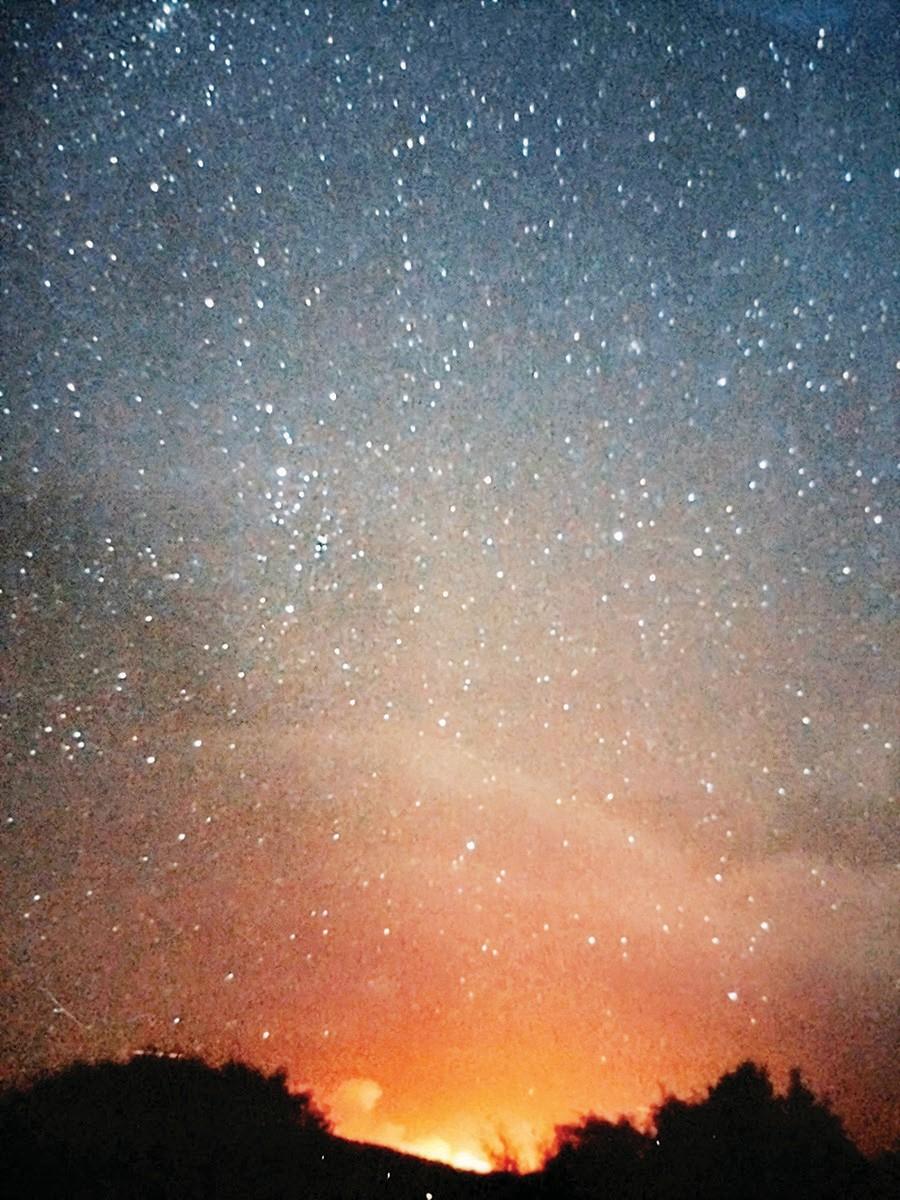

Reader Ron Davies provided this photo of the Dome Fire at night, not long after it was first reported in mid-September.
Although the Dome Fire burning inside of Yosemite National Park continues to grow, some of that is by design.
“When it is burning with low intensity, it helps the ecosystem,” said Kevin Brown, a public information officer for California Interagency Incident Management Team 3, the group in charge of fighting the blaze.
The Dome Fire began on Sept. 15 in the backcountry about a 1/4 mile north of Chilnualna Falls near Wawona.
Since that time, it has grown to more than 5,000 acres and cost the lives of two helicopter pilots whose chopper went down while fighting the blaze.
And though it continues to steadily grow, so does containment, which has hovered around 30 percent for a few days.
Using a map in Building A at the Mariposa County Fairgrounds, where the team has its headquarters, Brown explained how they are approaching this large fire.
He pointed to the miles and miles of hand lines that have been cut around the fire inside the park. He noted those hand lines were put in place quite a distance from where the fire is burning — all by design.
Because of the heavy brush and remote nature of the location, Brown said the strategy is to allow the fire to burn in those areas as it approaches the fire breaks.
Brown said that a fire break “only works” after it has first been tested by a fire, meaning whether it will stop the blaze from advancing. In this case, he said fire officials are confident that will happen because they have been able to put so many resources into those breaks.
A big plus is the fact they have virtually stopped the fire in the Wawona area, where there is nearby infrastructure, including homes, businesses and more.
“It is really cool down there,” he said of the fire in that location, meaning it is nearly out in much of that area though officials continue to monitor it and do what is necessary to keep it that way.
Another big factor that has helped firefighters is the fact they have been able to establish a camp at the Badger Pass Ski Area, greatly reducing the travel time from Mariposa. Brown said it shaves off nearly 75 mile of travel, meaning teams can spend more time fighting the fire.
Many of the hand crews who are working on those fire breaks are being stationed at that location.
It has also meant the closure of the popular Glacier Point Road and Brown said there is no estimated timeline on when that might change. The road is generally open only during the late spring, summer and early fall months before weather forces its closure.
Favorable conditions
The weather over the past week, too, has been beneficial, said Brown.
“Monday was the best day of this week,” he said, noting cooler temperatures, higher humidity and even some reported light misting on the northern part of the fire.
“We have had a lot of good weather,” he said.
That has also allowed helicopters to continue to attack the fire and there are many of them doing just that on a daily basis.
As of Monday, a total of 17 helicopters were part of the team fighting the fire. Those helicopters are varied in size, including the buckets used to dip the water and drop it onto the fire.
Brown didn’t have exact numbers on how many drops there have been in this fire, but said it is easily “in the hundreds.”
Some of that effort is why there are no structures threated by the Dome Fire, especially those in the Wawona area. In addition, he said there are no power lines in the area where the fire is burning because it is such remote backcountry that has trails but little else.
The primary growth of the fire, which increased by 406 acres on Sunday night, is to the north and northeast. In fact, Brown said the fire, in general, is moving in a northerly direction, which keeps it in the wilderness and was predicted by fire managers.
The daily information released by the team indicated “containment is increasing,” and Brown said that is a result of the numerous fire breaks which have been put into place. Also, he said some of the blaze is now in the footprint of the Empire Fire, meaning they can reinforced the breaks made during the 2017 event.
That fire burned a little more than 8,000 acres and lasted more than three months.
Although containment was listed at 30 percent on Monday, Brown stressed it was increased by 12 percent the prior day and 2 percent the day before that, meaning they are getting a better handle on the fire.
A major undertaking
Brown said as of Monday, there were 808 people assigned to the fire.
That increases and decreases periodically, he said, which will be the case this week.
On Thursday and Friday, he said a “team transfer” will take place, meaning there will be fresh firefighters coming in and those who have been on the fire will be able to leave.
All of that has meant a major undertaking to supply shelter, food and more to the firefighters.
Brown had high praise for officials at the Mariposa County Fairgrounds where the base camp has been set up for a couple of weeks.
“We are very happy with this location,” he said.
The fairgrounds provides buildings, infrastructure and more, Brown noted, said called it “really convenient.”
He especially praised local fairgrounds officials for working with the team in providing the location.
Park open as normal
Yosemite National Park remains open as normal, with the exception of the closure of several trails where the fire is burning as well as Glacier Point Road.
The Four Mile Trail and Panorama Trail remain open to Glacier Point for hikers.
The Chilnualna Falls Trail, as well as the trails from the top of Chilnualna Falls toward Buena Vista and Crescent Lakes are closed due to the Dome Fire. (The lakes are accessible from the east.)
Ostrander Trail and all areas and trails south of it are closed. The closed area extends from east of Wawona Road from Wawona to Chinquapin.
The Mariposa Yosemite Airport remains closed to general aviation traffic and there is no official information as to when it might reopen.
As for the fire itself, Brown said officials just don’t have good information how long it might last. A lot of that is dependent on many factors, he said, especially weather.
Mule assistance
Several pack mules from the Shasta-Trinity National Forest, as well as from the Stanislaus National Forest, are being used to support firefighters on the Dome Fire.
The animals provide invaluable support, officials said. Using pack mules allows helicopters to do other work, such as bucket drops — and mules can also be used in smoky conditions where a helicopter would not have good visibility to deliver supplies to a remote site.



Responses (0)