


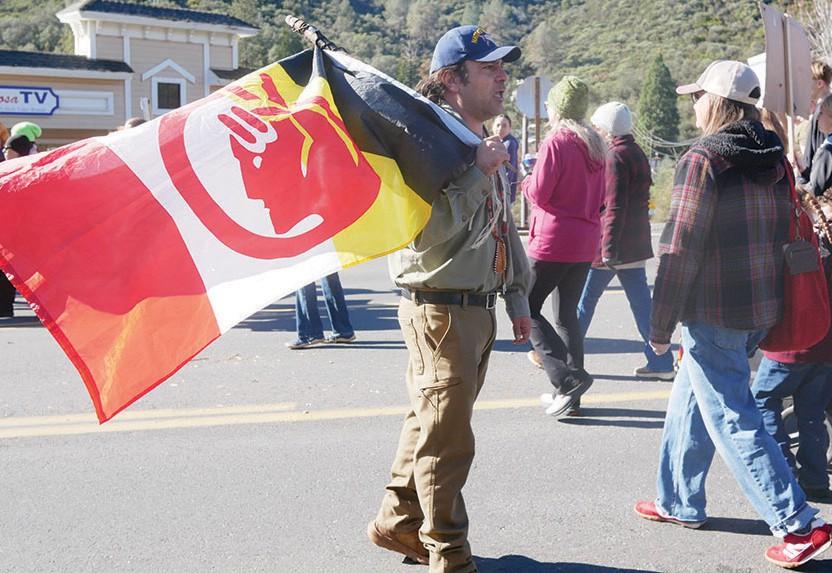

Bryce Green is shown chanting and holding the tribe’s flag. Photo by Sara Solano Aguirre
Before the first chant, there was the smell of sage.
It drifted across the lawn of the Mariposa County Courthouse on Saturday, Nov. 21, settling over the small distance where hundreds of Southern Sierra Miwuk Nation members and hundreds more, neighbors from the Mariposa community, stood waiting.
Between them lay the signs the tribe had made. Tribal members and community members each picked one up, and no one put theirs down.
There was no mistaking why they had come. The Southern Sierra Miwuk Nation was marching for federal recognition.
The SSMN is recognized by the state of California but not by the federal government, a gap that tribal members say shapes everything from scholarships to health care.
The tribe has been working toward that status for generations since 1982.
Before the march began, Acacia Coats, tribal member and organizer for the march went through the crowd and gathered the elders. They would lead, as in their tribe they have a profound respect for elders and “want them to feel seen.”

Miwa Johnson is shown while changing the headpiece worn by her daughter, Willow Stockwell.
Close behind them walked the women of the tribal council, then the children, then the adults and the community members who had come to stand beside them.
They were not quiet
“What do we want? Recognition! When do we want it? Now!” rose from the crowd and rolled down the street, mixed with Indigenous chants and songs, some of them kept to the beat of the clapper stick, one of their instruments.
Women walked in dance regalia: skirts, headpieces and jewelry. Some of the youngest girls wore beaded headpieces with strands of beads falling over their eyes, which protects them from harm.
Cars honked in support as the march turned onto Highway 140, past storefronts and the usual Saturday traffic, toward the Mariposa Arts Park.
There, the afternoon opened up.
The sun was out and the park was full of fall color, with leaves coming down in red, yellow and brown.

Apollo and Jace Jones are shown holding signs.
The week of rain had left the ground soft, and the children were soon muddy from playing on it.
They ran everywhere, tumbling and chasing one another, “one big tribe,” every speaker mentioned, proud of who they are and unashamed to show it.
In the middle of it, elder Philip Johnson, sang “the children’s song” in their language, Miwuk, beside his granddaughter, Willow Stockwell, 6.
She stood in dance regalia and a beaded headpiece, close enough to her grandfather to feel the energy of the past and see the generations to come.
“Our children are always listening,” one tribal member reminded her cousins.
As Johnson sang, around them, parents and elders watched and they joined in to the rhythm of the clapper stick.
Behind them, children laughed, played, rolled around and listened.
Another tribal member spoke about their role and honored their ancestors.
The animals, she said, are their relatives that came before them and showed them the way.

Signs for the federal recognition march are shown resting on benches at the Mariposa County Courthouse.
The animals showed them the acorn and guided them where it was safe to drink water.
The tribe, she said, owes it to its ancestors to keep caring for the land that gives them food, medicine and Mother Earth.
Aanthony Lerma, tribe member, spoke loudly and proudly.
If you want to help the SSMN,“you should not be silent,” he said. “You should not stand idle.”
Being an ally is “not enough anymore,” he said. “We need people that can join us in the trenches.”
Around the edges of the park, booths sold Native jewelry, sweet treats and drinks to support the tribe.
The shirt booth was nearly sold out by the time the last speaker finished.
Everyone said they felt the “energy,” and their ancestors, in the park that day.
Later, elders and council members led the acorn song and within the last notes, a clear sky and a gathered community, for a march that began by asking to be heard, their voice was hard to miss.

Ray Newman and on his shoulders, Kome Newman while the march begun.
Responses (0)