


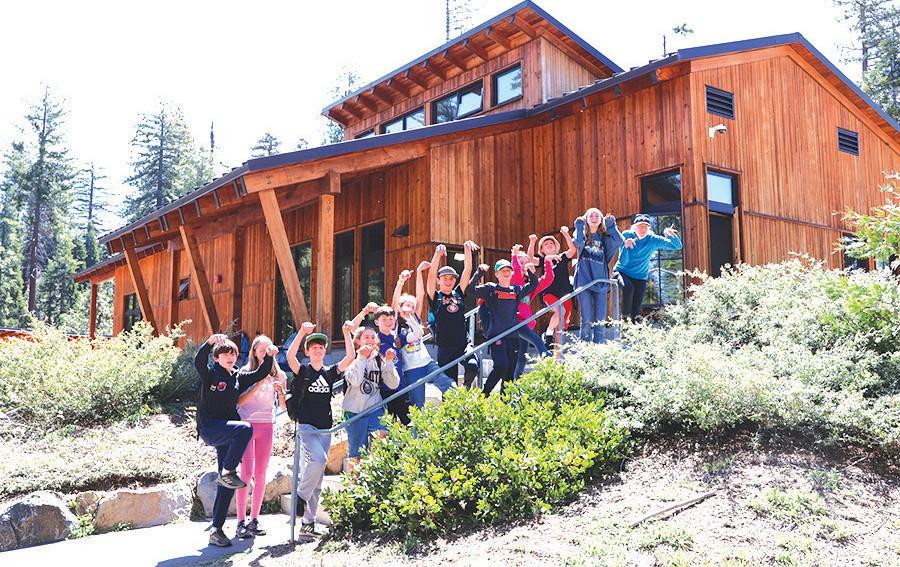

Students are shown at the Environmental Science Center outside of the interim dining hall. Submitted photos
Founded in 1971 after a Yosemite trip led by teacher Don Rees, Yosemite Institute, now known as NatureBridge, began as a small educational idea within nature and has since grown into one of the largest educational partners of the National Park Service.
With campuses in the Golden Gate National Recreation Area, Olympic National Park, and Prince William Forest Park, Yosemite National Park continues to serve as the organization’s flagship and foundational location.
“We mostly serve middle and high school students,” said Corinne Dedini, Campus Director at Yosemite.
“Our entire commitment is really to give students an experience they’re going to remember and help them fall in love with nature.”
Students come from all over the state and nation to participate in programs with NatureBridge.
During many of the programs happening in Yosemite, students visit for about a week where they experience transformative, hands-on environmental science education within the park by hiking on trails and visiting the waterfalls.

Students are shown enjoying the snow. Programs run all throughout the year with NatureBridge.
Each week of programming has themes where students focus on different subjects such as geology, ecosystems, biology, astronomy and leadership skills, among others.
“It’s pretty special,” said Dedini.
“Those who go never forget it, they remember it for the rest of their lives.”
Many of the programs are paid for privately or by individual school districts, but there are scholarships available and most hiking/camping supplies are available for students who need them.
While the bulk of students typically stay in Curry Village, NatureBridge opened their newest campus within Yosemite, the National Environmental Science Center last year.
The NatureBridge Yosemite Environmental Science Center, located at Henness Ridge in Yosemite National Park, represents a major step forward for an organization that operated for decades without a permanent home.
About 20 years ago, the National Park Service put a stake in the ground for NatureBridge, marking the beginning of a long-term partnership and making this center the first of its kind within the National Park System.
“We’re making a 100-year commitment to Yosemite,” Dedini explained.
“Our goal is to ensure environmental science and kids have a home in Yosemite for the long run. With the growth of the center, we expand our opportunities.”
The site officially opened in fall of 2024 with roughly one-third of the project completed.
At its current stage, the center can host about 50 students at a time, with plans to eventually expand to around 224 students as construction continues in the coming years.
“We’d like to host 224 here (at the center) with 224 in the valley (Curry Village), then have them switch half way through the week,” Dedini continued.
“We’d like to reach as many students as possible.”
Right now, the campus includes two cabins, an interim dining hall and a bathhouse.
Once finished the site will feature about eight bunkhouses, two bathhouses and a larger, permanent dining hall.
The bunkhouses were designed to be flexible, with large rooms and pocket doors that allow spaces to be adjusted depending on the needs of each group.
“It’s unique that schools who plan to visit have the option to configure the sleeping spaces,” Dedini continued.
“We want to be accommodating and inclusive and do what works best for each group.”
Accessibility and sustainability are central to the design of the campus.
The site and nearby trails are ADA (Americans with Disabilities Act) accessible and NatureBridge also has an off-road wheelchair available to help students navigate more rugged areas.
“The entire campus is accessible,” Dedini said.
“Even the trails.”
Fire education and research are a major focus at Henness Ridge, especially because the site lies within the area where the brutal Ferguson Fire was contained in 2018.
The Ferguson Fire burned over 95,000 acres and caused about $171 million in damages by the time it was 100 percent contained.
Evidence of the fire is still visible today, making the landscape itself an important learning tool.
The area has undergone fire treatment and preventative burning, supporting both safety efforts and hands-on learning about wildfire ecology.
“There’s been a lot of research done here in regard to forest fires,” Dedini said.
“There’s been a lot of fire clearance done and we want to teach students to be stewards of the space.”
Water conservation is another key feature of the center.
To bring water to the site, NatureBridge partnered with nearby private residents and the National Park Service.
Thanks to conservation-focused systems and practices, students and staff use an average of about seven gallons of water per person per day, compared to more than 25 gallons used by the average person.
Safety requirements also influenced the design of the space as a required fire truck turnaround area was creatively transformed into a small, multi-use amphitheater.
Although the center is only a third of the way complete, NatureBridge continues to work toward the next phase of development by collaborating with partners and raising funds.
The site is located next to land recently purchased by the Southern Sierra Miwuk Nation and NatureBridge hopes to collaborate with them in the future.
“Collaboration is a big part of what we do,” Dedini said.
“Those relationships are so important; together we can do so much more.”
While the center is mainly designed for student programs, it is also available to rent for conferences, retreats and other events, making it a flexible space that serves both education and the broader community.
NatureBridge runs programs all throughout the year and is rarely closed.
“We operate in difficult environments at times with snow closures, fires and floods,” Dedini said.
“We want to show people that they can do this.”
NatureBridge hopes to continue to grow and ensure access for all students.
“Increasingly students live lives that are really disconnected from nature and there’s so much research about the benefits of nature and building in person relationships,” Dedini explained.
“Our goal is to increase 125 percent capacity of participants over all programs and ensure all students who want to come to the programs can.”
For more information about NatureBridge and the Environmental Science Center, visit www.naturebridge.org/



Responses (0)