


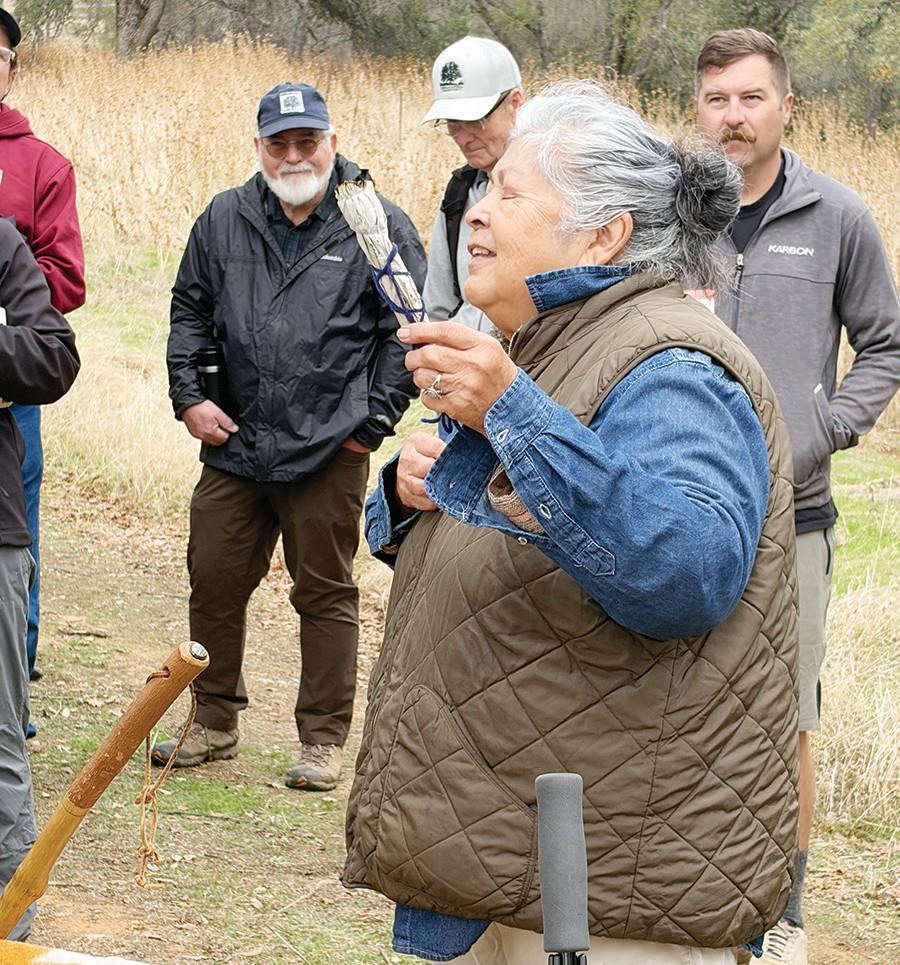

Sandra Chapman, Chairwoman for the Southern Sierra Miwuk Nation, is shown during the Stockton Creek Dedication on Nov. 13 saying a prayer while burning sage at the event. The Gazette will have complete coverage of both the dedication and the Nov. 21 march in our Nov. 26 edition. Photos by Sara Solano Aguirre
Bundles of sage hung in a corner at the Southern Sierra Miwuk Healing Center, while outside, men cut salmon that a tribal member had caught.
The tribe has practiced these ways for generations. What it doesn’t have is the federal government’s recognition, and on Nov. 21, it will march to say so.
The march, the tribe’s third since 2022, begins at 10 a.m. from the Mariposa County Courthouse and ends at the Mariposa Arts Park, where the tribe will hold an event with speakers, a traditional dance demonstration, informational booths, handmade jewelry and limited-edition shirts for sale.
Donations will go toward the cost of the recognition effort.
“Most people assume that we are federally recognized,” said Shona Medinas, Vice Chair of the Southern Sierra Miwuk Nation.
“It enlightened a lot of our locals.” Awareness, along with local support, is the point of the march, she said.
What recognition would change

Acacia Coats (left) and Shona Medinas. Photos by Sara Solano Aguirre
The tribe is recognized by California but not by the federal government.
That difference reaches into children’s schooling, health care and the land the tribe has gathered from for generations.
• Grants: Federal recognition makes tribes eligible for health and housing grants. Medinas said the money could pay for health care for elders and children and for repairs to elders’ homes.
• Scholarships: Many tribal scholarships require federal recognition. “I learned that when I was a senior in high school and I was devastated,” said Medinas, who is Native American but didn’t qualify.
• Yosemite: The Southern Sierra Miwuk is one of seven tribes associated with Yosemite National Park.
Only two aren’t federally recognized, they said.
The park’s plant-gathering agreement was changed this year to address federally recognized tribes.
Tribal members say nothing has been finalized and they’re still in meetings with the park. They said Yosemite’s superintendent, Ray McPadden, is “fully aware,” including from a Sept. 30 roundtable with the seven tribes.

Shown is the art of basketry the Southern Sierra Miwuks practice. Photo courtesy of Shona Medinas
• Language and culture: Elders teach a language class twice a month. Recognition, they said, would help pay to record and preserve the language.
Where the process stands
The tribe’s attorney, Stephen Quesenberry of Hobbs, Straus, Dean & Walker, LLP, has worked with the tribe for more than 20 years, much of it pro bono, they said.
The process is expensive: attorneys, genealogists and archaeologists who try to prove where the tribe’s villages once stood.
Membership is one of the biggest pieces.
The tribe submitted its membership list, a little over 600 people, around 2020, Medinas said.
It has stopped adding members since, so the number doesn’t change while the petition is reviewed, though the real number is likely closer to 1,200.

Acacia Coats shown at the pollinator garden while explaining how they use different plants for medicine and other needs.
Now the tribe’s membership committee, made up of volunteer elders, is updating addresses so the list holds up if federal reviewers audit it.
“We have elders that have passed away too,” said Medinas.
There’s no timeline.
“We always say it’s coming soon,” said Acacia Coats, tribal member of the SSMN. “We stay hopeful.”
Members said they have raised the issue with U.S. Rep. Tom McClintock, who “assumed that we were” recognized, Medinas said and that Chairwoman Sandra Chapman spoke about it at a visit this summer by Interior Secretary Doug Burgum.
However, they did not have a one-on-one conversation.
What they say recognition is not
“It does not mean that we want a casino,” said Coats.
The tribe’s goals, they said, are health care, sobriety and housing support, jobs and an after-school center for kids, perhaps with study rooms, a computer room and a climbing wall, open to the whole community.

The pollinator garden at the Miwumati Healing center.
To critics who say the tribe wants Yosemite back: “We are not trying to take Yosemite back. Would we love to have Yosemite? Yes. But we know that that’s not possible,” Medinas said.
Who they are
Tribal members say their ancestors have been in the area for 8,000 years and traveled seasonally between Yosemite and Mariposa, Coulterville and the surrounding foothills.
In winter they’d burn the valley so it could heal.
Today, tribal members still practice cultural burns, which they said clear parasites like mistletoe, help black oaks and support the plants they gather for baskets, within state limits.
The tribe’s healing center has been open for more than 20 years, with a food pantry, a pollinator garden and counseling one day a week, limited by funding.
The board is all volunteer, elected to two-year terms under bylaws, and currently majority women, which members said reflects who has time to serve, not a change in the tribe.
“I would say with our tribe, there’s always been a great respect for women,” said Coats. “It is empowering, as a woman, to look up at my board and see them all women.”
1969
Members said that in 1969 the National Park Service burned the 14 remaining cabins in the Indian village at Wahoga, in Yosemite Valley, after ruling that residents who weren’t park employees couldn’t live there.
Medinas said many families moved to Mariposa and the surrounding area.
“Even without recognition, we know who we are,” Medinas said. “But it is more to be acknowledged and to have that acceptance for our elders that fought for that as well.”
The march is for them, too. Coats said they make a point of putting elders at the front. They also said “anyone is welcome” to join them in solidarity for the Nov. 21 march
“We will continue to be here forever,” she said.

Responses (0)