


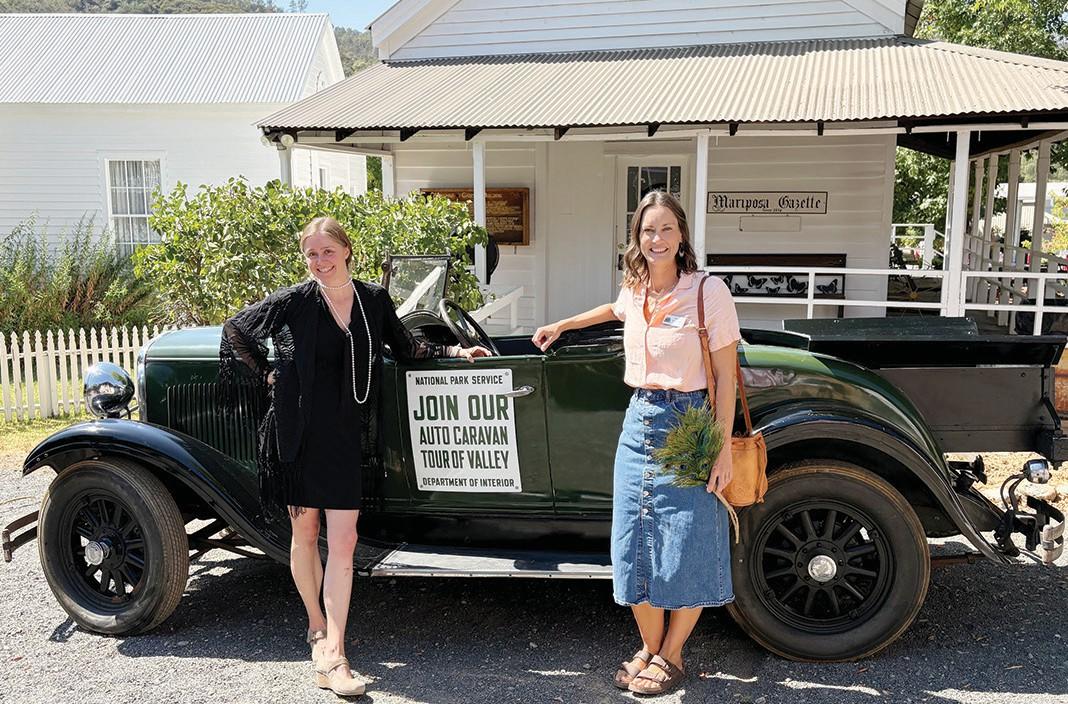

Kim Lawson, left, from the Yosemite Mariposa County Tourism Bureau, and Nancy Fluharty of the Sierra Foothill Conservancy, stand in front of the 1929 Dodge Roadster at the museum during the festivities. Photo by Nicole W. Little
It was a day filled with celebration, history and hope for the future.
On the morning of Tuesday, Sept. 22, a parade of about 10 antique vehicles, escorted by the Mariposa County Sheriff’s Office, slowly made its way down Highway 140 in downtown Mariposa.
The procession began at the office of this newspaper and ended at the Mariposa Museum and History Center.
The occasion, orchestrated by the museum and the Yosemite Mariposa County Tourism Bureau, was to celebrate 100 years of the highway on which those cars traveled. Known as the “All-Year Highway,” the road has been one of the key factors in tourism related to both Yosemite National Park and Mariposa County.
The parade of cars was all parked in front of the museum following the procession as the community gathered to hear the presentations.
“This is so important to the community,” said Scott Gediman, public information officer for the park and the emcee of the festivities.
The speakers

Scott Gediman, left, is shown at the museum as are Shona Medinas of the Southern Sierra Miwuk Nation along with tribal chairperson Sandra Chapman Photo by Nicole W. Little
Jonathan Farrington, executive director of the tourism bureau, was the first to speak.
“Stewardship plays an important role along the corridor,” said Farrington.
He then acknowledged the various other groups who were present, including Visit Merced County, the Sierra Foothill Conservancy, Yosemite Conservancy, Mariposa Trails and the Upper Merced River Watershed Council.
“We are celebrating the corridor for commerce,” said Farrington. “This has been a leading destination for tourism in California for over 100 years.”
Farrington said the automobile “began changing tourism as a whole” in the 1920s and the highway continues to play a key role.
“Highway 140 is part of the Yosemite experience itself,” said Farrington.
He said part of the charm of Highway 140, which begins in Gustine and ends in Yosemite Valley, is everything people can take in along the way.
“Slow down and experience the corridor,” said Farrington.

A redbud tree was planted on the museum grounds during the celebration. From left are Yosemite Superintendent Ray McPadden, Yosemite Mariposa Tourism Bureau Director Jonathan Farrington and Rep. Tom McClintock. Photo by Nicole W. Little
Following his remarks, Danette Toso, the chair of the Mariposa County Board of Supervisors, read a proclamation making Sept. 22, 2026, “Highway 140 Centennial Day.”
Also on hand for the event was Rep. Tom McClintock, who has represented this area, including Mariposa County and Yosemite, for 17 years and is seeking another term.
Before discussing the highway, McClintock took a moment to express his “profound gratitude” to the fire crews battling the Dome Fire in the park. He also acknowledged the two helicopter pilots who were killed last week while fighting the fire.
When talking about the highway, McClintock said it was to “celebrate a promise made to the American people that was fulfilled.”
That promise, he said, was to provide access to America’s national park.
He referenced the 1864 Yosemite Grant Act, signed by President Abraham Lincoln, that set the stage for what would be the national park system.
“Access matters,” said McClintock. “Roads matter. Highway 140 matters.”
The congressman also had high praise for the new leadership at Yosemite, including Superintendent
Ray McPadden, who has been at the helm since not long after the beginning of the Trump administration.
He said McPadden has been listening to officials in the gateway communities and is “now implementing those suggestions at remarkable speed.”
McClintock claimed there have been only two days this season in which traffic snarls backed up visitors for miles trying to get into the park. He said that was over the Labor Day holiday.
Those numbers are disputed by many, who say entrance to the park has been difficult since officials eliminated the reservation systems previous in place at Yosemite.
“We are celebrating a century behind us,” said McClintock, “but more importantly, we are celebrating the century ahead of us.”
McPadden was up next, first complimenting the 1929 Dodge Roadster that was on display at the museum and thanking museum officials for taking good care of the historic machine.
“We have a lot to be proud of inside Yosemite,” said McPadden.
He said the “first people” who came to Yosemite were “on foot,” followed by “horses” and then “trains.” But it was in the 1920s that the automobile changed the way people visited the park, he said.
McPadden concluded by saying he is “excited about” the local partnerships he has developed in the gateway communities and he wants to continue that effort.
Jerry Fischer, whose family founded Yosemite Resorts, addressed the gathering, saying his family “has a long history with Yosemite.”
Fischer remarked that in the beginning, the family welcomed 5,000 guests the first year. Since that time, they have welcomed more than five million.
He also had praise for Caltrans and how they have kept the road in good shape over the years, including following the 1997 floods as well as the Ferguson rock slide, which has changed a portion of the road for the past 20 years.
Also speaking was Sandra Chapman, the chairperson of the Southern Sierra Miwuk Nation, who used a little humor to address a serious issue.
Chapman first spoke about her father, who worked until 1961 for the highway department. She noted he always had a broom and shovel in his truck and would stop anywhere along Highway 140 to clean out gutters or anything that needed to be done.
Then, she addressed the issues of long lines getting into the park. Chapman said she has heard people complaining of having “to wait two hours” to get into Yosemite.
“How would you like to wait 40 years to become recognized?” she said, drawing applause from the crowd.
The Southern Sierra Miwuk Nation has been trying that long to receive federal recognition, but it has never happened. She said she was hopeful it would finally happen in the near future.
The future
The final speaker of the day was Corey Casey, the deputy project manager for the Ferguson Project.
That project, to build a rockshed along Highway 140 where the slide now rests, is moving forward, he said, “after 20 years.”
Casey said he was determined to get it completed.
He said it is one of the most unique projects “in the world,” with a price tag of $450 million.
The concept is to build a shed above the roadway so in the event of another slide, the rocks would go over the shed and into the Merced River area.
He said last fall, the first phase of the final push began and they are doing foundation work for the rockshed.
“It is truly unique,” he said. “It is a really challenging project.”
Casey told those in attendance it would take five years to complete and that he was determined to see it through to the finish.
“I am committed to keeping that route safe for the next 100 years,” he said, referring to the celebration at hand.
The redbud connection
Following the speeches, everyone was then escorted to the Butterfly Patio at the museum, where a ceremonial redbud tree was planted.
The redbuds are a symbol of the highway and were part of a unique beautification project in the 1960s.
It was then that Lady Bird Johnson, the first lady of the United States, initiated a national highway beautification project.
As part of the beautification effort, some local people in Mariposa requested coffee cans in order to plant redbud trees along the Highway 140 corridor.
The country responded overwhelmingly and those trees are now part of the scenic drive along Highway 140 through Mariposa County and the Merced River canyon.
The tree planting at the museum was opened by Shona Medinas, a member of the tribal council and museum board, who said a short prayer.
Then, the dignitaries planted the tree, which will be a lasting symbol of not only the 100th anniversary of the highway, but a reminder of what the future might hold.

Responses (0)